. 1996 Dec 10;93(25):14532-5.
doi: 10.1073/pnas.93.25.14532.

Lipidic cubic phases: a novel concept for the crystallization of membrane proteins

Affiliations

Lipidic cubic phases: a novel concept for the crystallization of membrane proteins

E M Landau et al. Proc Natl Acad Sci U S A. .

Abstract

Understanding the mechanisms of action of membrane proteins requires the elucidation of their structures to high resolution. The critical step in accomplishing this by x-ray crystallography is the routine availability of well-ordered three-dimensional crystals. We have devised a novel, rational approach to meet this goal using quasisolid lipidic cubic phases. This membrane system, consisting of lipid, water, and protein in appropriate proportions, forms a structured, transparent, and complex three-dimensional lipidic array, which is pervaded by an intercommunicating aqueous channel system. Such matrices provide nucleation sites ("seeding") and support growth by lateral diffusion of protein molecules in the membrane ("feeding"). Bacteriorhodopsin crystals were obtained from bicontinuous cubic phases, but not from micellar systems, implying a critical role of the continuity of the diffusion space (the bilayer) on crystal growth. Hexagonal bacteriorhodopsin crystals diffracted to 3.7 A resolution, with a space group P6(3), and unit cell dimensions of a = b = 62 A, c = 108 A; alpha = beta = 90 degrees and gamma = 120 degrees.


Figures
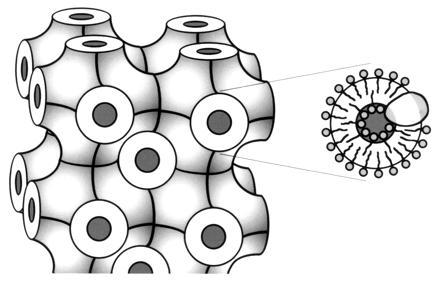
Figure 1
Figure 1
Schematic model of a bicontinuous cubic phase composed of monoolein, water, and a membrane protein. The matrix consists of two compartments, a membrane system with an infinite three-dimensional periodic minimal surface (Left), interpenetrated by a system of continuous aqueous channels (shown in black). The enlarged section (Right) shows the curved lipid bilayer (with an inserted membrane protein molecule) enveloping a water conduit. In a cubic phase consisting of 60–70% (wt/wt) monoolein or monopalmitolein and water, hydrophobic proteins diffuse laterally in the bilayer, while water-soluble components diffuse freely through the intercommunicating aqueous channel system (see text). Adapted from plate 9, ref. , with kind permission of Elsevier Science–NL, Sara Burgerhartstraat 25, 1055 KV Amsterdam, The Netherlands.
Figure 2
Figure 2
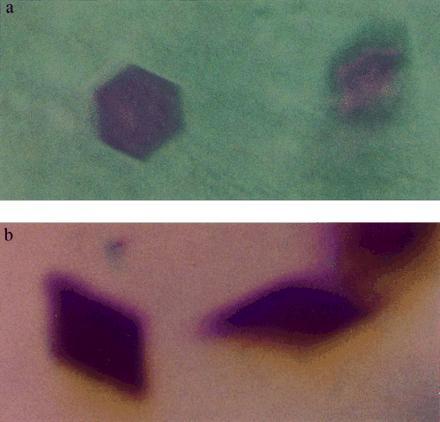
Morphology of BR crystals. (a) Hexagonal crystals grown in a monoolein cubic phase. (b) Rhombic crystals grown in a monopalmitolein cubic phase. In both photographs, crystals can be seen that, due to the depth in which they are embedded in the lipidic materials, are out of focus.
Figure 3
Figure 3
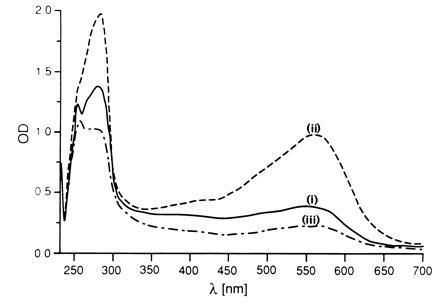
Optical spectra of BR in a cubic phase. (i) Initial absorption spectrum of the uniformly colored purple cubic phase (60% MO). (ii) Spectrum obtained by focusing the beam on a BR crystal at the final stages of crystal growth in the cubic phase after 14 days. (iii) Spectrum focused on the cubic phase surrounding the crystals. Spectra were recorded in both the visible and ultraviolet range using a Zeiss microspectrophotometer, kindly made available by J. N. Jansonius (Basel, Switzerland).
Figure 4
Figure 4
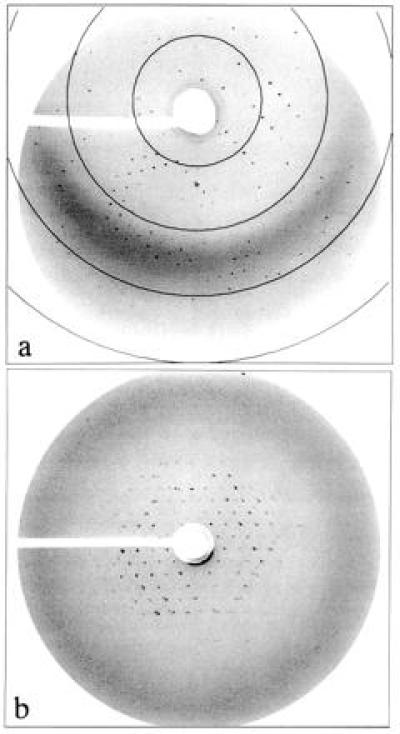
X-ray diffraction patterns of BR crystals. (a) Diffraction of a hexagonal crystal grown in MO cubic phase. The circles drawn indicate resolutions of 3.1, 4.1, 6.2, and 12.4 Å, respectively, at 2ω = 6.1°. The diffraction limit of the crystal is at a resolution of 3.7 Å. (b) Diffraction of a rhombic crystal grown in MP cubic phase. The diffraction limit of this crystal is at 9 Å. For details, see Materials and Methods.

References

    1. Henderson R, Unwin P N T. Nature (London) 1975;257:28–32. - PubMed
    1. Henderson R, Baldwin J M, Ceska T A, Zemlin F, Beckmann E, Downing K H. J Mol Biol. 1990;213:899–929. - PubMed
    1. Kühlbrandt W. Q Rev Biophys. 1992;25:1–49. - PubMed
    1. Unwin N. J Mol Biol. 1993;229:1101–1124. - PubMed
    1. Karrasch S, Bullough P A, Ghosh R. EMBO J. 1995;14:631–638. - PMC - PubMed

Publication types