


doi: 10.1073/pnas.93.25.14873.
Aspergillus has distinct fatty acid synthases for primary and secondary metabolism
Affiliations
- PMID: 8962148
- PMCID: PMC26229
- DOI: 10.1073/pnas.93.25.14873
Item in Clipboard
Aspergillus has distinct fatty acid synthases for primary and secondary metabolism
Proc Natl Acad Sci U S A.
.
Abstract
Aspergillus nidulans contains two functionally distinct fatty acid synthases (FASs): one required for primary fatty acid metabolism (FAS) and the other required for secondary metabolism (sFAS). FAS mutants require long-chain fatty acids for growth, whereas sFAS mutants grow normally but cannot synthesize sterigmatocystin (ST), a carcinogenic secondary metabolite structurally and biosynthetically related to aflatoxin. sFAS mutants regain the ability to synthesize ST when provided with hexanoic acid, supporting the model that the ST polyketide synthase uses this short-chain fatty acid as a starter unit. The characterization of both the polyketide synthase and FAS may provide novel means for modifying secondary metabolites.
Figures
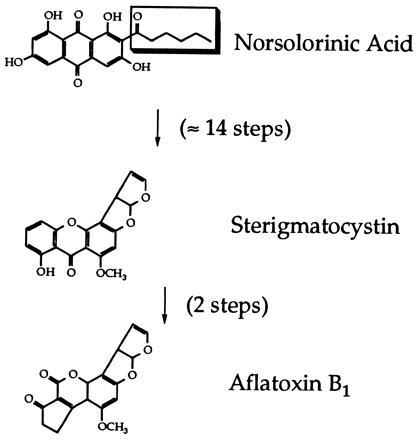
Sterigmatocystin/AF pathway. The aliphatic
moiety of norsolorinic acid, the first intermediate in the pathway, is
enclosed in a box.
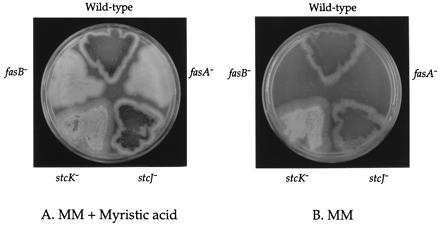
Growth requirements of the strains disrupted in
the two FASs. From the top clockwise: TTAARG (wild type), TDB57.1
(fasB−), TDB5
(stcK−), TDB1
(stcJ−), and TDB51.1
(fasA−). Minimal media (B) and
minimal media plus 2 mM myristic acid (n-tetradecanoic
acid, Sigma) (A).
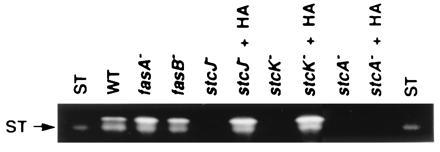
ST analysis of oatmeal culture extracts by TLC.
Approximately 20 times as much material from
stcJ− and stcK−
mutants was loaded as compared with wild type and samples were resolved
with benzene/glacial acetic acid (95:5 vol/vol). The nature of the
band above ST is unknown.
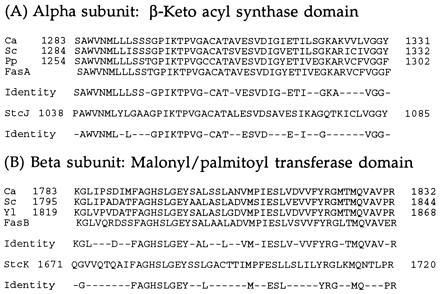
Amino acid alignments of two representative FAS
domains. (A) FAS β-keto acyl synthase domain of the α
subunit. Ca, C. albicans (23); Sc, S.
cerevisiae (25); Pp, P. patulum (28); and FasA
and StcJ, A. nidulans. The constitutive FAS a peptides
share 78% identity within this domain in contrast to StcJ that shares
only 57% identity. (B) FAS malonyl/palmitoyl transferase
domain of the β subunit. Ca, C. albicans (22); Sc,
S. cerevisiae (24); Yl, Y. lipolytica
(26); and FasB and StcK, A. nidulans. The constitutive
FAS β peptides share 72% identity in contrast to StcK that shares
44% identity.
References
-
- Hutchinson C R, Fujii I. Annu Rev Microbiol. 1995;49:201–238. - PubMed
-
- Sargeant K, Sheridan A, O’Kelly J. Nature (London) 1961;192:1095–1097.
-
- Wogan, G. N., Househam, K. C. & Hundt, H. K. (1992) Cancer Res. 52, Suppl., 2114S–2118S. - PubMed
-
- Hsu I C, Metcalf R A, Sun T, Welsh J A, Wang N J, Harris C C. Nature (London) 1991;350:427–428. - PubMed
Publication types
MeSH terms
Substances
Associated data
- Actions
- Actions
LinkOut - more resources
Full Text Sources
Other Literature Sources
Molecular Biology Databases
Research Materials
Miscellaneous
