. 1996 Dec 10;93(25):14978-83.
doi: 10.1073/pnas.93.25.14978.

"Agrolistic" transformation of plant cells: integration of T-strands generated in planta

Affiliations

"Agrolistic" transformation of plant cells: integration of T-strands generated in planta

G Hansen et al. Proc Natl Acad Sci U S A. .

Abstract

We describe a novel plant transformation technique, termed "agrolistic," that combines the advantages of the Agrobacterium transformation system with the high efficiency of biolistic DNA delivery. Agrolistic transformation allows integration of the gene of interest without undesired vector sequence. The virulence genes virD1 and virD2 from Agrobacterium tumefaciens that are required in bacteria for excision of T-strands from the tumor-inducing plasmid were placed under the control of the CaMV35S promoter and codelivered with a target plasmid containing border sequences flanking the gene of interest. Transient expression assays in tobacco and in maize cells indicated that vir gene products caused strand-specific nicking in planta at the right border sequence, similar to VirD1/VirD2-catalyzed T-strand excision observed in Agrobacterium. Agrolistically transformed tobacco calli were obtained after codelivery of virD1 and virD2 genes together with a selectable marker flanked by border sequences. Some inserts exhibited right junctions with plant DNA that corresponded precisely to the sequence expected for T-DNA (portion of the tumor-inducing plasmid that is transferred to plant cells) insertion events. We designate these as "agrolistic" inserts, as distinguished from "biolistic" inserts. Both types of inserts were found in some transformed lines. The frequency of agrolistic inserts was 20% that of biolistic inserts.


Figures
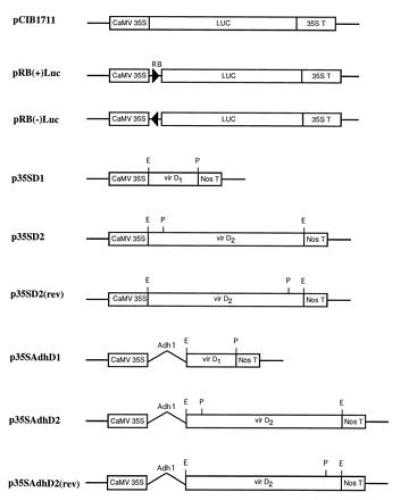
Figure 1
Figure 1
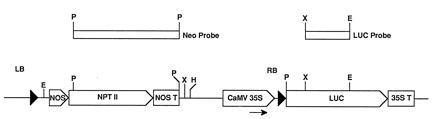
Constructs. Components of the plasmids are as described in Materials and Methods. RB, the 25-bp right border sequence. Restriction sites are indicated as: E, EcoRI; P, PstI,
Figure 2
Figure 2
Schematic diagram of pNeoRBLuc. LB, left border; RB, right border. The arrow indicates the location of the primer used to sequence the junction. The top boxes above the diagram indicate the probes used for Southern blot analysis of transformants. Restriction sites are indicated as follows: E, EcoRI; H, HindIII; P, PstI; X, XbaI.
Figure 3
Figure 3
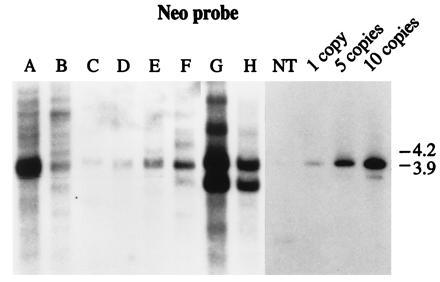
Southern blot hybridization analysis of DNA from kanamycin-resistant calli derived from cells bombarded with control plasmids. pNeoRBLuc plasmid (lanes A–F) and the borderless construct pNeoLuc together with p35SD1 and p35SD2 plasmids (lanes G and H) were delivered to maize cells. The blot was hybridized with the neo probe. NT, DNA from nontransformed tobacco cells. Lanes 1, 5, and 10: genomic DNA mixed with pNeoRBLuc to reconstruct the integration of 1, 5, or 10 copies of the gene per diploid nucleus, respectively.
Figure 4
Figure 4
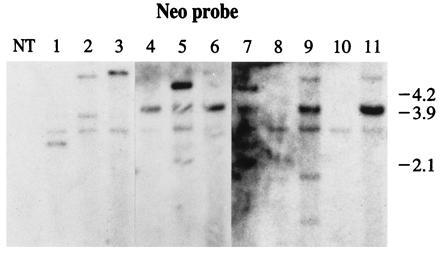
Southern blot analysis of kanamycin-resistant calli derived from cells bombarded with pNeoRBLuc and p35SD1 and p35SD2 plasmid DNAs. NT, DNA from nontransformed tobacco callus. The transformed calli are labeled from lanes 1 to 11. The blot was hybridized with the neo probe.
Figure 5
Figure 5
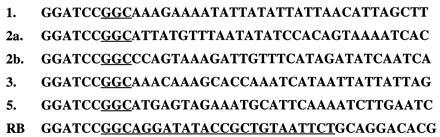
Sequence analysis of plant DNA target sites after transformation with pNeoRBLuc, p35SD1, and p35SD2 plasmids. Numbers refer to the target clones as listed in Fig. 4. The right border sequence carried by pNeoRBLuc is underlined (lane RB). The plant target sequence of fragments 1, 2a, 3, and 5 shows 100% homology with PSII of tobacco (GenBank accession no. X62426X62426; nt 908), with NtpII10 of tobacco (GenBank accession no. X70088X70088; nt 573), with ribulose 1,5-bisphosphate carboxylase of tobacco (GenBank accession no. X02353X02353; nt 2174) and 80% homology with a chlorophyll binding protein of petunia (GenBank accession no. M21317M21317; nt 1013), respectively. Numbers between brackets indicate the accession number and the nucleotide coordinate from which the homology starts.

References

    1. Ahl Goy P, Duesing J H. Bio/Technology. 1995;13:454–458.
    1. Koziel M G, Beland G L, Bowman C, Carozzi N B, Crenshaw R, Crossland L, Dawson J, Desai N, Hill M, Kadwell S, Launis K, Lewis K, Maddox D, McPherson K, Meghji M R, Merlin E, Rhodes R, Warren G W, Wright M, Evola S V. Bio/Technology. 1993;11:194–200.
    1. Klein T M, Harper E C, Svab Z, Sanford J C, Fromm M E, Maliga P. Proc Natl Acad Sci USA. 1988;85:8502–8505. - PMC - PubMed
    1. Klein T M, Kornstein L, Sanford J C, Fromm M E. Plant Physiol. 1989;91:440–444. - PMC - PubMed
    1. Gordon-Kamm W J, Spencer T M, Mangano M L, Adams T R, Daines R J, Start W G, O’Brien J V, Chambers S A, Adams R A, Willets N G, Rice T B, Mackey C J, Krueger R W, Kausch A P, Lemaux P G. Plant Cell. 1990;2:603–618. - PMC - PubMed

LinkOut - more resources