


Norepinephrine and serotonin receptors in the paraventricular nucleus interactively modulate ethanol consumption
- PMID: 8986220
- PMCID: PMC4266412
- DOI: 10.1111/j.1530-0277.1996.tb01714.x
Norepinephrine and serotonin receptors in the paraventricular nucleus interactively modulate ethanol consumption
Abstract
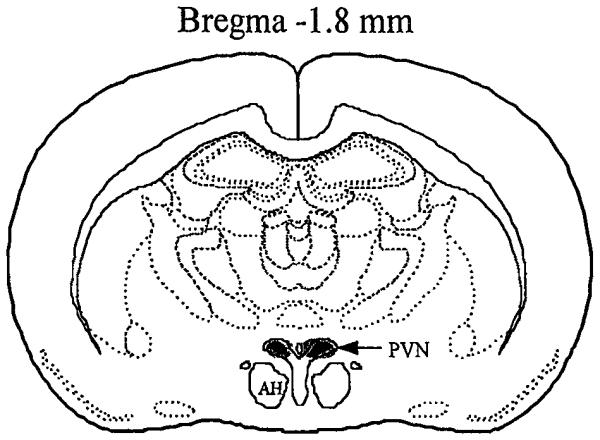
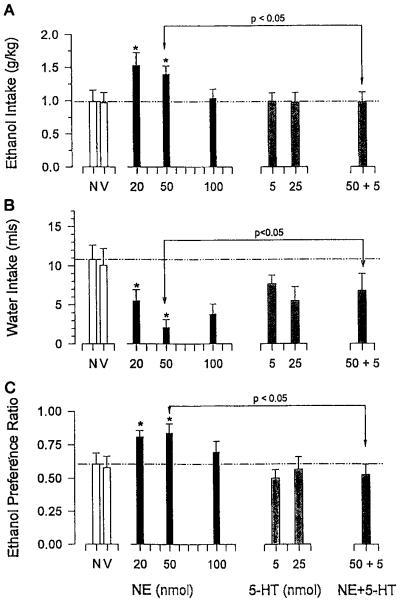
The homeostatic function of the hypothalamus has long been recognized. In particular, the role of the paraventricular nucleus (PVN) in regulating ingestive behavior has been of interest. Infusions of serotonin and norepinephrine into the PVN are correlated with nutrient selective decreases and increases in consumatory behavior, respectively. Given the wide range of homeostatic functions of the hypothalamus, it is plausible that similar hypothalamic mechanisms may also be involved in the regulation of ethanol intake. This study examined the effects of PVN infusions of serotonin (5-HT) and norepinephrine (NE) on ethanol intake in a 1-hr limited-access two-bottle paradigm. When intake of 6% (v/v) ethanol versus water stabilized, male Wistar rats were implanted with stainless steel guide cannulae aimed at the PVN. After recovery, NE (20, 50, and 100 nmol), 5-HT (5 and 25 nmol), and their combination (NE 50 nmol + 5-HT 5 nmol) were microinjected into the PVN in a volume of 0.5 microliter/side over 1 min. Baseline ethanol intake was approximately 1.0 g/kg and ethanol preference (milliliters ethanol per total milliliters) was approximately 60%. Both 20 and 50 nmol of NE significantly increased absolute ethanol intake by 50% and relative ethanol intake by approximately 30%. Corresponding decreases were observed in water intake. Neither dose of 5-HT when administered alone altered ethanol or water consumption, but the 5-nmol dose of 5-HT attenuated the increase observed after NE (50 nmol) administration. These data demonstrate that NE and 5-HT receptors in the PVN interact in the modulation of ethanol ingestion. This finding suggests that homeostatic regulatory functions of the hypothalamus are involved in ethanol intake, and a perturbation of this system may influence excessive drinking.
Figures
References
-
- Koob GF. Drugs of abuse: Anatomy, pharmacology and function of reward pathways. TIPS. 1992;13:177–184. - PubMed
-
- Hodge CW, Haraguchi M, Samson HH. Microinjections of dopamine agonists in nucleus accumbens increase ethanol reinforced responding. Pharmacol Biochem Behav. 1992;43:249–254. - PubMed
-
- Hodge CW, Haraguchi M, Erickson HL, Samson HH. Microinjections of quinpirole in the ventral tegmentum decrease ethanol reinforced responding. Alcohol Clin Exp Res. 1993;17:370–375. - PubMed
-
- Hodge CW, Samson HH, Tolliver GT, Haraguchi M. Effects of intra-accumbens injections of dopamine agonists and antagonists on sucrose- and sucrose-ethanol reinforced responding. Pharmacol Biochem Behav. 1994;48:141–150. - PubMed
-
- Rassnick S, Pulvirenti L, Koob GF. Oral ethanol self-administration in rats is reduced by the administration of dopamine and glutamate receptor antagonists into the nucleus accumbens. Psychopharmacology. 1992;109:92–98. - PubMed
Publication types
MeSH terms
Substances
Grants and funding
LinkOut - more resources
Full Text Sources
Medical
