


doi: 10.1073/pnas.93.26.15047.
Amphipols: polymers that keep membrane proteins soluble in aqueous solutions
Affiliations
- PMID: 8986761
- PMCID: PMC26353
- DOI: 10.1073/pnas.93.26.15047
Item in Clipboard
Amphipols: polymers that keep membrane proteins soluble in aqueous solutions
Proc Natl Acad Sci U S A.
.
Abstract
Amphipols are a new class of surfactants that make it possible to handle membrane proteins in detergent-free aqueous solution as though they were soluble proteins. The strongly hydrophilic backbone of these polymers is grafted with hydrophobic chains, making them amphiphilic. Amphipols are able to stabilize in aqueous solution under their native state four well-characterized integral membrane proteins: (i) bacteriorhodopsin, (ii) a bacterial photosynthetic reaction center, (iii) cytochrome b6f, and (iv) matrix porin.
Figures
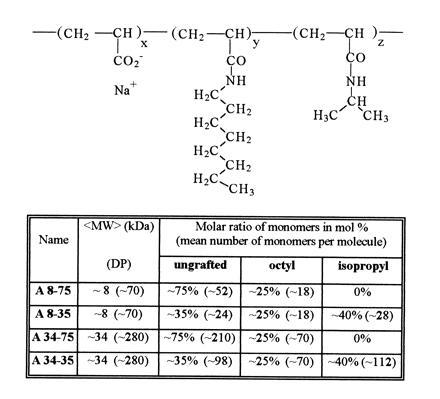
Molecular structure of amphipols. The weight
average apparent molecular weight (〈MW〉) was deduced from the
〈MW〉 of the polyacrylate precursors as estimated by gel permeation
chromatography using narrow MW polyoxyethylene calibration standards
(which may entail systematic errors). DP (〈MW〉/MW of monomer) is
the corresponding number of units per chain. The number of monomers per
chain in the most abundant molecules (representing ≈80% of the mass)
actually ranges over one decade. x, y, and z are the molar percentages
of each type of unit, randomly distributed along the chain. The average
number of each type of unit per amphipol molecule is given between
parentheses.
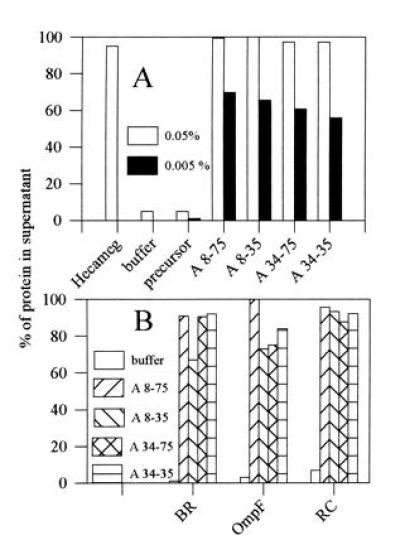
Solubility of membrane protein/amphipol
complexes in aqueous solution. Aliquots from stock solutions of
amphipols (5 g/liter in water) were added to purified membrane
proteins in detergent solution and the mixtures diluted 10× with
detergent-free buffer or with water. After 15 min incubation at 4°C,
the solutions were centrifuged for 30 min at 4°C in the A-110 rotor
of an Airfuge (Beckman) at 20 psi (1 psi = 6.89 kPa;
≈210,000 × g). The concentration of protein in
the supernatant was determined from the absorbance at 564 nm (redox
difference spectrum of b6), 546 nm (BR), 278
nm (OmpF), or 802 nm (RC). (A) Cytochrome
b6f complex. Stock
solution was ≈5 μM
b6f complex in 20 mM
HG (cmc ≈19.5 mM), 0.1 g/liter EPC, 400 mM NaOH/AP buffer (pH
8.0). Final amphipol concentrations following 10× dilution with water
were 0.5 g/liter (open bars) or 0.05 g/liter (solid bars). Control
experiments included dilution with a 20 mM HG solution (Hecameg) or
with water (buffer) in the absence of amphipols, and dilution with
water in the presence of nonderivatized low MW polyacrylate
(precursor). (B) Other proteins. Stock solutions:
bacteriorhodopsin, ≈0.1 g/liter in 100 mM AP
(pH 8.0), ≈10% sucrose, 10 mM OTG (cmc ≈9 mM); OmpF porin, ≈4
g/liter in 0.2% (wt/wt) octyl-POE (≈9.2 mM; cmc ≈7 mM) in the
same buffer; reaction center, ≈3 g/liter in 20 mM HG in 20 mM
NaOH·Tricine buffer (pH 8.0). Tenfold dilution with 100 mM AP (pH
8.0) to a final amphipol concentration of 0.5 g/liter.
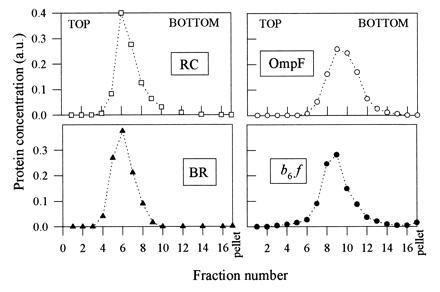
Sedimentation velocity analysis of
protein/amphipol complexes on detergent-free sucrose gradients.
Aliquots (100 μl) of membrane proteins in detergent solution (cf.
legend to Fig. 2) were supplemented with 1 g/liter A8-75 (plus, in
the case of b6f, 0.33
g/liter EPC), diluted 2-fold with 100 mM AP (pH 8.0), layered on top
of 2-ml 5–20% (wt/wt) sucrose gradients in the same buffer and
centrifuged at 54,000 rpm in the TLS55 rotor of a TL100
ultracentrifuge. After 5.25 h (RC), 5 h
(b6f), 6.5 h
(OmpF), or 10 h (BR), gradients were collected by 120-μl
fractions. Protein concentrations in the 16 fractions and in the
resuspended pellet were determined spectrophotometrically (cf. legend
to Fig. 2).
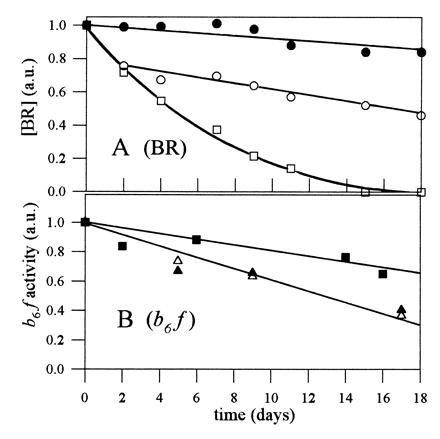
Stability of BR and cytochrome
b6f complexed by
amphipols. (A) BR was either kept in 10 mM OTG in 100 mM AP,
pH 8.0 (□; final concentration of OTG was 10 mM), or
complexed by A8-75 (○) or A8-35 (•) as described
in the legend of Fig. 2B (final concentration of
amphipol was 0.5 g/liter). The three samples were stored at 4°C in
the dark. Every second or third day, each sample was centrifuged in the
Airfuge (cf. legend to Fig. 2) before measuring the absorbance at 546
nm. (B) Cytochrome
b6f was either kept
in 20 mM HG, 0.1 g/liter EPC, 400 mM AP (pH 8.0) (▪), or
complexed with A8-75 (▵) or A8-35 (▴) and
isolated by sucrose gradient centrifugation as described in the legend
of Fig. 3. The samples were stored at 4°C in the dark. Enzymatic
activity was determined by diluting an aliquot 50- to 200-fold in 0.25
mM LM, 20 mM Tricine·NaOH buffer (pH 8.0), and measuring the rate
of stigmatellin-sensitive electron transfer from decylplastoquinol to
oxidized plastocyanin (14).
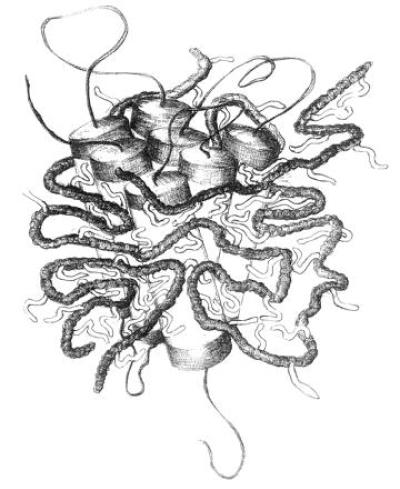
Sketch of an integral membrane protein complexed
by amphipols. Protein and amphipols are drawn to scale (α-helix
diameter, ≈1 nm; spacing of acrylic units along the polymer, ≈0.3
nm; length of octyl chains, ≈1 nm; expected mass of protein-bound
amphipol, ≈20 kDa per mole of protein). The persistence length of the
polymer, which determines the tightness of the loops, has been taken
equal to ≈3 nm. It actually depends on such parameters as the density
of charges along the chain and the ionic strength of the solution. The
fractions of alkyl chains and polymer not in contact with the
protein’s surface are largely speculative.
References
-
- Helenius A, Simons K. Biochim Biophys Acta. 1975;415:29–79. - PubMed
-
- Tanford C. The Hydrophobic Effect: Formation of Micelles and Biological Membranes. New York: Wiley; 1980.
-
- Roth M, Lewitt-Bentley A, Michel H, Deisenhofer J, Huber R, Oesterhelt D. Nature (London) 1989;340:659–662.
-
- Møller J V, le Maire M. J Biol Chem. 1993;268:18659–18672. - PubMed
-
- Iliopoulos I, Olsson U. J Phys Chem. 1994;98:1500–1505.
Publication types
MeSH terms
Substances
LinkOut - more resources
Full Text Sources
Other Literature Sources
