Comparative Study
. 1996 Dec 24;93(26):15057-62.
doi: 10.1073/pnas.93.26.15057.

Purification of the beta-cell glucose-sensitive factor that transactivates the insulin gene differentially in normal and transformed islet cells

Affiliations
Comparative Study

Purification of the beta-cell glucose-sensitive factor that transactivates the insulin gene differentially in normal and transformed islet cells

S Marshak et al. Proc Natl Acad Sci U S A. .

Abstract

The beta cell-specific glucose-sensitive factor (GSF), which binds the A3 motif of the rat I and human insulin promoters, is modulated by extracellular glucose. A single mutation in the GSF binding site of the human insulin promoter abolishes the stimulation by high glucose only in normal islets, supporting the suggested physiological role of GSF in the glucose-regulated expression of the insulin gene. GSF binding activity was observed in all insulin-producing cells. We have therefore purified this activity from the rat insulinoma RIN and found that a single polypeptide of 45 kDa was responsible for DNA binding. Its amino acid sequence, determined by microsequencing, provided direct evidence that GSF corresponds to insulin promoter factor 1 (IPF-1; also known as PDX-1) and that, in addition to its essential roles in development and differentiation of pancreatic islets and in beta cell-specific gene expression, it functions as mediator of the glucose effect on insulin gene transcription in differentiated beta cells. The human cDNA coding for GSF/IPF-1 has been cloned, its cell and tissue distribution is described. Its expression in the glucagon-producing cell line alpha TC1 transactivates the wild-type human insulin promoter more efficiently than the mutated construct. It is demonstrated that high levels of ectopic GSF/IPF-1 inhibit the expression of the human insulin gene in normal islets, but not in transformed beta TC1 cells. These results suggest the existence of a control mechanism, such as requirement for a coactivator of GSF/IPF-1, which may be present in limiting amounts in normal as opposed to transformed beta cells.


Figures
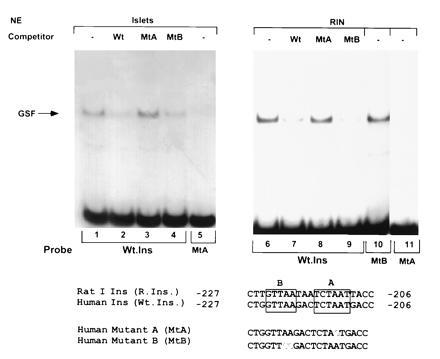
Figure 1
Figure 1
Binding of islet and RINm5F nuclear extracts to human insulin DNA sequences. EMSA was performed with nuclear extracts (NE), using as probes the wild-type human insulin sequence (Wt.Ins) and its mutated forms A (lanes 5 and 11) and B (lane 10). Competition with 50-fold excess unlabeled double-stranded oligonucleotides of wild-type (Wt; lanes 2 and 7), mutant A (MtA; lanes 3 and 8), and mutant B (MtB) sequences (lanes 4 and 9).
Figure 2
Figure 2
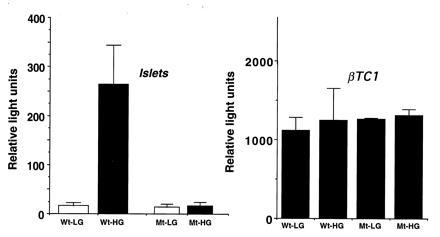
Effect of glucose on luciferase activity in transiently transfected normal islets and βTC1 cells. Wt contains the wild-type human insulin promoter linked to the luciferase reporter gene. Mt is the promoter carrying the A → G mutation (see Fig. 1). Cells were cultured in medium supplemented with 2 mM (LG) or 20 mM (HG) glucose for 48 h, extracted, and assayed for luciferase activity. Results represent the mean of five (Wt) and four (Mt) independent experiments in cultured islets and three in βTC1 cells.
Figure 3
Figure 3
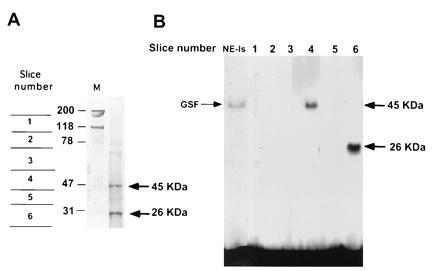
Purification of the GSF. Proteins were extracted from RINm5F nuclei and chromatographed over heparin–agarose followed by DNA affinity columns. (A) Coomassie blue staining of the final purified fraction subjected to SDS gel electrophoresis and transferred onto a PVDF membrane. Two major bands, of 45 kDa and 26 kDa, were detected. (B) EMSA of protein fractions eluted from sliced PVFD membrane containing the purified material shown in A. The 45-kDa polypeptide corresponds to GSF. NE-Is, islet nuclear extracts.
Figure 4
Figure 4
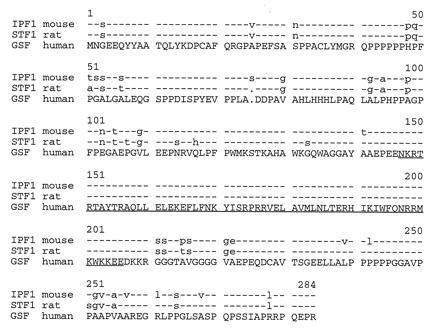
Sequence comparison of the human GSF, mouse IPF-1, and rat STF-1/IDX-1. hGSF consists of 283 aa. The homeodomain (underlined) shares 100% amino acid identity.
Figure 5
Figure 5
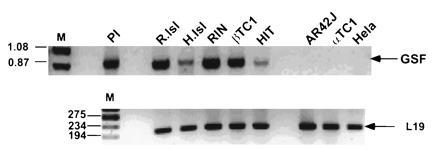
Tissue distribution of hGSF/IPF-1 mRNA. Total RNA from rat (R.Isl) and human islets (H.Isl), β-cell lines RIN, βTC1, and HIT, AR42J exocrine cells, glucagon-producing αTC1 cells, and Hela cells were reverse-transcribed. cDNAs were amplified by PCR using human primers complementary to the 5′ and 3′ ends of the hGSF/IPF-1 mRNA. A 0.88-kb fragment corresponding to the hGSF/IPF-1 coding region is shown (Upper). Primers complementary to 194 bp of the ribosomal L19 gene were used as control (Lower). Pl, hGSF/IPF-1 plasmid.
Figure 6
Figure 6
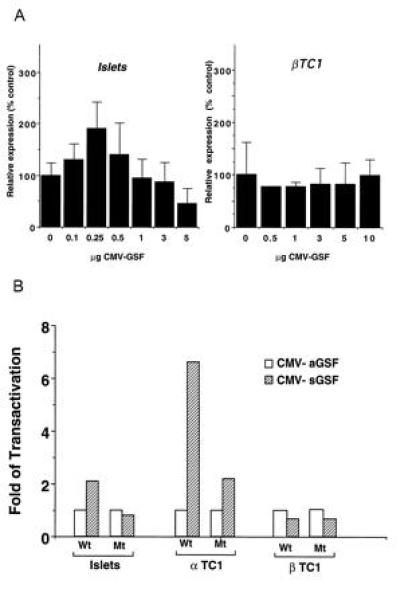
Transactivation of the human insulin promoter. (A) Indicated amounts of CMV–hGSF were cotransfected with wild-type insulin–luciferase construct in rat islets and in βTC1 cells. Expression is presented as percentage of control. Each column gives mean ± SD of three to seven independent experiments. (B) Rat islets, αTC1, and βTC1 cells were cotransfected with 0.25 μg (islets) or 5 μg (cell lines) CMV–sGSF (sense orientation, hatched bars) or CMV-aGSF (antisense, open bars) and with the wild-type human insulin (Wt) or the mutated insulin (Mt) luciferase constructs. Forty-eight hours after transfection, cell extracts were tested for luciferase activity. Results represent mean of three independent experiments. Luciferase activity was normalized to internal control β-galactosidase value.

References

    1. Stein R. Trends Endocrinol Metab. 1993;4:96–101. - PubMed
    1. Docherty K, Clark A R. FASEB J. 1994;8:20–27. - PubMed
    1. German M, Ashcroft S, Docherty K, Edlund H, Edlund T, et al. Diabetes. 1995;44:1002–1004. - PubMed
    1. Murre C, McCaw P S, Baltimore D. Cell. 1989;56:777–783. - PubMed
    1. Naya F J, Stellrecht C M M, Tsai M-J. Genes Dev. 1995;8:1009–1019. - PubMed

Publication types

MeSH terms

Associated data