. 1996 Dec 24;93(26):15075-80.
doi: 10.1073/pnas.93.26.15075.

The ATM homologue MEC1 is required for phosphorylation of replication protein A in yeast

Affiliations

The ATM homologue MEC1 is required for phosphorylation of replication protein A in yeast

G S Brush et al. Proc Natl Acad Sci U S A. .

Abstract

Replication protein A (RPA) is a highly conserved single-stranded DNA-binding protein, required for cellular DNA replication, repair, and recombination. In human cells, RPA is phosphorylated during the S and G2 phases of the cell cycle and also in response to ionizing or ultraviolet radiation. Saccharomyces cerevisiae exhibits a similar pattern of cell cycle-regulated RPA phosphorylation, and our studies indicate that the radiation-induced reactions occur in yeast as well. We have examined yeast RPA phosphorylation during the normal cell cycle and in response to environmental insult, and have demonstrated that the checkpoint gene MEC1 is required for the reaction under all conditions tested. Through examination of several checkpoint mutants, we have placed RPA phosphorylation in a novel pathway of the DNA damage response. MEC1 is similar in sequence to human ATM, the gene mutated in patients with ataxia-telangiectasia (A-T). A-T cells are deficient in multiple checkpoint pathways and are hypersensitive to killing by ionizing radiation. Because A-T cells exhibit a delay in ionizing radiation-induced RPA phosphorylation, our results indicate a functional similarity between MEC1 and ATM, and suggest that RPA phosphorylation is involved in a conserved eukaryotic DNA damage-response pathway defective in A-T.


Figures
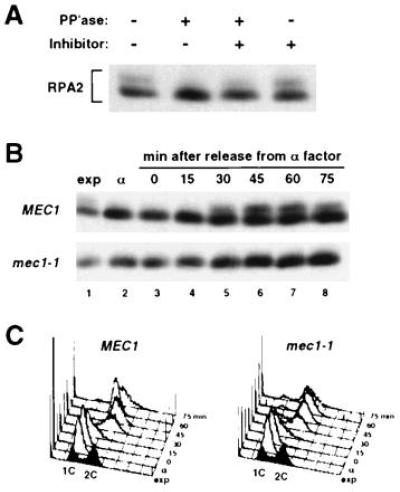
Figure 1
Figure 1
Cell cycle-regulated RPA2 phosphorylation is absent in mec1-1. (A) Western blot analysis of RPA2 from exponentially growing wild-type cells. Crude extract was treated with the indicated combinations of λ protein phosphatase (PP′ase) and the phosphatase inhibitor sodium vanadate. (B) Western blot analysis of RPA2 from synchronized TWY397 (MEC1) and DLY285 (mec1-1) cells. Samples from the exponentially growing cultures prior to α factor treatment (exp) and from the G1-arrested cultures directly prior to release (α) have been included. Equivalent volumes of original cell culture were analyzed. (C) Flow cytometry of synchronized cultures analyzed in B.
Figure 2
Figure 2
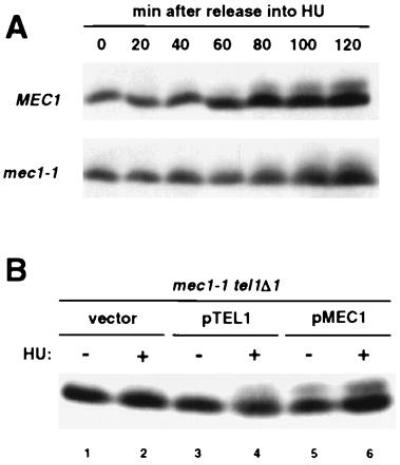
RPA2 phosphorylation in the presence of HU is abnormal in mec1-1. (A) Western blot analysis of RPA2 from synchronized TWY397 (MEC1) and DLY285 (mec1-1) cells released into medium containing HU. Equivalent volumes of original cell culture were analyzed. (B) Western blot analysis of RPA2 from YDM937 (mec1-1 tel1Δ1) harboring pRS316 (vector), the TEL1-containing plasmid pDM197 (pTEL1), or the MEC1-containing plasmid pDM207 (pMEC1) in the absence (−) or presence (+) of HU. Equal numbers of cells were analyzed.
Figure 3
Figure 3
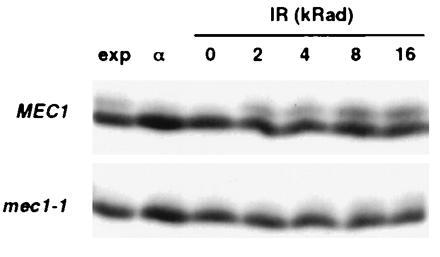
Ionizing radiation induces RPA2 phosphorylation dependent on MEC1. Western blot analysis of RPA2 from TWY397 (MEC1) and DLY285 (mec1-1) cells exposed to increasing doses of ionizing radiation (IR). Samples from the exponentially growing cultures prior to α factor treatment (exp) and from the G1-arrested cultures directly prior to release (α) have been included. Equivalent volumes of original cell culture were analyzed.
Figure 4
Figure 4
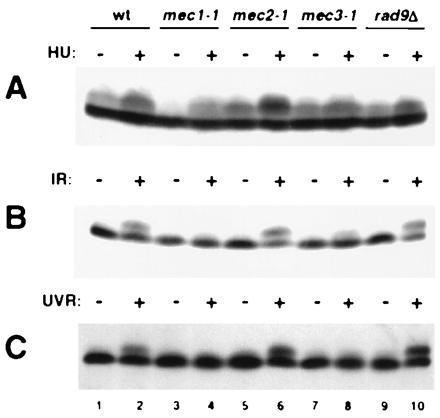
RPA phosphorylation in a collection of checkpoint mutants. Western blot analysis of RPA2 from wild-type and checkpoint mutants (A) in exponentially growing (−) or HU-arrested (+) cells, (B) after mock (−) or ionizing radiation (+, 8 krad) exposure (IR), and (C) after mock (−) or UV radiation (+, 60 J/m2) exposure (UVR). TWY397 was the wild-type control in all three experiments. For the mec1-1 samples, TWY308 was used in A and DLY285 was used in B and C. Within each experiment, equal numbers of cells were analyzed.
Figure 5
Figure 5
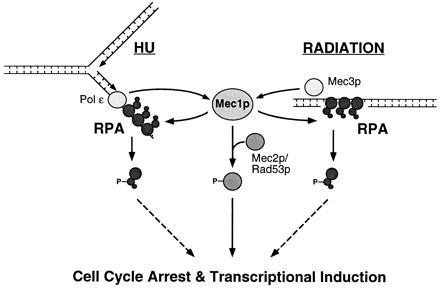
Model of MEC1-dependent RPA phosphorylation. Schematic diagram of the pathways leading from DNA replication inhibition or DNA damage to RPA phosphorylation. In this representation, the DNA-associated RPA becomes phosphorylated, as has been suggested for DNA-PK-catalyzed phosphorylation of human RPA (11, 14).

References

    1. Wobbe C R, Weissbach L, Borowiec J A, Dean F B, Murakami Y, Bullock P, Hurwitz J. Proc Natl Acad Sci USA. 1987;84:1834–1838. - PMC - PubMed
    1. Wold M S, Kelly T. Proc Natl Acad Sci USA. 1988;85:2523–2527. - PMC - PubMed
    1. Fairman M P, Stillman B. EMBO J. 1988;7:1211–1218. - PMC - PubMed
    1. Kenny M K, Schlegel U, Furneaux H, Hurwitz J. J Biol Chem. 1990;265:7693–7700. - PubMed
    1. Erdile L F, Wold M S, Kelly T J. J Biol Chem. 1990;265:3177–3182. - PubMed

Publication types

MeSH terms