


The Malthusian parameter of ascents: what prevents the exponential increase of one's ancestors?
- PMID: 8986801
- PMCID: PMC26394
- DOI: 10.1073/pnas.93.26.15276
The Malthusian parameter of ascents: what prevents the exponential increase of one's ancestors?
Abstract
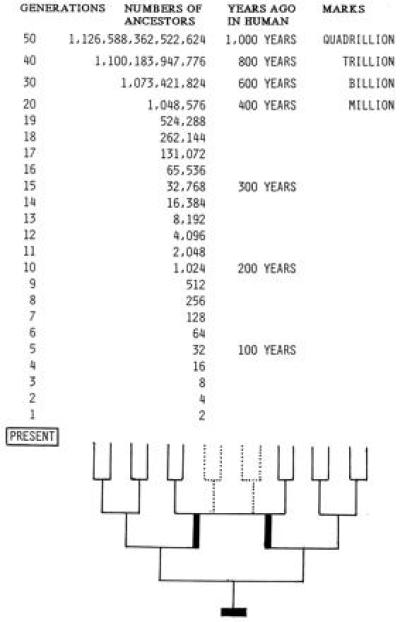
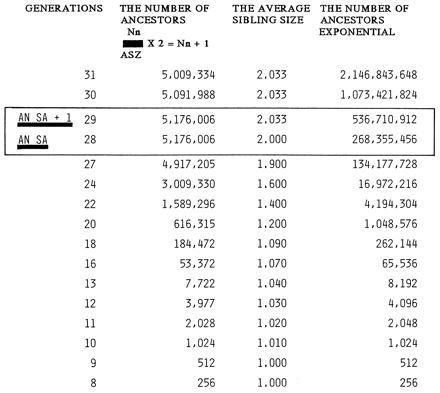
The reason that the indefinite exponential increase in the number of one's ancestors does not take place is found in the law of sibling interference, which can be expressed by the following simple equation: [equation: see text] where Nn is the number of ancestors in the nth generation, ASZ is the average sibling size of these ancestors, and Nn + 1 is the number of ancestors in the next older generation (n + 1). Accordingly, the exponential increase in the number of one's ancestors is an initial anomaly that occurs while ASZ remains at 1. Once ASZ begins to exceed 1, the rate of increase in the number of ancestors is progressively curtailed, falling further and further behind the exponential increase rate. Eventually, ASZ reaches 2, and at that point, the number of ancestors stops increasing for two generations. These two generations, named AN SA and AN SA + 1, are the most critical in the ancestry, for one's ancestors at that point come to represent all the progeny-produced adults of the entire ancestral population. Thereafter, the fate of one's ancestors becomes the fate of the entire population. If the population to which one belongs is a successful, slowly expanding one, the number of ancestors would slowly decline as you move toward the remote past. This is because ABZ would exceed 2. Only when ABZ is less than 2 would the number of ancestors increase beyond the AN SA and AN SA + 1 generations. Since the above is an indication of a failing population on the way to extinction, there had to be the previous AN SA involving a far greater number of individuals for such a population. Simulations indicated that for a member of a continuously successful population, the AN SA ancestors might have numbered as many as 5.2 million, the AN SA generation being the 28th generation in the past. However, because of the law of increasingly irrelevant remote ancestors, only a very small fraction of the AN SA ancestors would have left genetic traces in the genome of each descendant of today.
Figures
References
-
- Fisher R A. The Genetical Theory of Natural Selection. Oxford: Oxford Univ. Press; 1939.
-
- Kimura M, Ohta T. Theoretical Aspects of Population Genetics. Princeton: Princeton Univ. Press; 1981.
-
- Polani E. In: Trisomy 21 (Down’s Syndrome) Research Perspectives. de la Crutz F F, Gerald P E, editors. Baltimore: Univ. Park Press; 1981. pp. 112–115.
MeSH terms
LinkOut - more resources
Full Text Sources
Miscellaneous
