


Mutation rate varies among alleles at a microsatellite locus: phylogenetic evidence
- PMID: 8986803
- PMCID: PMC26396
- DOI: 10.1073/pnas.93.26.15285
Mutation rate varies among alleles at a microsatellite locus: phylogenetic evidence
Abstract
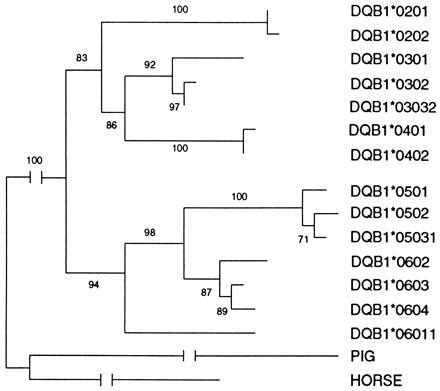
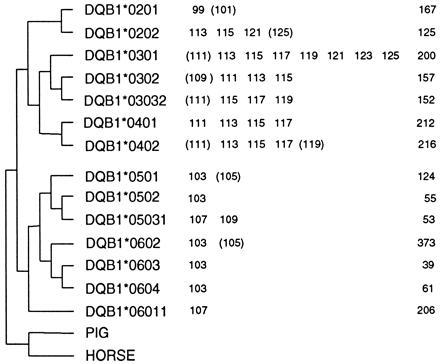
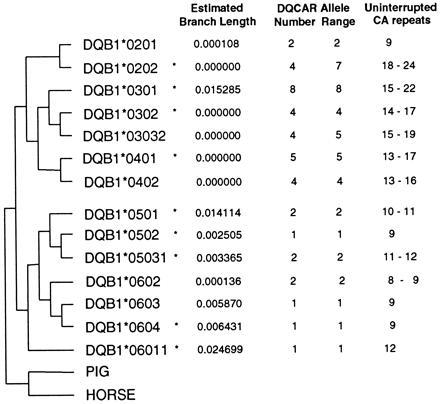
The understanding of the mutational mechanism that generates high levels of variation at microsatellite loci lags far behind the application of these genetic markers. A phylogenetic approach was developed to study the pattern and rate of mutations at a dinucleotide microsatellite locus tightly linked to HLA-DQB1 (DQCAR). A random Japanese population (n = 129) and a collection of multiethnic samples (n = 941) were typed at the DQB1 and DQCAR loci. The phylogeny of DQB1 alleles was then reconstructed and DQCAR alleles were superimposed onto the phylogeny. This approach allowed us to group DQCAR alleles that share a common ancestor. The results indicated that the DQCAR mutation rate varies drastically among alleles within this single microsatellite locus. Some DQCAR alleles never mutated during a long period of evolutionary time. Sequencing of representative DQCAR alleles showed that these alleles lost their ability to mutate because of nucleotide substitutions that shorten the length of uninterrupted CA repeat arrays; in contrast, all mutating alleles had relatively longer perfect CA repeat sequences.
Figures
References
Publication types
MeSH terms
Substances
Grants and funding
LinkOut - more resources
Full Text Sources
Other Literature Sources
Research Materials
