. 1996 Dec 24;93(26):15305-10.
doi: 10.1073/pnas.93.26.15305.

The common nodABC genes of Rhizobium meliloti are host-range determinants

Affiliations

The common nodABC genes of Rhizobium meliloti are host-range determinants

P Roche et al. Proc Natl Acad Sci U S A. .

Abstract

Symbiotic bacteria of the genus Rhizobium synthesize lipo-chitooligosaccharides, called Nod factors (NFs), which act as morphogenic signal molecules on legume hosts. The common nodABC genes, present in all Rhizobium species, are required for the synthesis of the core structure of NFs. NodC is an N-acetylglucosaminyltransferase, and NodB is a chitooligosaccharide deacetylase; NodA is involved in N-acylation of the aminosugar backbone. Specific nod genes are involved in diverse NF substitutions that confer plant specificity. We transferred to R. tropici, a broad host-range tropical symbiont, the ability to nodulate alfalfa, by introducing nod genes of R. meliloti. In addition to the specific nodL and nodFE genes, the common nodABC genes of R. meliloti were required for infection and nodulation of alfalfa. Purified NFs of the R. tropici hybrid strain, which contained chitin tetramers and were partly N-acylated with unsaturated C16 fatty acids, were able to elicit nodule formation on alfalfa. Inactivation of the R. meliloti nodABC genes suppressed the ability of the NFs to nodulate alfalfa. Studies of NFs from nodA, nodB, nodC, and nodI mutants indicate that (i) NodA of R. meliloti, in contrast to NodA of R. tropici, is able to transfer unsaturated C16 fatty acids onto the chitin backbone and (ii) NodC of R. meliloti specifies the synthesis of chitin tetramers. These results show that allelic variation of the common nodABC genes is a genetic mechanism that plays an important role in signaling variation and in the control of host range.


Figures
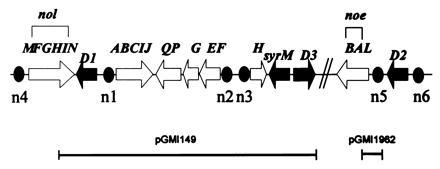
Figure 1
Figure 1
Genetic map of the R. meliloti nodulation region. The open arrows represent the structural nod, nol, and noe genes and operons, and black arrows represent the regulatory nodD and syrM genes. Filled ovals identify the nod boxes. Below the map, the two segments represent the pGMI149 and pGMI1962 plasmids.
Figure 2
Figure 2
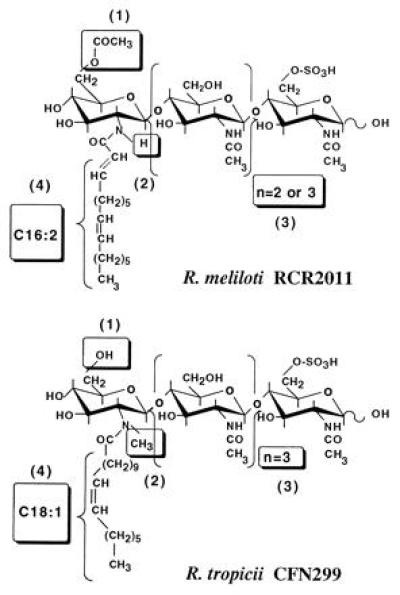
Structures of the major NFs of R. meliloti and R. tropici. Differences between the NFs from the two species are boxed. (1) ± O-acetate group; (2) ± N-methyl group; (3) number of N-acetylglucosamine residues; (4) structure of the acyl chain.
Figure 3
Figure 3
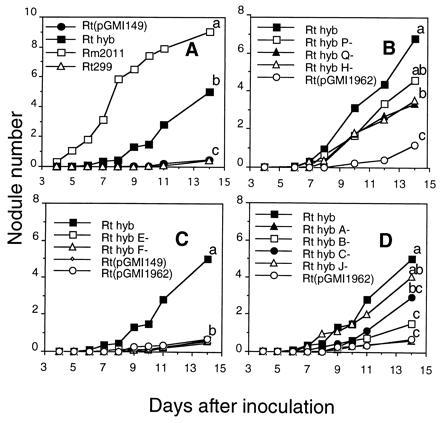
Induction of nodule formation on M. sativa cv. Europa by living bacterial cells of R. tropici CFN299 carrying various combinations of R. meliloti nod genes. (A) R. meliloti, Rm2011; R. tropici, Rt299; R. tropici (pGMI149), Rt (pGMI149); R. tropici (pGMI149)(pGMI1962), Rt hyb. (B–D) R. tropici (pGMI149)(pGMI1962) with Tn5 insertions in the R. meliloti nod genes carried in pGMI149. (B) Mutations in the sulfation genes nodP, nodQ, and nodH. (C) Mutations in the nodFE and nodL genes. (D) Mutations in the nodA, nodB, nodC, and nodIJ genes. Rt hyb, R. tropici (pGMI149)(pGMI1962); Rt hyb D1-, R. tropici (pGMI149nodD1)(pGMI1962) and so on. Nodule numbers represent the average of 20 tubes, each containing two seedlings. Statistical analysis of nodule numbers 2 weeks after inoculation: treatments with letters in common do not differ significantly at the P = 0.05 level. Analysis of variance with Fisher’s test.
Figure 4
Figure 4
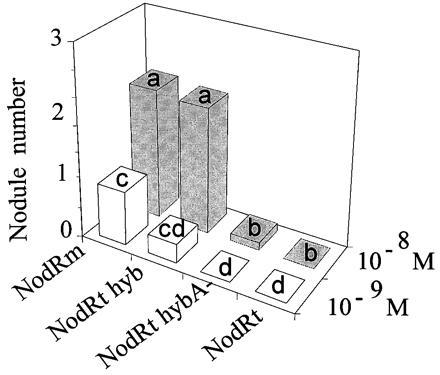
Nodules induced on M. sativa by addition of purified NFs at 10−8 M and 10−9 M. NFs were purified from the following strains. NodRm, R. meliloti RCR2011(pMH682); NodRt, R. tropici wild type; NodRt hyb, R. tropici (pGMI149)(pGMI1962); NodRt hybA, R. tropici (pGMI149nodA)(pGMI1962). Nodules were scored 25 days after addition of the NFs. Ten tubes were used for each dilution, with two seedlings per tube. For details on the statistical analysis of nodule numbers, see the Fig. 3 legend.
Figure 5
Figure 5
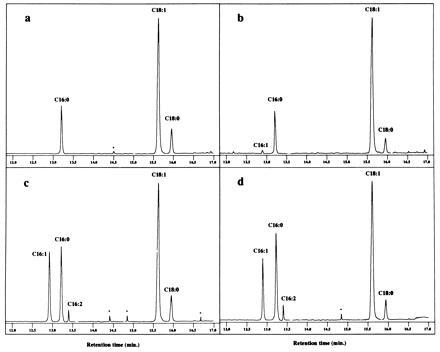
Gas chromatographic analysis of NF acyl chains. Fatty acids were released after methanolysis of NFs from the following R. tropici strains. (a) CFN299 wild type. (b) R. tropici (pGMI149nodA)(pGMI1962). (c) R. tropici (pGMI149)(pGMI1962). (d) R. tropici (pGMI149nodB)(pGMI1962).
Figure 6
Figure 6
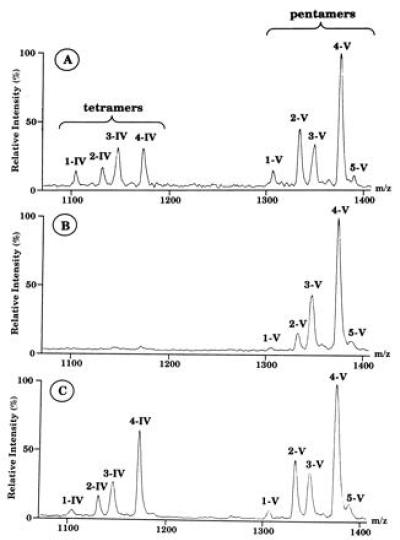
Negative ion MALDI mass spectra of NFs from the following R. tropici (pGMI149)(pGMI1962) derivatives. (A) The control strain with unmodified pGMI149. (B) A derivative with a nodC::Tn5 insertion in pGMI149. (C) A derivative with a nodI::Tn5 insertion in pGMI149. Tetrameric (IV) and pentameric (V) NFs were found with the following substitutions (nomenclature as proposed in ref. 9). 1-IV: m/z 1105 (IV, C16:0,S), m/z 1103 (IV, C16:1,S); 2-IV: m/z 1131 (IV, C18:1,S); 3-IV: m/z 1147 (IV, Ac, C16:0,S), m/z 1145 (IV, Ac, C16:1,S), m/z 1145 (IV, Me, C18:1,S); 4-IV: m/z 1173 (IV, Ac, C18:1,S); 1-V: m/z 1308 (V, C16:0,S), m/z 1306 (V, C16:1,S); 2-V: m/z 1334 (V, C18:1,S); 3-V: m/z 1350 (V, Ac, C16:0,S), m/z 1348 (V, Ac, C16:1,S), m/z 1348 (IV, Me, C18:1,S); 4-V: m/z 1376 (V, Ac, C18:1,S); 5-V: m/z 1390 (V, Me, Ac, C18:1,S).

References

    1. Fisher R F, Long S R. Nature (London) 1992;357:655–660. - PubMed
    1. Dénarié J, Cullimore J. Cell. 1993;74:951–954. - PubMed
    1. Schultze M, Kondorosi E, Ratet P, Buire M, Kondorosi A. Int Rev Cytol. 1994;156:1–75.
    1. Spaink H P. Annu Rev Phytopathol. 1995;33:345–368. - PubMed
    1. Spaink H P, Wijffelman C A, Pees E, Okker R J H, Lugtenberg B J J. Nature (London) 1987;328:337–340.

Publication types

MeSH terms

LinkOut - more resources