. 1996 Dec 24;93(26):15508-11.
doi: 10.1073/pnas.93.26.15508.

When the brain changes its mind: interocular grouping during binocular rivalry

Affiliations

When the brain changes its mind: interocular grouping during binocular rivalry

I Kovács et al. Proc Natl Acad Sci U S A. .

Abstract

The prevalent view of binocular rivalry holds that it is a competition between the two eyes mediated by reciprocal inhibition among monocular neurons. This view is largely due to the nature of conventional rivalry-inducing stimuli, which are pairs of dissimilar images with coherent patterns within each eye's image. Is it the eye of origin or the coherency of patterns that determines perceptual alternations between coherent percepts in binocular rivalry? We break the coherency of conventional stimuli and replace them by complementary patchworks of intermingled rivalrous images. Can the brain unscramble the pieces of the patchwork arriving from different eyes to obtain coherent percepts? We find that pattern coherency in itself can drive perceptual alternations, and the patchworks are reassembled into coherent forms by most observers. This result is in agreement with recent neurophysiological and psychophysical evidence demonstrating that there is more to binocular rivalry than mere eye competition.


Figures
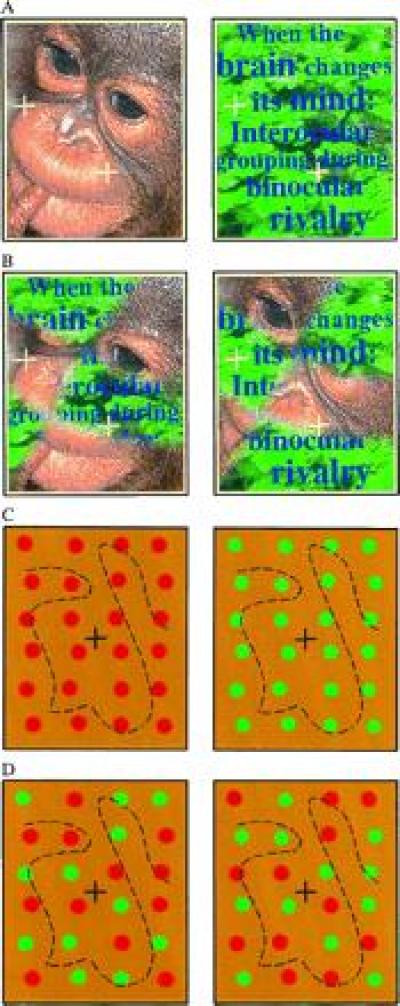
Figure 1
Figure 1
The dichoptic pairs shown in AD induce binocular rivalry when brought into correspondence by means of converging (or diverging) the eyes (the black fixation marks should be fused). These stereo pairs offer a critical test for investigating the role of eye competition and pattern coherence in binocular rivalry. (A) Conventional rivalry inducing pair: eye of origin and pattern coherence are correlated. Alternation of the monkey face and the jungle scene is observed. (B) Patchwork rivalry stimulus: eye of origin and pattern coherence are uncorrelated. Alternation of the monkey face and the jungle scene can still be observed, which is unexplained by eye competition theories of rivalry. (C) Conventional color rivalry condition: eye of origin and pattern coherence are correlated. (D) Patchwork color rivalry condition: eye of origin and pattern coherence are uncorrelated. Eye competition would only predict mixed percepts here; however, all-red and all-green percepts are also observed. Similar stimuli were used in the reported experiments. Each eye’s frame was tessellated into fictitious abutting rectangular tiles (four columns by seven columns), and an element was placed within each tile with a random positional jitter. Elements were equiluminant to the uniform yellow background, the luminance of which was 7.5 candelas per m2, and their color was low-pass filtered spatially with a circular Gaussian envelope that had a σ of 11.2 min of arc. Thus, the element’s color was pure red (or green) at its center, and it gradually blended with the background at its edges. The Gaussian bell was truncated to zero at a radius of 16.4 min of arc. The equiluminant settings were individually obtained for each observer using a heterochromatic flicker photometry technique.
Figure 2
Figure 2
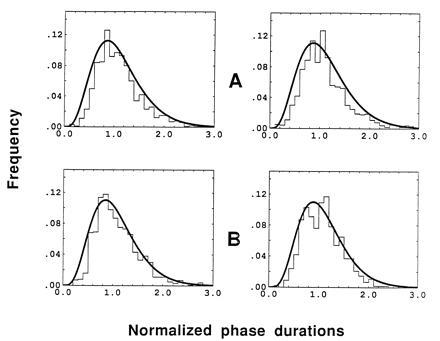
Histograms of normalized phase durations for the all-red (Left), all-green (Right) percepts in conventional (A) and patchwork (B) color rivalry conditions. Results are averaged across three observers (A.F., M.Y., and T.V.P.). Data are fitted using the Gamma function (smooth black lines)—i.e., f(x) = [λr/Γ(r)] xr−1exp(−λx), with Γ(r) = (r−1)!. The parameters of the Gamma functions (see Table 1) were not significantly different in the two conditions.

References

    1. Blake R. Psychol Rev. 1989;96:145–167. - PubMed
    1. Lehky S R. Perception. 1988;17:215–288. - PubMed
    1. Matsuoka K. Biol Cybern. 1984;49:201–208. - PubMed
    1. Sugie N. Biol Cybern. 1982;43:13–21. - PubMed
    1. Wolfe J M. Psychol Rev. 1986;93:269–282. - PubMed

Publication types

LinkOut - more resources