. 1997 Jan 1;17(1):409-19.
doi: 10.1523/JNEUROSCI.17-01-00409.1997.

Functional stages in the formation of human long-term motor memory

Affiliations

Functional stages in the formation of human long-term motor memory

R Shadmehr et al. J Neurosci. .

Abstract

Previous research has demonstrated that the primate CNS has the ability to learn and store multiple and conflicting visuo-motor maps. Here we studied the ability of human subjects to learn to make reaching movements while interacting with one of two conflicting mechanical environments as produced by a robotic manipulandum. We demonstrate that two motor maps may be learned and retained, but only if the training sessions in the tasks are separated by an interval of approximately 5 hr. If the interval is shorter, learning of the second map begins with an internal model appropriate for the first task and performance in the second task is significantly impaired. Analysis of the after-effects suggests that with a short temporal distance, learning of the second task leads to an unlearning of the internal model for the first. With the longer temporal distance, learning of the second task starts with an unbiased internal model, and performance approaches that of naives. Furthermore, the memory of the consolidated skill lasts for at least 5 months after training. These results argue for a distinct change in the state of resistance of motor memory (to disruption) within a few hours after acquisition. We suggest that motor practice results in memories that have at least two functional components: soon after completion of practice, one component fades while another is strengthened. A further experiment suggests that the hypothetical first stage is not merely a gateway to long-term memory, but also temporary storage for items of information, whether new or old, for use in the near-term. Our results raise the possibility that there are distinct neuronal mechanisms for representation of the two functional stages of motor memory.


Figures
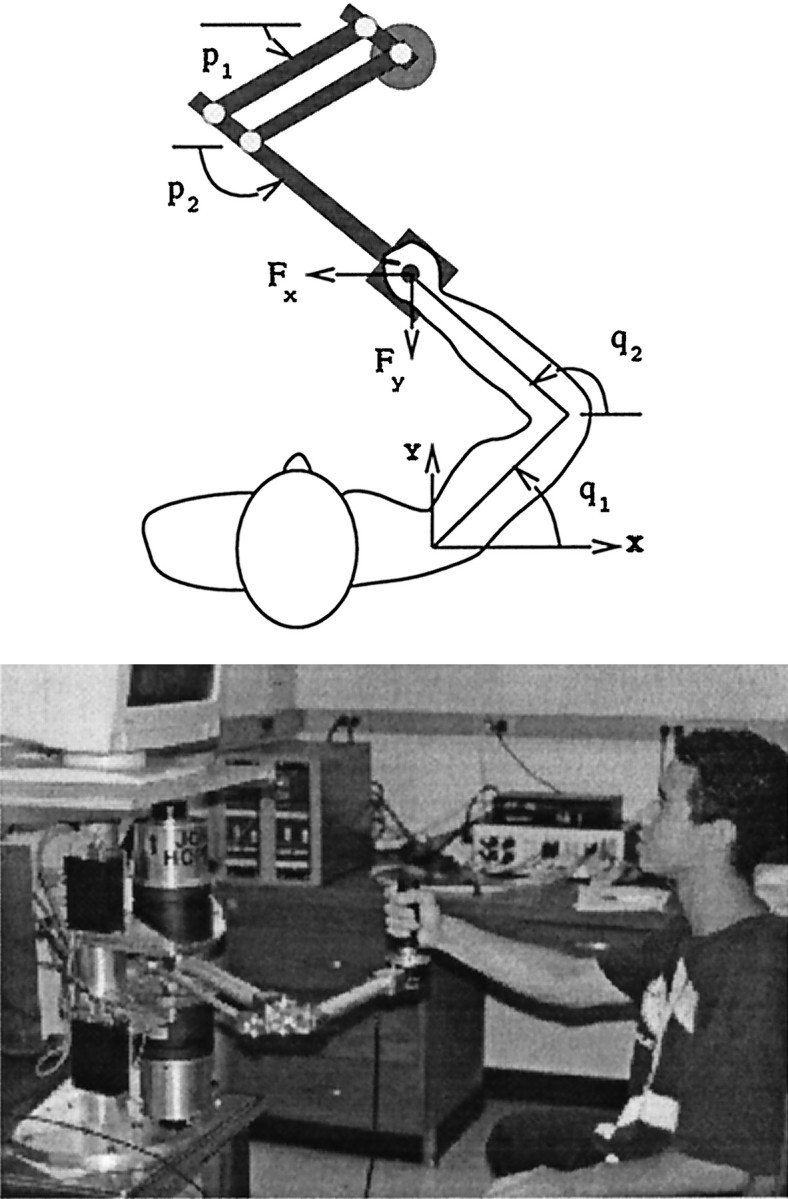
Fig. 1.
Fig. 1.
The robot manipulandum and the experimental setup. The manipulandum is a very low-friction, planar mechanism powered by two high-performance torque motors. The subject grips the handle of the robot. The handle houses a force transducer. The video monitor facing the subject displays a cursor corresponding to the position of the handle. A target position is displayed, and the subject makes a reaching movement. With practice, the subject learns to compensate for the forces produced by the robot.
Fig. 2.
Fig. 2.
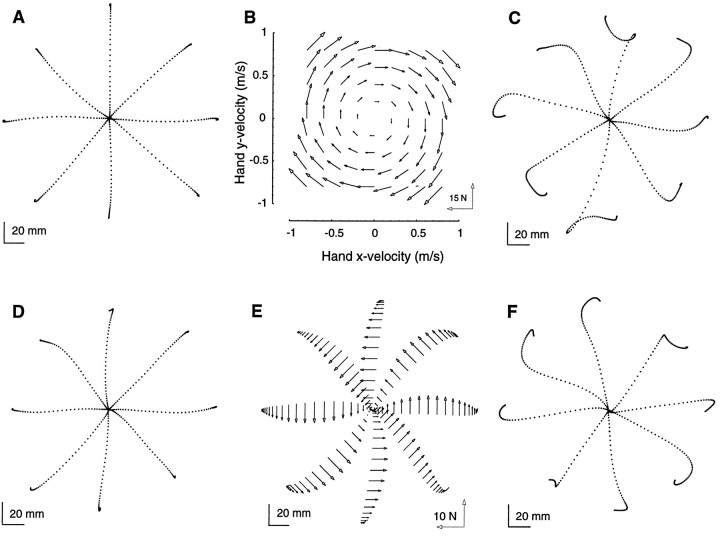
A, Hand path of a typical subject in the null field (the points in all hand paths are 10 msec apart). B, An example of a force field produced by the robot. The field is a linear function of hand velocity, and thex- and y-coordinates refer to that of Figure 1. C, Hand path of an untrained subject in the field. D, Hand path after 300 movements in the field. The trajectory in the field converges to the trajectory observed in the null field. E, Forces produced by a typical trained subject to counter the effect of the force field as a function of hand position for each movement. These forces are the projection of the forces measured at the interaction point between the subject and robot onto a direction perpendicular to the direction of target.F, While training in the field, random targets are presented with null field conditions. The results are after-effects.
Fig. 3.
Fig. 3.
The component of the interaction force perpendicular to the direction of motion plotted as a function of time along straight-line paths to the targets. A, Interaction forces while moving in a null field. B, Interaction forces of a trained subject while moving in a field. C, Results for a simulation in which the controller of Eq. 3 had learned an IM of the force field and, unexpectedly, the field was removed, i.e., force predicted for the after-effects in the case that the controller had learned a perfect model of the field. Forces are plotted for the first 250 msec of movement. D–F, Forces recorded from three typical subjects during their after-effects (first 250 msec of movement). The motor output of subjects changed by roughly the same pattern and magnitude as the simulation had predicted. The vectors in all paths are 10 msec apart.
Fig. 4.
Fig. 4.
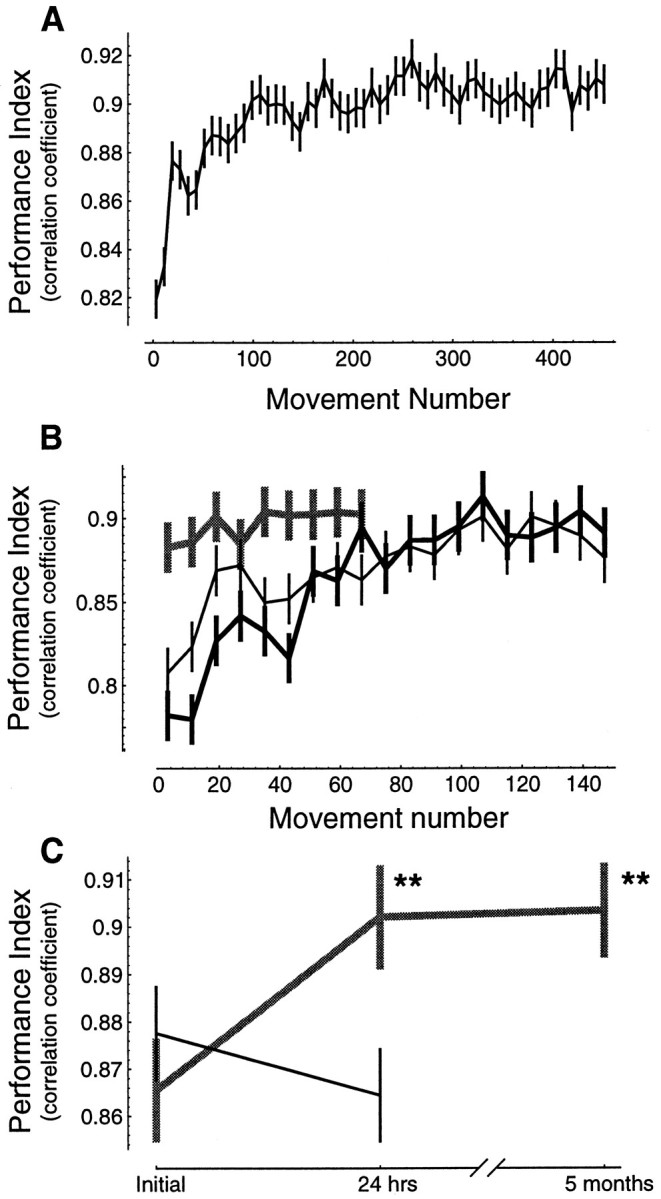
Performance during initial training in a force field and subsequent tests of recall. Performance index is a correlation between the hand trajectory in the force field and the hand trajectory in the null field (baseline trajectories, as in Fig.2A). A, Mean performance ± 95% confidence intervals for all subjects (n = 60). For each subject, groups of eight consecutive movements are binned together (there were 8 different directions of movement, and target directions were presented in random order). B, Initial performance in a field and performance 24 hr later. All lines are mean performance ± 95% confidence intervals. Thin line, Performance of naive subjects (n = 18) in field B1. Thick black line, Performance of a subset of these subjects (n = 8) in a novel field,B2, measured 24 hr after training inB1. Thick gray line, Performance of the remaining subjects at 24 hr on fieldB1. C, Summary performance scores ± 95% confidence intervals for the two groups of subjects. Gray line represents subjects that were tested on the field in which they were trained. Black linerepresents subjects that at 24 hr were tested on a novel field.
Fig. 5.
Fig. 5.
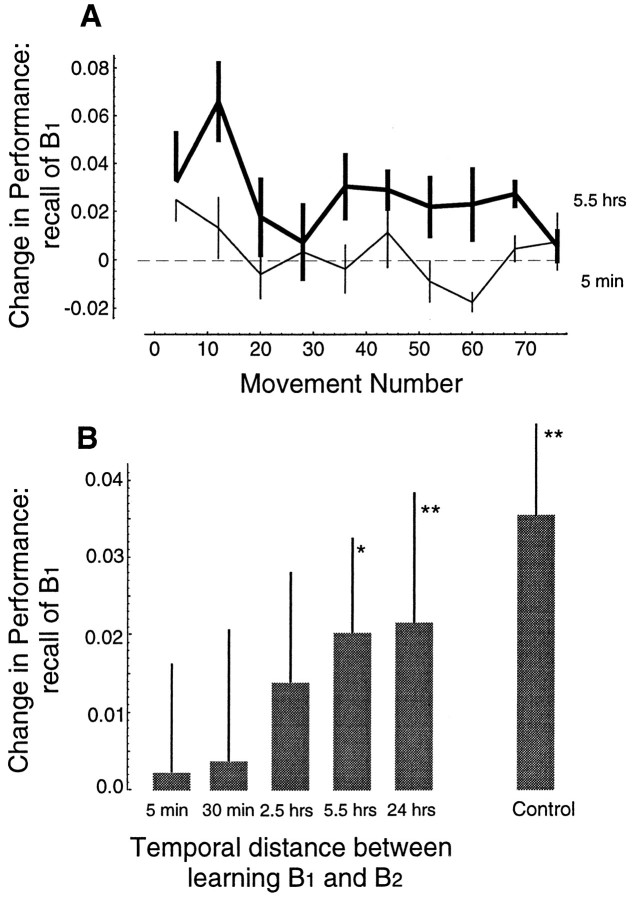
Performance during the test of recall forB1 as a function of temporal distance between learning of B1 andB2. B1 was tested for recall 1 week after B1 andB2 were learned. A, Mean ± SE improvement in performance for two groups of subjects.Thin line is for the group (n = 9) that practiced in B2 at 5 min after completion of practice in B1. Thick line is for the group (n = 10) that practiced in B2 at 5.5 hr afterB1. B, The ability to recallB1 is significantly dependent on temporal distance between B1 andB2. Each bar is the mean ± 95% confidence interval of change in performance as measured for a target set during the recall test versus during initial practice.
Fig. 8.
Fig. 8.
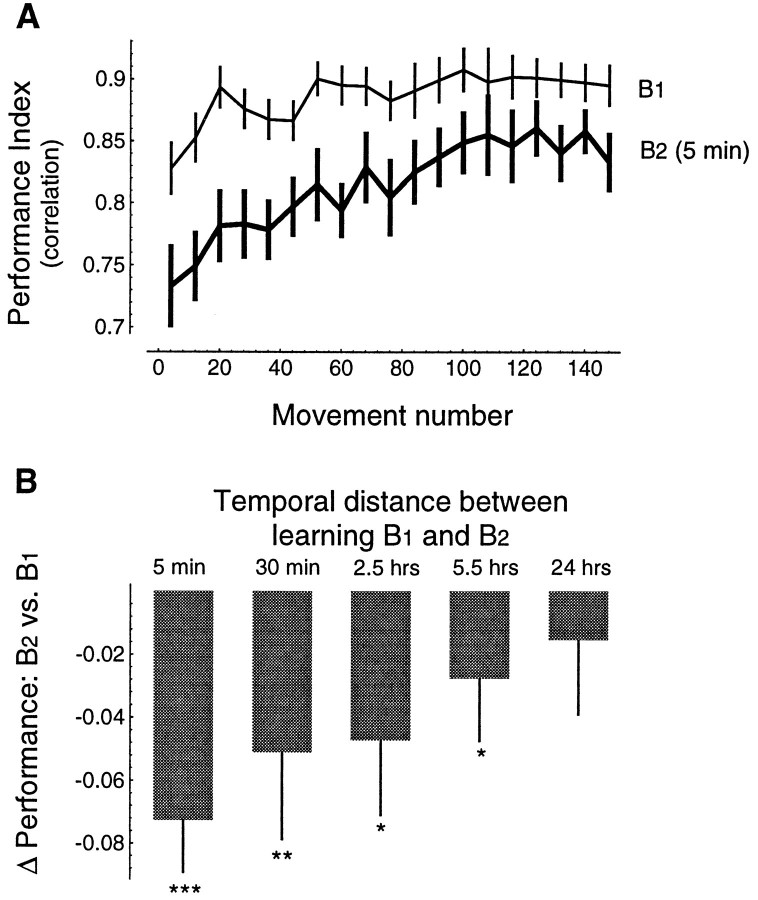
Performance of subjects in fieldB2 as a function of time since learningB1. A, WhenB2 is introduced 5 min after completion of training in B1, performance is worse than that recorded from B1. Plotted are mean ± SE of correlations. B, Performance inB2 is significantly dependent on temporal distance between B1 andB2. Each bar is the mean ± 95% confidence interval of change in performance as measured for the initial target set in B1 andB2.
Fig. 6.
Fig. 6.
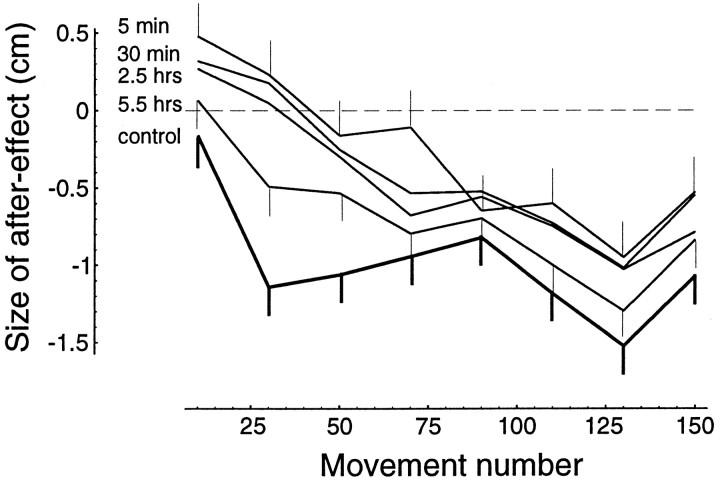
Size and direction of after-effects as subjects learn field B2 at different time intervals after practicing in B1. Size is determined as the distance from a straight line (from the previous to the next target) at 300 msec into the movement. Direction is positive for an after-effect appropriate for field B1 (i.e., counter-clockwise, as in Fig. 2) and negative for an after-effect appropriate for field B2. Plotted are the means and 95% confidence intervals. Each point represents the average after-effect for a group of subjects at a given movement number (bin size is 4). Because the size of after-effects depends on direction of target (e.g., Fig. 2F), the change for a given curve is not expected to be monotonic. However, the sequence of targets for all subjects is the same. Therefore, after-effects at a movement number may be directly compared among the different groups. The figure shows that at 5 min after learningB1, subjects begin learningB2 with after-effects that are in the direction of B1. Control subjects who never learned B1 begin learningB2 with no after-effects, i.e., unbiased. With temporal distance between training sessions, initial after-effects begin to resemble those of the control group.
Fig. 7.
Fig. 7.
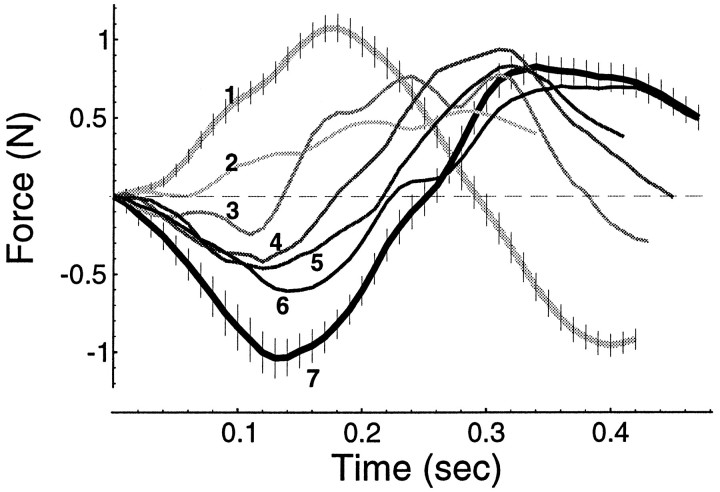
A measure of forces recorded at the interaction point between subjects and robot as a function of time into an after-effect. Each line is an average change in the interaction force during after-effects (n = 5) to targets at 270° and 225° for the first 80 movements in a given force field with respect to those recorded from the same group of subjects in the baseline conditions. This representation of the interaction force is the same as the measure shown in Figure3DF, with the difference that time is explicitly represented and the sign of the force is positive for a counter-clockwise vector and negative otherwise. Line 1represents mean ± 95% confidence interval of the force produced by naive subjects that learned field B1.Line 7 represents mean ± 95% confidence interval for naive subjects that learned field B2.Lines 26 are the forces produced by subjects that were learning B2 at 5 min, 30 min, 2.5 hr, 5.5 hr, or 24 hr after learningB1, respectively.
Fig. 9.
Fig. 9.
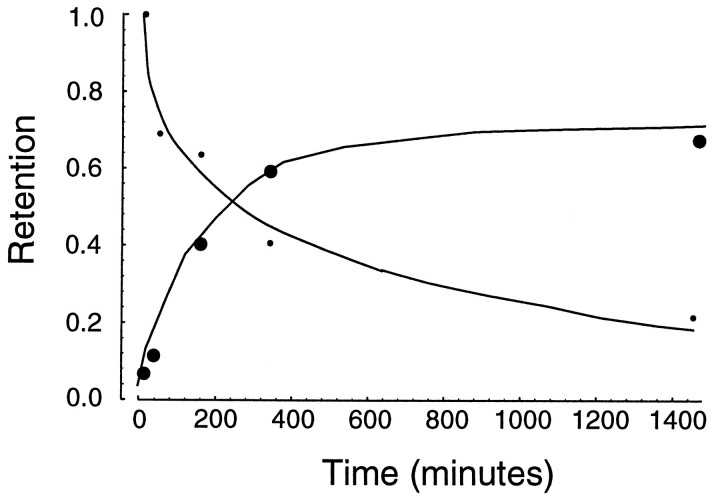
The data from Figures 5 and 8 have been combined to produce two hypothetical stages in formation of long-term motor memory. The data points that constitute the decaying stage are the amount of anterograde interference that was recorded (as a percentage of that recorded at 5 min) as subjects attempted learning of a second field at different times. The data points that constitute the rising curve are a measure of memory retained from the first field after learning of a second field at different times.

References

    1. Aizawa H, Inase M, Mushiake H, Shima K, Tanji J. Reorganization of activity in the supplementary motor area associated with motor learning and functional recovery. Exp Brain Res. 1991;84:668–671. - PubMed
    1. Alvarez P, Squire LR. Memory consolidation and the medial temporal lobe: a simple network model. Proc Nat Acad Sci USA. 1994;91:7041–7045. - PMC - PubMed
    1. Asanuma H, Keller A. Neuronal mechanisms of motor learning in mammals. NeuroReport. 1991;2:217–224. - PubMed
    1. Bailey CH, Kandel ER. Molecular and structural mechanisms underlying long-term memory. In: Gazzaniga M, editor. The cognitive neurosciences. MIT; Cambridge, MA: 1995. pp. 19–36.
    1. Baker J, Perlmutter SO, Peterson BW, Rude SA, Robinson FR. Simultaneous opposing adaptive changes in cat vestibulo-ocular reflex direction for two body orientations. Exp Brain Res. 1987;69:220–224. - PubMed

Publication types