. 1997 Jan 7;94(1):42-7.
doi: 10.1073/pnas.94.1.42.

A new pathway for vacuolar cadmium sequestration in Saccharomyces cerevisiae: YCF1-catalyzed transport of bis(glutathionato)cadmium

Affiliations

A new pathway for vacuolar cadmium sequestration in Saccharomyces cerevisiae: YCF1-catalyzed transport of bis(glutathionato)cadmium

Z S Li et al. Proc Natl Acad Sci U S A. .

Abstract

The yeast cadmium factor (YCF1) gene encodes an MgATP-energized glutathione S-conjugate transporter responsible for the vacuolar sequestration of organic compounds after their S-conjugation with glutathione. However, while YCF1 was originally isolated according to its ability to confer resistance to cadmium salts, neither its mode of interaction with Cd2+ nor the relationship between this process and organic glutathione-conjugate transport are known. Here we show through direct comparisons between vacuolar membrane vesicles purified from Saccharomyces cerevisiae strain DTY167, harboring a deletion of the YCF1 gene, and the isogenic wild-type strain DTY165 that YCF1 mediates the MgATP-energized vacuolar accumulation of Cd-glutathione complexes. The substrate requirements, kinetics and Cd2+/glutathione stoichiometry of cadmium uptake and the molecular weight of the transport-active complex demonstrate that YCF1 selectively catalyzes the transport of bis(glutathionato)cadmium (Cd x +GS2). On the basis of these results--the Cd2+ hypersensitivity of DTY167, versus DTY165, cells, the inducibility of YCF1-mediated transport, and the rapidity and spontaneity of Cd-GS2 formation--this new pathway is concluded to contribute substantially to Cd2+ detoxification.


Figures
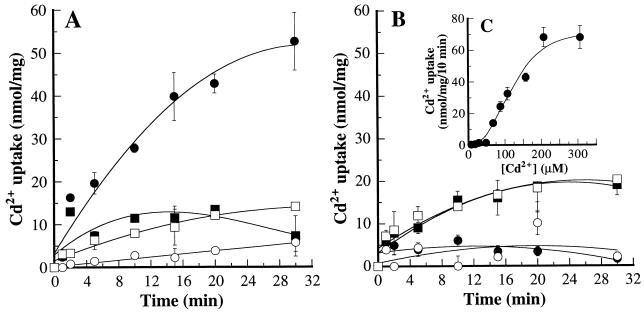
Figure 1
Figure 1
Uptake of Cd2+ into vacuolar membrane vesicles purified from DTY165 and DTY167 cells. Uptake of 109Cd2+ by DTY165 membranes (A) or DTY167 membranes (B) was measured in the absence of MgATP plus (○) or minus GSH (1 mM) (□) or in the presence of MgATP (3 mM) plus (•) or minus (▪) GSH. 109CdSO4 and gramicidin-D were added at concentrations of 80 μM and 5 μM, respectively. (C) Rate of 109Cd2+ uptake by DTY165 membranes plotted as a function of the total concentration of Cd2+ ([Cd2+]) added to uptake media containing 1 mM GSH, 3 mM MgATP, and 5 μM gramicidin-D. Values shown are means ± SE (n = 3–6).
Figure 2
Figure 2
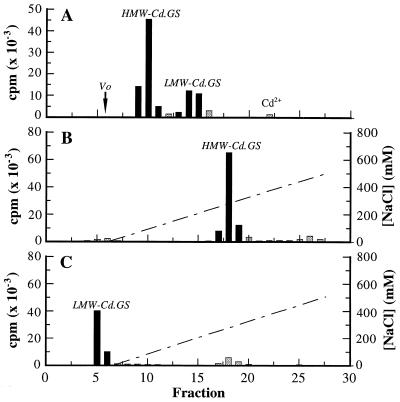
Purification of cadmium·glutathione complexes by gel-filtration (A) and anion-exchange chromatography (B and C). 109CdSO4 (20 mM) was incubated with 40 mM GSH at 45°C for 24 h, and the mixture was chromatographed on Sephadex G-15 to resolve a high molecular weight 109Cd-labeled component (HMW-109Cd·GS) from a low molecular weight component (LMW-109Cd·GS) (A). The peaks corresponding to HMW-109Cd·GS and LMW-109Cd·GS were then chromatographed on Mono-Q and eluted with a linear NaCl gradient (- — -) (B and C). 109Cd (cpm × 10−3) was determined on 5 μl aliquots of the column fractions by liquid scintillation counting. Solid bars denote fractions subjected to further manipulations.
Figure 3
Figure 3
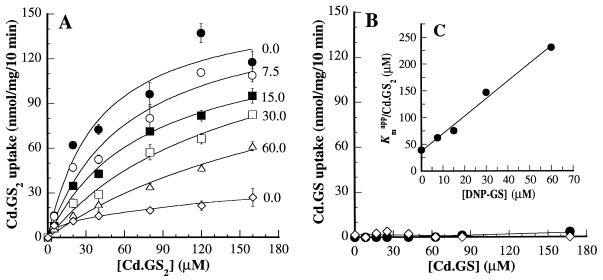
Kinetics of MgATP-dependent, uncoupler-insensitive 109Cd·GS2 (HMW-109Cd·GS; A) and 109Cd·GS (LMW-109Cd·GS; B) uptake. S-(2,4-dinitrophenyl)glutathione (DNP-GS) was added at the concentrations (μM) indicated to DTY165 membranes (•, ○, ▪, □, ▵) or DTY167 membranes (⋄). A secondary plot of the apparent Michaelis constants for Cd·GS2 uptake (Kmapp/Cd·GS2) as a function of DNP-GS concentration is shown (C). The kinetic parameters for Cd·GS2 transport by DTY165 membranes were Km, 39.1 ± 14.1 μM, Vmax, 157.2 ± 30.4 nmol/mg/10 min, and Ki(DNP-GS), 11.3 ± 2.1 μM. Kinetic parameters were computed by nonlinear least squares analysis (14). Values shown are means ± SE (n = 6).
Figure 4
Figure 4
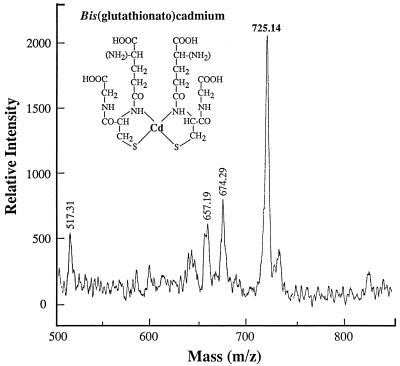
Matrix-assisted laser desorption mass spectrometry of HMW-Cd·GS. MALD-MS was performed on Sephadex G-15-, Mono-Q-purified HMW-Cd·GS as described. The molecular structure inferred from a mean m/z ratio of 725.4 ± 0.7 (n = 9) and average Cd/GS stoichiometry of 0.5 (Cd·GS2, molecular weight 724.6 Da) is shown.
Figure 5
Figure 5
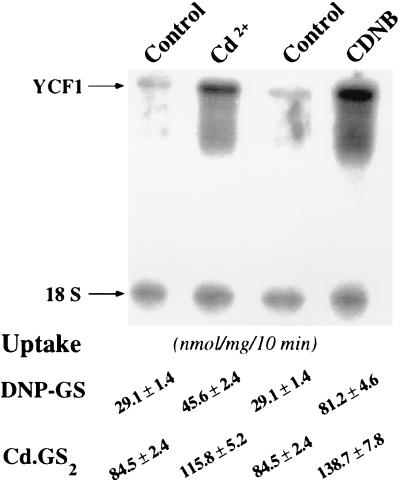
Induction of YCF1 expression and YCF1-dependent Cd·GS2 and DNP-GS transport by pretreatment of DTY165 cells with CdSO4 (Cd2+, 200 μM) or CDNB (150 μM) for 24 h. YCF1-specific mRNA and 18S rRNA were detected in the total RNA extracted from control or pretreated cells (10 μg/lane) by RNase protection. Uptake of 109Cd·GS2 (50 μM) or [3H]DNP-GS (66.2 μM) by vacuolar membrane vesicles was measured in standard uptake medium containing 5 μM gramicidin-D. Values shown are means ± SE (n = 3).

References

    1. Ishikawa T. Trends Biochem Sci. 1992;17:463–468. - PubMed
    1. Cole S P C, Bhardwaj G, Gerlach J H, Mackie J E, Grant C E, Almquist K C, Stewart A J, Kurz E U, Duncan A M V, Deeley R G. Science. 1992;258:1650–1654. - PubMed
    1. Leier I, Jedlischsky G, Buchholz U, Cole S P, Deeley R G, Keppler D. J Biol Chem. 1994;269:27807–27810. - PubMed
    1. Szczypka M, Wemmie J A, Moye-Rowley W S, Thiele D J. J Biol Chem. 1994;269:22853–22857. - PubMed
    1. Li Z-S, Szczypka M, Lu Y-P, Thiele D J, Rea P A. J Biol Chem. 1996;271:6509–6517. - PubMed

Publication types

MeSH terms

LinkOut - more resources