Comparative Study
. 1997 Jan 7;94(1):73-8.
doi: 10.1073/pnas.94.1.73.

A computer screening approach to immunoglobulin superfamily structures and interactions: discovery of small non-peptidic CD4 inhibitors as novel immunotherapeutics

Affiliations
Comparative Study

A computer screening approach to immunoglobulin superfamily structures and interactions: discovery of small non-peptidic CD4 inhibitors as novel immunotherapeutics

S Li et al. Proc Natl Acad Sci U S A. .

Abstract

The interaction between CD4 and major histocompatibility complex (MHC) class II proteins is critical for the activation of CD4+ T cells, which are involved in transplantation reactions and a number of autoimmune diseases. In this study we have identified a CD4 surface pocket as a functional epitope implicated in CD4-MHC class II interaction and T-cell activation. A computer-based strategy has been used to screen approximately 150,000 non-peptidic organic compounds in a molecular data base and to identify a group of compounds as ligands of the proposed CD4 surface pocket. These small organic compounds have been shown to specifically block stable CD4-MHC class II binding, and exhibit significant inhibition of immune responses in animal models of autoimmune disease and allograft transplant rejection, suggesting their potential as novel immunosuppressants. This structure-based computer screening approach may have general implications for studying many immunoglobulin-like structures and interactions that share similar structural features. Furthermore, the results from this study have demonstrated that the rational design of small non-peptidic inhibitors of large protein-protein interfaces may indeed be an achievable goal.


Figures
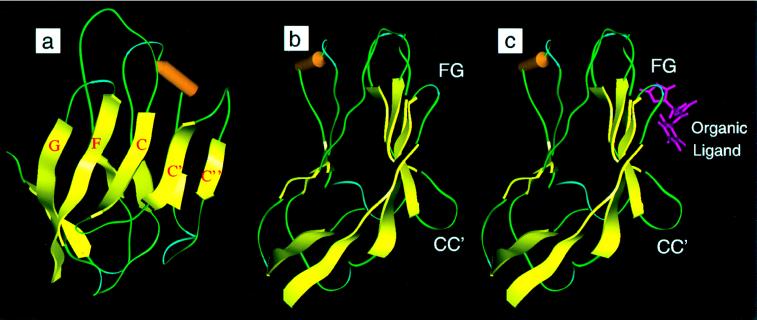
Figure 1
Figure 1
A proposed surface-binding pocket on the CD4 D1 domain. (a) Front view of the pocket showing the potential involvement of the GFCC′C" sheet, and the FG, CC′ and C′C" loops. (b) Side view of the pocket in a rotated 90°, highlighting the prominent role of the FG and CC′ loops in forming this binding pocket. (c) CD4 surface pocket bound by an organic inhibitor TJU104 colored in cyan (see Fig. 2 for the chemical structure of TJU104).
Figure 2
Figure 2
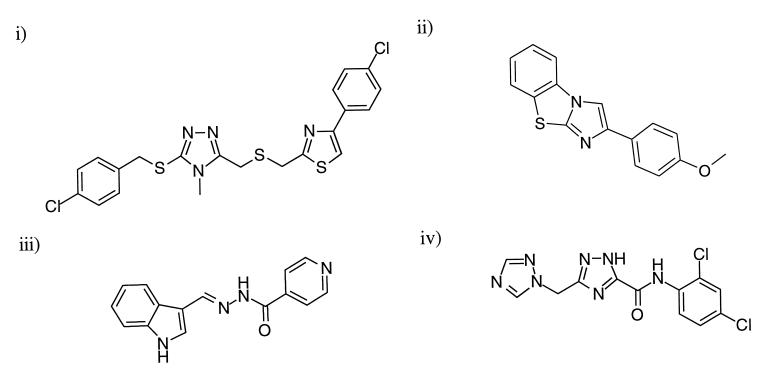
Four non-peptidic organic inhibitors of stable CD4–MHC class II interactions: (i) TJU101, 5-(4-chloro-benzylthio)-3-{[(4-chlorophenyl)-2-thiazolyl]methylthiomethyl}-4-methyl-1,2,4-triazole; (ii) TJU102, 4-(4-methoxy-phenyl)-1-imidazo[2,1-B]benzothiazole; (iii) TJU103, N-(3-indoylmethylene)-isonicotinic hydrazone; (iv) TJU104, N-(2,4-dichloro-phenyl)-3-(1,2,4-triazol-1-ylmethyl)-1,2,4-triazole-5-carboxamide.
Figure 3
Figure 3
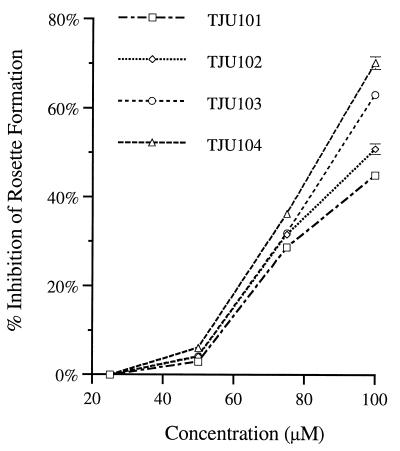
Inhibitory activity by the four most potent organic compounds on CD4–MHC class II binding, as measured by the cell adhesion assay. The chemical structures of these compounds are given in Fig. 2. The points represent the mean of three independent assays.
Figure 4
Figure 4
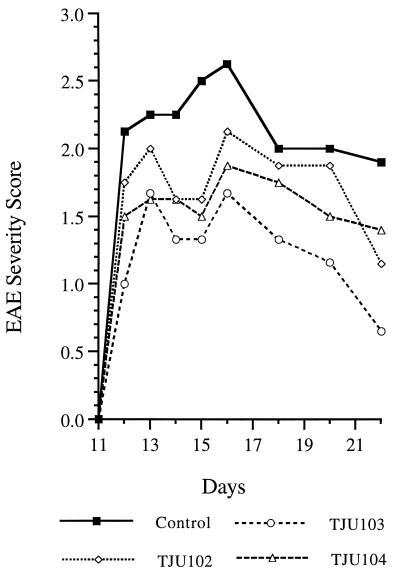
Efficacy of the three selected organic compounds on the development of EAE severity in SJL/J mice. Mice were challenged subcutaneously (100 μg in 0.15 ml PBS emulsified in an equal volume of complete Freund’s adjuvant) with the proteolipid epitope (p139-151) on days 0 and 7. Pertussis was administered 30 min after antigen injection on day 7 (0.25/ml containing 5 × 10⁹ inactivated organisms, i.v.). The organic compounds were injected i.v. on day 12 at a dosage of 50 μg in 0.25 ml 0.25% DMSO. The mean severity score for each experimental group was calculated to include those mice that did not exhibit any symptoms of EAE. For all groups n = 4, except for TJU103 (n = 3).
Figure 5
Figure 5
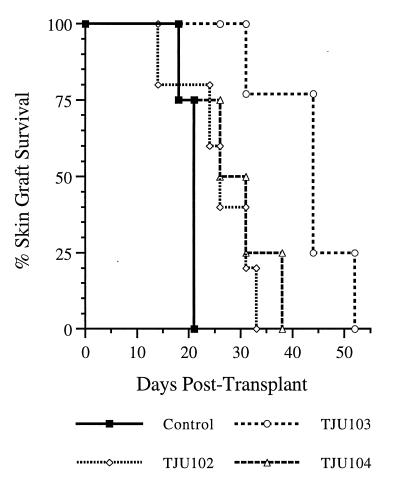
Efficacy of the three selected organic compounds on allograft skin rejection. B6 mice were transplanted with either syngeneic or allogeneic (bm12) skin grafts. The compounds were injected 3 hr before transplantation at a dosage of 50 μg in 0.2 ml 0.25% DMSO. For all groups n = 4, except for TJU102 (n = 5).
Figure 6
Figure 6
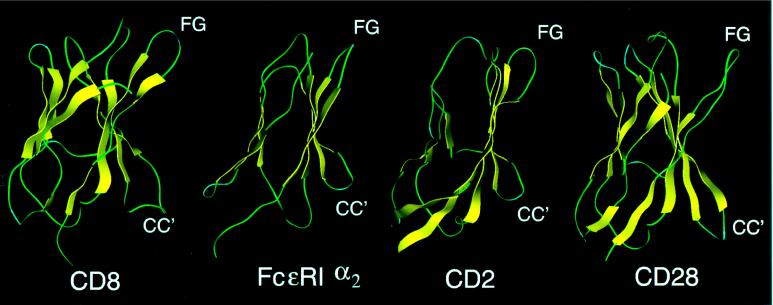
Surface-binding pockets consisting of FG and CC′ loops observed in: CD8α, which mediates dimerization (35); FcɛRIα2, which is the domain of IgE high- affinity receptor that binds IgE (36); CD2, which binds LFA-3 (37); and CD28, which binds CD80/86 (38). These surface interaction sites show a similar feature to that of the CD4 protein as shown in Fig. 1. The structure of FcɛRIα2 was modeled based on the crystal structures of CD2 domain 2 (37) and CD4 domain 2 (12). The structure of CD28 was modeled by using the crystal structure of the VH chain of HYHEL-5 Fab (39).

References

    1. Janin J, Chothia C. J Biol Chem. 1990;265:16027–16030. - PubMed
    1. Davies D R, Padlan E A, Sheriff S. Annu Rev Biochem. 1990;59:439–473. - PubMed
    1. Clackson T, Wells J A. Science. 1995;267:383–386. - PubMed
    1. Livnah O, Stura E A, Johnson D L, Middleton S A, Mulcahy L S, Wrighton N C, Dower W J, Jolliffe L K, Wilson I A. Science. 1996;273:464–471. - PubMed
    1. Williams A F, Barclay A N. Annu Rev Immunol. 1988;6:381–405. - PubMed

Publication types

MeSH terms

Substances