Comparative Study
. 1997 Jan 7;94(1):109-14.
doi: 10.1073/pnas.94.1.109.

Cloning and characterization of a functional human homolog of Escherichia coli endonuclease III

Affiliations
Comparative Study

Cloning and characterization of a functional human homolog of Escherichia coli endonuclease III

R Aspinwall et al. Proc Natl Acad Sci U S A. .

Abstract

Repair of oxidative damage to DNA bases is essential to prevent mutations and cell death. Endonuclease III is the major DNA glycosylase activity in Escherichia coli that catalyzes the excision of pyrimidines damaged by ring opening or ring saturation, and it also possesses an associated lyase activity that incises the DNA backbone adjacent to apurinic/apyrimidinic sites. During analysis of the area adjacent to the human tuberous sclerosis gene (TSC2) in chromosome region 16p13.3, we identified a gene, OCTS3, that encodes a 1-kb transcript. Analysis of OCTS3 cDNA clones revealed an open reading frame encoding a predicted protein of 34.3 kDa that shares extensive sequence similarity with E. coli endonuclease III and a related enzyme from Schizosaccharomyces pombe, including a conserved active site region and an iron/sulfur domain. The product of the OCTS3 gene was therefore designated hNTH1 (human endonuclease III homolog 1). The hNTH1 protein was overexpressed in E. coli and purified to apparent homogeneity. The recombinant protein had spectral properties indicative of the presence of an iron/sulfur cluster, and exhibited DNA glycosylase activity on double-stranded polydeoxyribonucleotides containing urea and thymine glycol residues, as well as an apurinic/apyrimidinic lyase activity. Our data indicate that hNTH1 is a structural and functional homolog of E. coli endonuclease III, and that this class of enzymes, for repair of oxidatively damaged pyrimidines in DNA, is highly conserved in evolution from microorganisms to human cells.


Figures
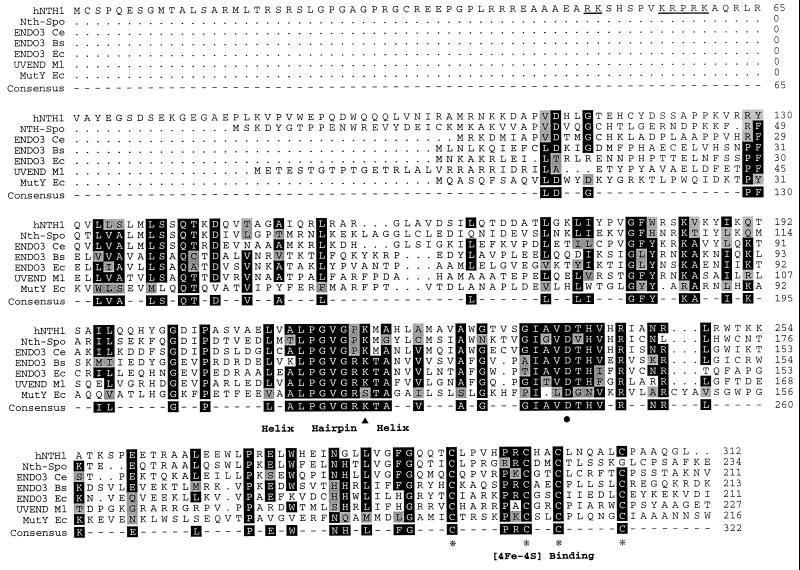
Figure 1
Figure 1
A comparison of the sequences (species code and GenBank accession no. in brackets) of endonuclease III-like proteins of human (hNTH1), S. pombe (Nth-Spo; Q09907), Caenorhabditis elegans (Ce; Z50874), Bacillus subtilis (Bs; P39788), and E. coli (Ec; P20625); UV N-glycosylase from Micrococcus luteus (Ml; P46303) and Mut Y of E. coli (Ec; P17802). The cysteine residues (Cys-Xaa6-Cys-Xaa2-Cys-Xaa5-Cys) involved in binding the [4Fe-4S] cluster are marked with asterisks. The S. pombe endonuclease III homolog, Nth-Spo (13), has the last cysteine displaced by two residues. The highly conserved helix–hairpin–helix motif, which is thought to interact with DNA, is indicated. The hairpin consists of GVG, usually flanked by P. The proposed active site lysine residue is indicated by a solid triangle and the conserved aspartic acid is marked with a dot. The potential nuclear targeting sequences in the N-terminal domain of the human protein are underlined. Positions with a majority of identical residues are boxed (black) and shown in the consensus. Amino acids similar to the consensus are shaded grey. The C-terminal regions that extend beyond the termini of the human and E. coli proteins are not shown.
Figure 2
Figure 2
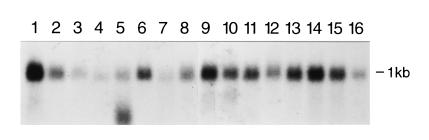
Northern blot analysis of mRNA (2 μg) from human tissues. Lanes: 1, heart; 2, brain; 3, placenta; 4, lung; 5, liver; 6, skeletal muscle; 7, kidney; 8, pancreas; 9, spleen; 10, thymus; 11, prostate; 12, testis; 13, ovary; 14, small intestine; 15, colon; 16, leukocytes. The ubiquitously expressed OCTS3 mRNA is ≈1.0 kb. The smaller product (≈0.5 kb) present only in liver may be due to alternative splicing or specific degradation (although other probes detected no degradation of the RNA in this sample).
Figure 3
Figure 3
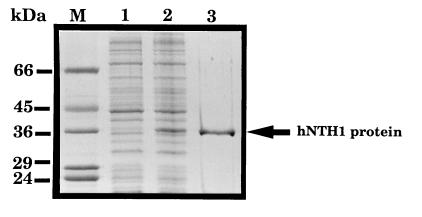
Purification of recombinant hNTH1 protein. A Coomassie blue-stained SDS/polyacrylamide gel is shown of a lysate of BL21 cells containing the pET14b/hNTH1 plasmid before (lane 1) and after (lane 2) induction of hNTH1 protein expression by isopropyl β-d-thiogalactoside. The hNTH1 protein eluting from the nickel-chelate column in the presence of 1 M imidazole is in lane 3, and is indicated on the right. Lane M contains molecular mass standards (Sigma) as indicated on the left.
Figure 4
Figure 4
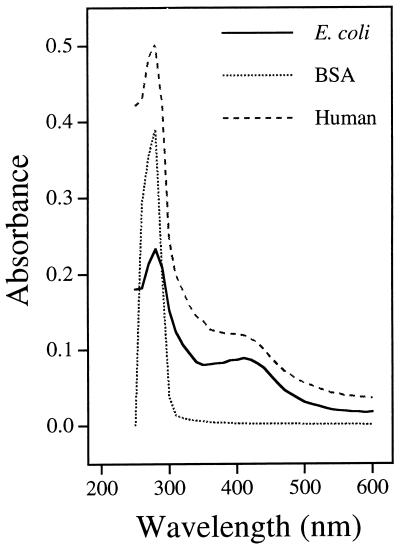
Absorption spectra in the 415 nm range of purified E. coli endonuclease III and hNTH1 proteins. BSA is shown as a control.
Figure 5
Figure 5
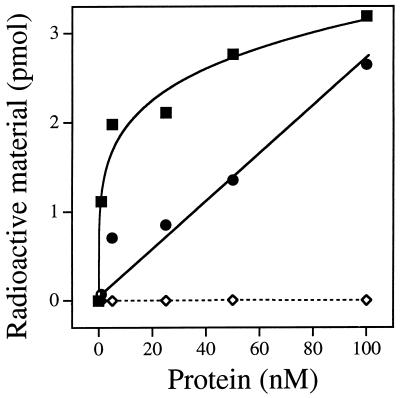
Enzymatic release of urea and thymine glycol by the DNA glycosylase activity of the hNTH1 protein. A poly(dA, [2-14C]dT) polymer was treated with KMnO4 (▪) or OsO4 (•) or was left untreated (◊), and then annealed with a complementary poly(dT) strand before use as enzyme substrate. The DNA was incubated at 37°C with increasing amounts of hNTH1 protein for 30 min under standard conditions. Radioactive material in an aliquot (300 μl) of the ethanol-soluble fraction was measured by scintillation counting.
Figure 6
Figure 6
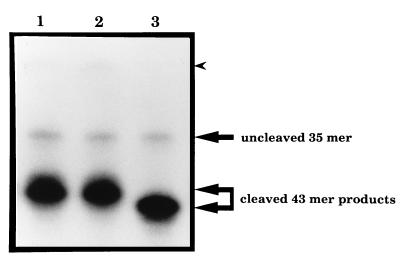
AP lyase activity of hNTH1. Analysis of the products of the AP site incision activity of hNTH1 (lane 1), E. coli endonuclease III (lane 2), and HAP1 (lane 3) proteins. The positions of the uncleaved 35-mer oligonucleotide, and the products of cleavage of the 43-mer containing a single AP site are indicated on the right. The unannotated arrow head indicates the position where the uncleaved 43-mer would migrate.

References

    1. Ames B N, Gold L S. Mutat Res. 1991;250:3–16. - PubMed
    1. Martin G M, Austad S N, Johnson T E. Nat Genet. 1996;13:25–34. - PubMed
    1. Demple B, Harrison L. Annu Rev Biochem. 1994;63:915–948. - PubMed
    1. Seeberg E, Eide L, Bjoras M. Trends Biochem Sci. 1995;20:391–396. - PubMed
    1. Cunningham R P, Weiss B. Proc Natl Acad Sci USA. 1985;82:474–478. - PMC - PubMed

Publication types

MeSH terms

Associated data