. 1996 Dec 24;93(26):15119-23.
doi: 10.1073/pnas.93.26.15119.

The N-terminal domain of a K+ channel beta subunit increases the rate of C-type inactivation from the cytoplasmic side of the channel

Affiliations

The N-terminal domain of a K+ channel beta subunit increases the rate of C-type inactivation from the cytoplasmic side of the channel

M J Morales et al. Proc Natl Acad Sci U S A. .

Abstract

Voltage-gated K+ channels are complexes of membrane-bound, ion-conducting alpha and cytoplasmic ancillary (beta) subunits. The primary physiologic effect of coexpression of alpha and beta subunits is to increase the intrinsic rate of inactivation of the alpha subunit. For one beta subunit, Kv beta 1.1, inactivation is enhanced through an N-type mechanism. A second beta subunit, Kv beta 1.2, has been shown to increase inactivation, but through a distinct mechanism. Here we show that the degree of enhancement of Kv beta 1.2 inactivation is dependent on the amino acid composition in the pore mouth of the alpha subunit and the concentration of extracellular K+. Experimental conditions that promote C-type inactivation also enhance the stimulation of inactivation by Kv beta 1.2, showing that this beta subunit directly stimulates C-type inactivation. Chimeric constructs containing just the nonconserved N-terminal region of Kv beta 1.2 fused with an alpha subunit behave in a similar fashion to coexpressed Kv beta 1.2 and alpha subunit. This shows that it is the N-terminal domain of Kv beta 1.2 that mediates the increase in C-type inactivation from the cytoplasmic side of the pore. We propose a model whereby the N terminus of Kv beta 1.2 acts as a weakly binding "ball" domain that associates with the intracellular vestibule of the alpha subunit to effect a conformational change leading to enhancement of C-type inactivation.


Figures
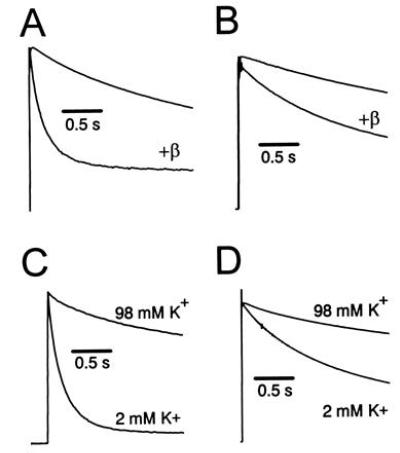
Figure 1
Figure 1
Kvβ1.2 causes a [K+]o-sensitive increase in the rate of inactivation of α subunits. (A) Effects of coexpression of Kvβ1.2 with FK1Δ2-146. Current traces are in response to a depolarizing pulse to +50 mV from a holding potential of −90 mV. Currents shown in this and subsequent figures were normalized to peak current for purposes of comparison. (B) Effects of coexpression of Kvβ1.2 with ShBΔ6-46. (C) [K+]o sensitivity of coexpression of Kvβ1.2 with FK1Δ2-146. Peak current values at +50 mV in 2 mM [K+]o were 3.9 ± 1.5 μA for FK1Δ2-146 plus Kvβ1.2. (D) [K+]o sensitivity of coexpression of Kvβ1.2 with ShBΔ6-46. Peak current value at +50 mV in 2 mM [K+]o was 8.30 ± 0.19 μA.
Figure 2
Figure 2
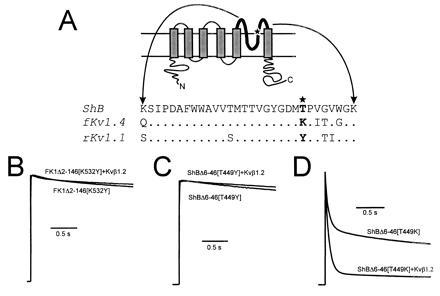
Kvβ1.2 influence on the rate of C-type inactivation rate in the presence of pore mouth mutations that affect C-type inactivation. (A Upper) Schematic representation of a voltage gated K+ channel 6-membrane spanning domain structure. The bold line represents the pore forming domain, with the star showing the approximate position of the pore mouth mutations. (Bottom) Alignments of the amino acid sequence of the pore regions from ShB (24), ferret Kv1.4 (15), and rat Kv1.1 (25). Mutations that alter the rate of C-type inactivation were constructed at position 449 in Shaker and 532 in fKv1.4 (★). (B) Coexpression of Kvβ1.2 with FK1Δ2-146[K532Y] had no effect on inactivation rate (P > 0.25). (C) Coexpression of Kvβ1.2 with ShBΔ6-46[T449Y] also had no effect on inactivation rate (P > 0.25). (D) ShBΔ6-46[T449K] mutation greatly increased the rate of C-type inactivation. Total inactivation measured at 100 ms increased 1.4 fold (Table 1; P < 0.05) in response to Kvβ1.2 coexpression. All current traces shown are in response to a depolarizing pulse to +50 mV from a holding potential of −90 mV. Peak current values measured at +50 mV in 2 mM [K+]o were 5.6 ± 1.6 μA for FK1Δ2-146[K532Y], 21 ± 4 μA for ShBΔ2-46[T449Y], 3.4 ± 1.2 μA for FK1Δ2-146[K532Y] plus Kvβ1.2, 28 ± 8 μA for ShBΔ2-46[T449Y] plus Kvβ1.2, 17 ± 1 μA for ShBΔ2-46[T449K], and 19 ± 3 μA for ShBΔ2-46[T449K] plus Kvβ1.2.
Figure 3
Figure 3
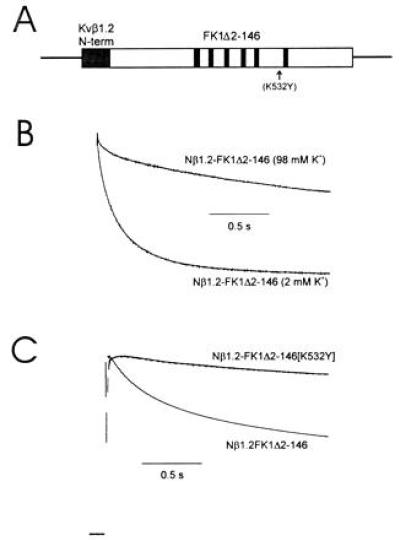
The N-terminal domain of Kvβ1.2 increases the rate of C-type inactivation of FK1. (A) Diagram of the Kvβ1.2–FK1 chimeric construct. Amino acids 1–79 were spliced to the N terminus of FK1Δ2-146 (B and C) or FK1Δ2-146[532Y] (C). (B) The chimeric construct between Kvβ1.2 and FK1 showed an increased rate of inactivation which was sensitive to an increase of [K+]o. (C) Inactivation of the chimeric construct was greatly slowed by a mutation in the pore region (K532Y) that largely removed C-type inactivation. Current traces shown are in response to a depolarizing pulse to +50 mV from a holding potential of −90 mV. Currents were normalized to peak current for purposes of comparison of inactivation rates. Peak current values measured at +50 mV in 2 mM [K+]o were 11 ± 3.5 μA for the chimera and 21 ± 4 μA for the mutant chimera.
Figure 4
Figure 4
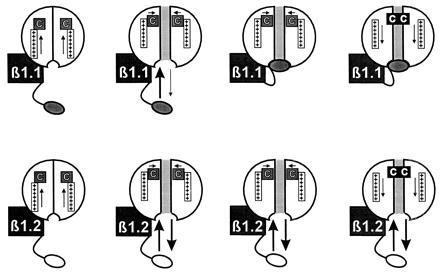
Proposed mechanism of action of Kvβ1.2. The N-terminal domain of Kvβ1.2 promotes C-type inactivation by binding rapidly to the intracellular vestibule, resulting in conformational changes favorable to C-type inactivation and/or reducing K+ occupancy in the pore. Unbinding may occur before attainment of the C-type inactivated conformation because it is relatively low affinity compared with conventional N-terminal domains.

References

    1. Chandy K G, Gutman G A. In: Handbook of Receptors and Channels: Ligand and Voltage-Gated Ion Channels. North R A, editor. Boca Raton, FL: CRC; 1995. pp. 1–71.
    1. Scott V E S, Rettig J, Parcej D N, Keen J N, Findlay J B C, Pongs O, Dolly J O. Proc Natl Acad Sci USA. 1994;91:1637–1641. - PMC - PubMed
    1. Rettig J, Heinemann S H, Wunder F, Lorra C, Parcej D N, Dolly J O, Pongs O. Nature (London) 1994;369:289–294. - PubMed
    1. Morales M J, Castellino R C, Crews A L, Rasmusson R L, Strauss H C. J Biol Chem. 1995;270:6272–6277. - PubMed
    1. Majumder K, De Biasi M, Wang Z, Wible B A. FEBS Lett. 1995;361:13–16. - PubMed

Publication types

MeSH terms

LinkOut - more resources