. 1997 Jan 21;94(2):407-11.
doi: 10.1073/pnas.94.2.407.

Conferring RNA polymerase activity to a DNA polymerase: a single residue in reverse transcriptase controls substrate selection

Affiliations

Conferring RNA polymerase activity to a DNA polymerase: a single residue in reverse transcriptase controls substrate selection

G Gao et al. Proc Natl Acad Sci U S A. .

Abstract

The traditional classification of nucleic acid polymerases as either DNA or RNA polymerases is based, in large part, on their fundamental preference for the incorporation of either deoxyribonucleotides or ribonucleotides during chain elongation. The refined structure determination of Moloney murine leukemia virus reverse transcriptase, a strict DNA polymerase, recently allowed the prediction that a single amino acid residue at the active site might be responsible for the discrimination against the 2'OH group of an incoming ribonucleotide. Mutation of this residue resulted in a variant enzyme now capable of acting as an RNA polymerase. In marked contrast to the wild-type enzyme, the K(m) of the mutant enzyme for ribonucleotides was comparable to that for deoxyribonucleotides. The results are consistent with proposals of a common evolutionary origin for both classes of enzymes and support models of a common mechanism of nucleic acid synthesis underlying catalysis by all such polymerases.


Figures
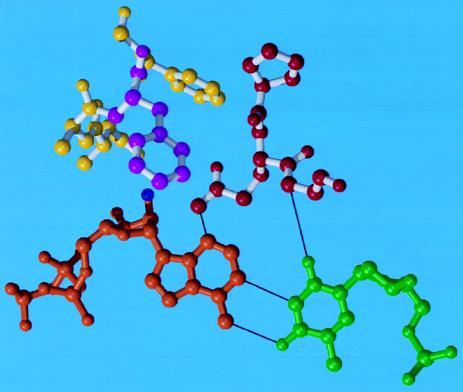
Figure 1
Figure 1
Modeling of interactions between the MMLV RT, DNA, and rATP at the polymerase active site. A ball-and-stick representation of the minor groove hydrogen-bonding interactions is shown for the modeled ternary complex. Residues 189–191 are shown in red, residues 153, 154, and 156 in yellow, F155 in magenta, rATP in orange, and dT in green. F155 is shown directly below the 2′OH of rATP, serving to discriminate between ribose- and deoxyribose-containing nucleotides.
Figure 2
Figure 2
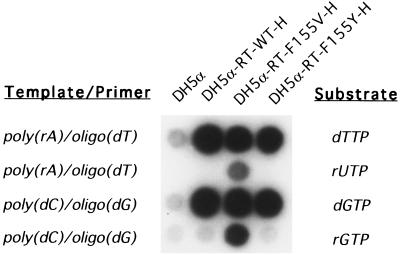
RT-F155V-H can incorporate rUTP or rGTP into products, using poly(rA)/oligo(dT) or poly(dC)/oligo(dG) as template/primer. Reactions were performed with the indicated template/primer, enzymes, and labeled substrates, and elongated products were assayed by spotting on DE81 paper, washing, and autoradiography. Mutant RT-F155V-H was uniquely able to incorporate ribonucleotides.
Figure 3
Figure 3
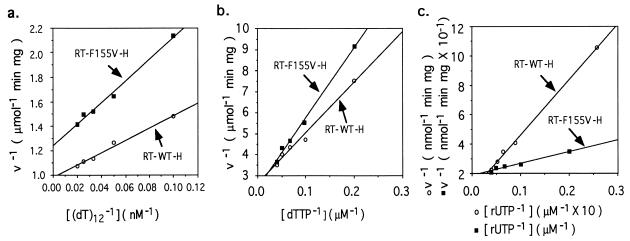
Kinetic analysis of RT-WT-H and RT-F155V-H. (a) Various concentrations of oligo(dT)12 primer were annealed to 15 μg/ml poly(rA) template in a reaction buffer containing 60 mM Tris·HCl (pH 8.0), 75 mM NaCl, 0.7 mM MgCl2, 5 mM DTT, 100 μM dTTP, and 20 μCi/ml [32P]dTTP. Reactions were initiated by adding 800 ng/ml purified enzyme. Data points were taken at 20-sec intervals. (b) Reactions were performed in the presence of 15 μg/ml poly(rA), 7.5 μg/ml oligo(dT), 800 ng/ml enzyme, and various concentrations of dTTP and [32P]dTTP. Data points were taken at 20-sec intervals. (c) Reactions were performed in the presence of 15 μg/ml poly(rA), 7.5 μg/ml oligo(dT), 8 μg/ml enzyme, and various concentrations of rUTP and [32P]rUTP. Data points were taken at intervals of 2 min (for RT-WT-H) or 20 sec (for RT-F155V-H).
Figure 4
Figure 4
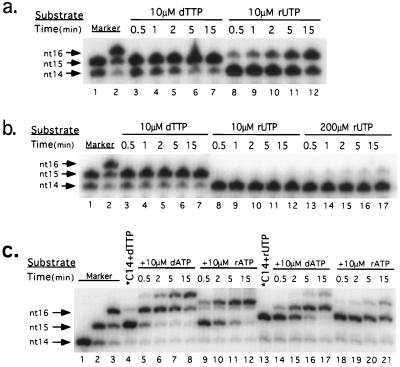
Both incorporation and extension of incorporated ribonucleotides by RT-F155V-H are slower than for deoxyribonucleotides. 5′ end radiolabeled 14-mer DNA primer was annealed to a 17-mer DNA template at a 1:1 ratio. (a) The primer was extended by RT-F155V-H using either 10 μM dTTP or rUTP as a substrate. At the indicated time points, an aliquot of the reaction was removed and analyzed by gel electrophoresis. (b) The primer was extended by RT-WT-H in the presence of 10 μM dTTP, 10 μM rUTP, or 200 μM rUTP. (c) The 14-mer primer was first extended by either 10 μM dTTP or 10 μM rUTP to completion. The extended 15-mer primers were then further extended by adding either 10 μM dATP or 10 μM rATP to the reaction. Markers were generated by extending *C14 with ddTTP (nt15) or dTTP plus ddATP (nt16). Products with ribonucleotides at the 3′ terminus migrated more slowly than those with deoxyribonucleotides at the terminus. The bands migrating at the position of nt17 (lanes 5–8 and 15–17) presumably resulted from untemplated extension of dATP at the last nucleotide of the template.
Figure 5
Figure 5
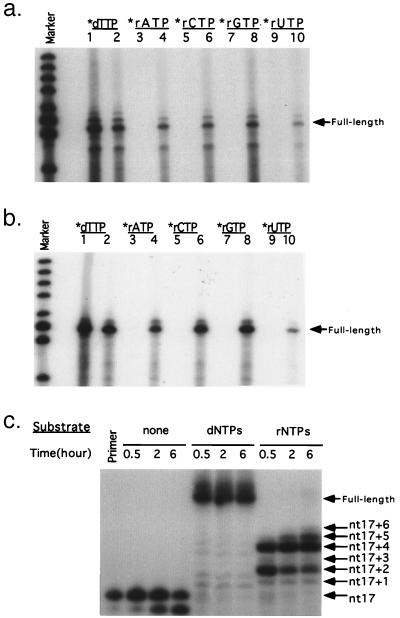
RT-F155V-H incorporates ribonucleotides into products. (a) A short primer was extended by RT-WT-H (lanes 1, 3, 5, 7, and 9) or RT-F155V-H (lanes 2, 4, 6, 8, and 10) on a long single-stranded RNA template in the presence of a mixture of four dNTPs and radiolabeled nucleotides as indicated. (b) Similar experiment on a single-stranded DNA template. (c) End-labeled P17 oligonucleotide primer was extended by RT-F155V-H on T28 oligonucleotide template using either four dNTPs or rNTPs as substrates.

References

    1. Kornberg A. DNA Synthesis. San Francisco: Freeman; 1974.
    1. Kornberg A, Baker T A. DNA Replication. New York: Freeman; 1991.
    1. Delarue M, Poch O, Tordo N, Moras D, Argos P. Protein Eng. 1990;3:461–467. - PubMed
    1. McAllister W T, Raskin C A. Mol Microbiol. 1993;10:1–6. - PubMed
    1. Arnold E, Ding J, Hughes S H, Hostomsky Z. Curr Opin Struct Biol. 1995;5:27–38. - PubMed

Publication types

LinkOut - more resources