. 1997 Jan 21;94(2):634-9.
doi: 10.1073/pnas.94.2.634.

Interferon-alpha/beta inhibition of interleukin 12 and interferon-gamma production in vitro and endogenously during viral infection

Affiliations

Interferon-alpha/beta inhibition of interleukin 12 and interferon-gamma production in vitro and endogenously during viral infection

L P Cousens et al. Proc Natl Acad Sci U S A. .

Abstract

Interferon (IFN)-alpha/beta-mediated negative regulation of interleukin 12 (IL-12) and IFN-gamma proteins is reported here. Both IFN-alpha and IFN-beta inhibited fixed Staphylococcus aureus Cowan strain induction of IL-12 and IFN-gamma production by mouse splenic leukocytes in culture. Extended studies with IFN-alpha demonstrated that inhibition was at the level of biologically active IL-12 p70. Effects were selective, as induction of tumor necrosis factor was unaffected and induction of IL-6 was enhanced. Neutralization of IFN-alpha/beta expressed endogenously during infections with murine cytomegalovirus (MCMV) enhanced early IL-12 and IFN-gamma protein production. Furthermore, during infections of mice with lymphocytic choriomeningitis virus (LCMV), this treatment revealed a previously undetected early IL-12 and IFN-gamma protein expression, and mice deficient in IFN-alpha/beta receptor function, but not control mice, also expressed endogenous LCMV-induced IL-12. The effects of IFN-alpha/beta neutralization on production of IL-12 and IFN-gamma during the viral infections were detected in both serum samples and medium conditioned with splenic leukocytes isolated from infected animals. In vitro studies demonstrated that splenic leukocytes isolated from LCMV-infected mice were primed to produce IL-12 in response to stimulation with Staphylococcus aureus Cowan strain, but that this responsiveness was sensitive to added IFN-alpha. Moreover, endogenous IFN-alpha/beta induced by LCMV inhibited in vivo lipopolysaccharide stimulation of IL-12 production. These results demonstrate a new pathway for regulating cytokine responses, and suggest a mechanism for inhibition of IL-12-dependent immune responses during viral infections.


Figures
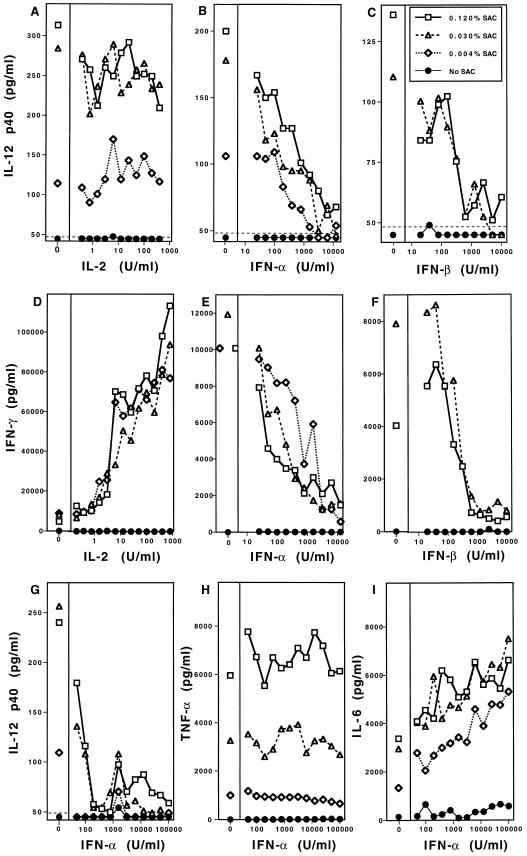
Figure 1
Figure 1
IFN-α/β inhibition of IL-12 and IFN-γ protein production in vitro. The effects of IFN-α, IFN-β, or IL-2 on SAC-induced IL-12, IFN-γ, TNF, and IL-6 production were examined in culture after 24 hr stimulation of 1 × 10⁶ splenic leukocytes isolated from C57BL/6 mice. Stimulation with SAC was carried out with 0.12% (□), 0.03% (▵), and 0.004% (⋄), or no (•) SAC as specified. Serial dilutions of purified natural IFN-α, IFN-β, or human recombinant IL-2 were added to the test conditions as indicated. Culture supernatant fluids were prepared, and production of IL-12 p40, IFN-γ, TNF, or IL-6 was determined by specific protein ELISA. The following are shown: IL-2 effects on SAC-induced IL-12 p40 (A), IFN-α (B) and IFN-β (C) effects on SAC-induced IL-12 p40, IL-2 effects on SAC-induced IFN-γ (D), IFN-α (E) and IFN-β (F) effects on SAC-induced IFN-γ production, and IFN-α effects on SAC-induced IL-12 p40 (G), TNF (H), and IL-6 (I). The confidence limit of detection for assays is indicated (dotted line).
Figure 2
Figure 2
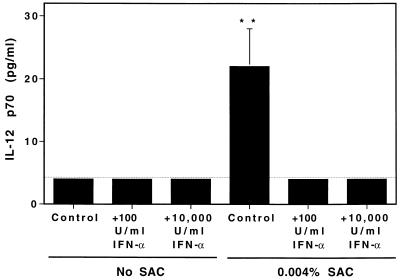
Effect of IFN-α on production of biologically active IL-12 p70 in vitro. The effects of IFN-α on SAC-induced IL-12 p70 production were examined in culture after 24 hr of stimulation of 1 × 10⁶ splenic leukocytes isolated from C57BL/6 mice. Stimulation with SAC was carried out with 0.004% or no SAC as specified. Purified natural IFN-α at concentrations of 100 units/ml or 10,000 units/ml were added to the test conditions as indicated. Culture supernatant fluids were prepared, and production of IL-12 p70 was determined by bioassay. Results shown are means of four mice per group ± SE. Differences between SAC stimulation of IL-12 p70 in the absence of IFN-α and in the presence of either 100 or 10,000 units/ml IFN-α are significant by the Student’s t test. ∗∗, P < 0.05.
Figure 3
Figure 3
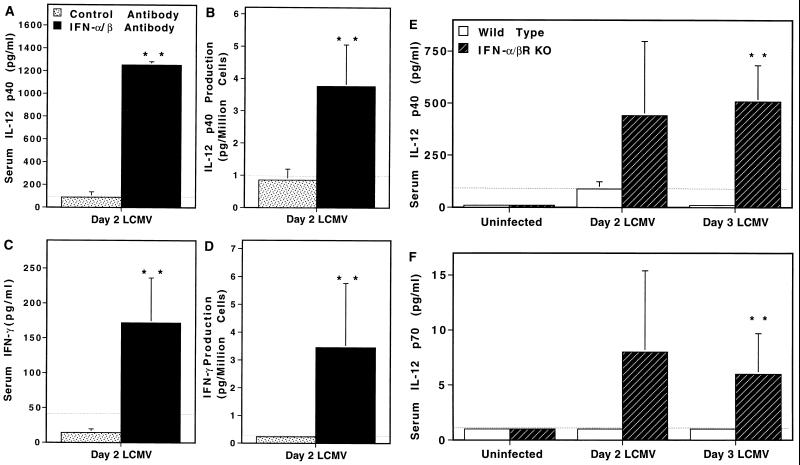
Effects of endogenous IFN-α/β on IL-12 and IFN-γ expression during LCMV infection. IFN-α/β functions were evaluated by either treatment with neutralizing antibody (AD) or in IFN-α/βR KO mice (E and F). Mice were infected with 2 × 10⁴ plaque-forming units Armstrong strain LCMV clone E350. Serum samples were collected and splenic leukocytes were harvested from uninfected and infected mice at times indicated. Conditioned medium were prepared with splenic leukocytes at 107 cells/ml of medium for 24 hr, and supernatant fluids were harvested and concentrated. IL-12 p40 and IFN-γ protein levels were measured by specific ELISA, and IL-12 p70 was measured with a capture bioassay. The confidence limit of detection for each assay is indicated (· · ·). C57BL/6 mice were treated with neutralizing sheep antibody to IFN-α/β (▪) or control sheep IgG (□) 3 hr before infection (AD). The following are shown: (A) IL-12 p40 in serum samples from three mice per group; (B) IL-12 p40 in conditioned medium samples from three mice per group; (C) IFN-γ in serum from six mice per group; (D) IFN-γ in conditioned medium samples from six mice per group. Wild-type 129 (□) and IFN-α/βR KO (▪) mice were infected with LCMV for 0, 2, or 3 days, four mice per group (E and F). Shown are IL-12 levels in serum samples, quantitated by IL-12 p40-specific ELISA (E) and IL-12 p70 bioassay (F). Results are means ± SE. The differences between the samples from anti-IFN-α/β- and control-treated (AD), or IFN-α/β RKO and wild-type-infected mice (E and F) were significant by Student’s t test. ∗∗, P < 0.05.
Figure 4
Figure 4
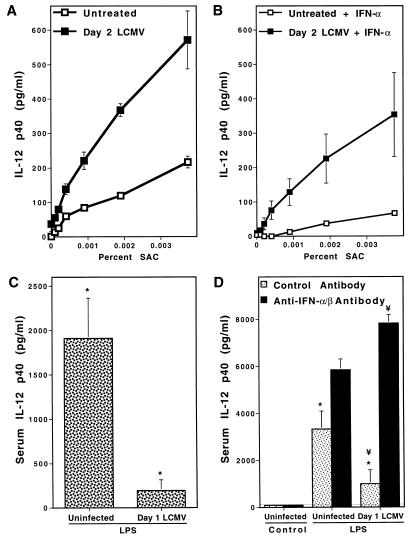
Effects of IFN-α/β during LCMV infection on cellular responsiveness to in vitro and in vivo stimulation of IL-12 production. Virus-induced IFN-α/β effects were examined in vitro by stimulating splenic leukocytes prepared from uninfected or LCMV-infected C57BL/6 mice with SAC, and evaluating IL-12 production (A and B). Cells, isolated from untreated (□) or day 2 LCMV-infected (▪) mice, were stimulated in vitro with 2-fold serial dilutions of SAC (0.12–0.001%) alone (A) or in the presence of 104 units/ml of IFN-α (B). Supernatant fluids were harvested after 24 hr and IL-12 p40 was measured by ELISA. In vivo responsiveness to a replication-independent stimulus of IL-12 in the context of virus-induced IFN-α/β was examined by administering 5 μg of S. enteriditis-derived LPS to uninfected or day 1 LCMV-infected C57BL/6 mice (C and D). Serum samples were prepared for IL-12 p40 by ELISA at 4 hr after LPS administration. Uninfected and infected mice treated with PBS only did not produce significant levels of serum IL-12 p40 (data not shown). Means ± SE of results from three mice per group are shown for all experiments. In vivo IL-12 induction by LPS in uninfected and day 1 LCMV-infected mice is shown (C). The role of endogenous IFN-α/β for inhibition of IL-12 stimulation in LCMV-infected mice was examined by treating uninfected and day 1 LCMV-infected mice with control antibody (□) or anti-IFN-α/β (▪) (D). Samples from uninfected and infected mice given LPS (C and D) were significantly different (∗), as were those from anti-IFN-α/β- compared with control-treated mice given LPS one day after LCMV infection (¥) as determined by a Student’s t test (P < 0.05) (D).

References

    1. Trinchieri G. Blood. 1994;84:4008–4027. - PubMed
    1. Biron C A. Curr Opin Immunol. 1994;6:530–538. - PubMed
    1. Biron C A, Gazzinelli R T. Curr Opin Immunol. 1995;7:485–496. - PubMed
    1. Orange J S, Wolf S F, Biron C A. J Immunol. 1994;152:1253–1264. - PubMed
    1. Orange J S, Salazar-Mather T P, Opal S M, Spencer R L, Miller A H, McEwen B S, Biron C A. J Exp Med. 1995;181:901–914. - PMC - PubMed

LinkOut - more resources