Elevated plasma gamma-aminobutyric acid (GABA) levels in individuals with either Prader-Willi syndrome or Angelman syndrome
- PMID: 9017532
- PMCID: PMC5972534
- DOI: 10.1176/jnp.9.1.75
Elevated plasma gamma-aminobutyric acid (GABA) levels in individuals with either Prader-Willi syndrome or Angelman syndrome
Abstract
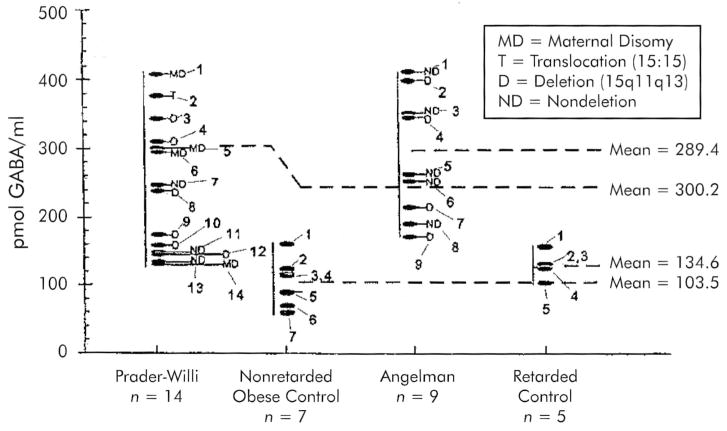
Plasma gamma-aminobutyric acid (GABA) levels were measured in 14 subjects with Prader-Willi syndrome, 9 subjects with Angelman syndrome, and matched control subjects. Mean levels in both patient groups were 2 to 3 times higher than in nonretarded moderately obese or retarded nonobese control subjects. Levels in each patient group differed significantly from both control groups. Neither the two patient groups nor the two control groups differed. GABA levels seemed unrelated to genetic status (chromosome 15 deletion or disomy). These preliminary findings of elevated plasma GABA levels possibly represent a compensatory increase in presynaptic GABA release in response to hyposensitivity of a subset of GABA receptors and could produce increased postsynaptic activation of other normal GABA receptor subtypes, resulting in complex alterations of GABAergic function throughout the brain.
Figures
References
-
- Prader A, Labhart A, Willi H. Ein Syndrome von Adipoitas, Kleinwuchs, Kryptochismus und Oligophrenie nach myatonieartigem Zustand in Neugeborenenalter [Syndrome of adiposity, short stature, cryptorchidism, and mental retardation after hypotonia in the newborn period] Schweiz Med Wochenschr. 1956;86:1260–1261.
-
- Butler MG. Prader-Willi and Angelman syndromes: examples of genetic imprinting in man. In: Seth PK, Seth S, editors. Human Genetics. New Delhi, India: Omega Scientific; 1993. pp. 185–200.
-
- Cassidy SB. Prader-Willi syndrome. Curr Probl Pediatr. 1984;14:1–55. - PubMed
Publication types
MeSH terms
Substances
Grants and funding
LinkOut - more resources
Full Text Sources
Other Literature Sources
Medical