


Death effector domain-containing herpesvirus and poxvirus proteins inhibit both Fas- and TNFR1-induced apoptosis
- PMID: 9037025
- PMCID: PMC19763
- DOI: 10.1073/pnas.94.4.1172
Death effector domain-containing herpesvirus and poxvirus proteins inhibit both Fas- and TNFR1-induced apoptosis
Abstract
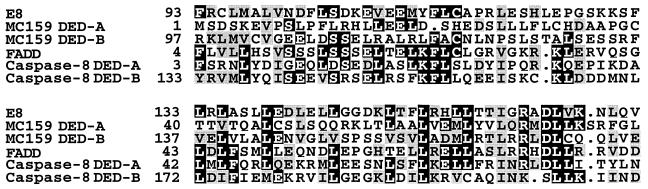
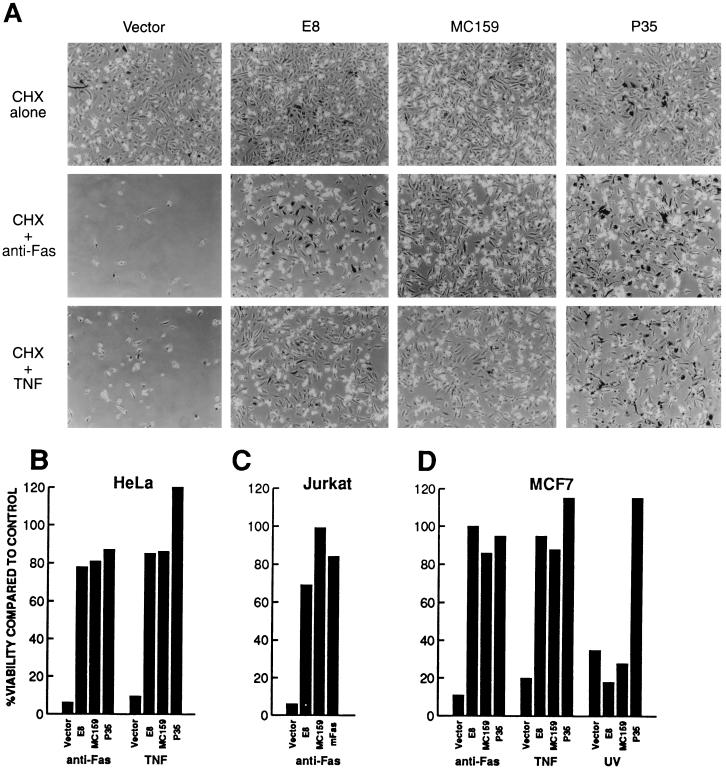
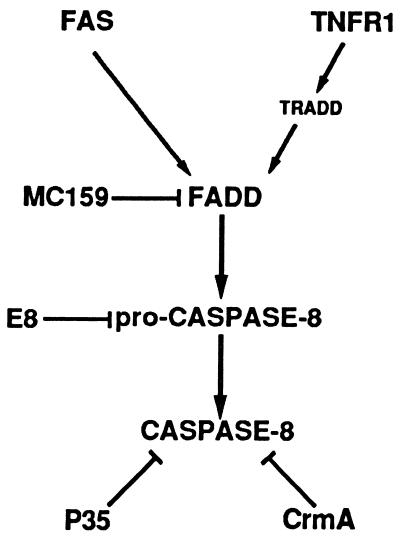
To identify novel antiapoptotic proteins encoded by DNA viruses, we searched viral genomes for proteins that might interfere with Fas and TNFR1 apoptotic signaling pathways. We report here that equine herpesvirus type 2 E8 protein and molluscum contagiosum virus MC159 protein both show sequence similarity to the death effector domains (DEDs) of the Fas/TNFR1 signaling components FADD and caspase-8. Yeast two-hybrid analysis revealed that E8 protein interacted with the caspase-8 prodomain whereas MC159 protein interacted with FADD. Furthermore, expression of either E8 protein or MC159 protein protected cells from Fas- and TNFR1-induced apoptosis indicating that certain herpesviruses and poxviruses use DED-mediated interactions to interfere with apoptotic signaling pathways. These findings identify a novel control point exploited by viruses to regulate Fas- and TNFR1-mediated apoptosis.
Figures
References
-
- Henkart P A. Immunology. 1996;4:195–201. - PubMed
-
- Alnemri E S, Livingston D J, Nicholson D W, Salvesen G, Thornberry N A, Wong W W, Yuan J. Cell. 1996;87:171. - PubMed
-
- Boldin M P, Goncharov T M, Goltsev Y V, Wallach D. Cell. 1996;85:803–815. - PubMed
-
- Muzio M, Chinnaiyan A M, Kischkel F C, O’Rourke K, Shevchenko A, Ni J, Scaffidi C, Bretz J D, Zhang M, Gentz R, Mann M, Krammer P H, Peter M E, Dixit V M. Cell. 1996;85:817–827. - PubMed
Publication types
MeSH terms
Substances
LinkOut - more resources
Full Text Sources
Other Literature Sources
Research Materials
Miscellaneous
