. 1997 Feb 18;94(4):1344-9.
doi: 10.1073/pnas.94.4.1344.

Allergen-induced bronchial hyperreactivity and eosinophilic inflammation occur in the absence of IgE in a mouse model of asthma

Affiliations

Allergen-induced bronchial hyperreactivity and eosinophilic inflammation occur in the absence of IgE in a mouse model of asthma

P D Mehlhop et al. Proc Natl Acad Sci U S A. .

Abstract

In patients with asthma, elevations of IgE correlate both with allergic inflammation of the airways and with bronchial hyperreactivity (BHR). Several investigations, using mouse models of this disease, have indicated a central role for IgE in the pathogenesis of the eosinophilic inflammation as well as in the obstructive airway physiology of BHR. Some diagnostic studies and therapeutic strategies for asthma are based on the putative role of IgE in asthma pathogenesis. Here, we use mice with a null mutation of the C epsilon locus to show that bronchial inflammation and BHR in response to allergen inhalation both can occur in the absence of IgE. We demonstrate that the eosinophilic bronchial inflammation elicited in an established mouse model of hypersensitivity to Aspergillus fumigatus (Af) is accompanied by the asthmatic physiology of BHR. Wild-type and IgE-deficient mice were sensitized intranasally with Af extract. Both groups of animals developed bronchoalveolar lavage eosinophilia and pulmonary parenchymal eosinophilia. This was accompanied by increased serum levels of total and Af-specific IgE in the wild-type animals only. This Af-sensitization protocol resulted in significant BHR in both wild-type mice and IgE-deficient mice. Interestingly, unsensitized IgE-deficient mice had increased bronchial responsiveness compared with unsensitized wild-type controls. We conclude that BHR and airways inflammation can be fully expressed via IgE-independent mechanisms. These may involve the activation of mast cells by factors other than IgE as well as a mucosal lymphocyte-mediated immune response to allergen.


Figures
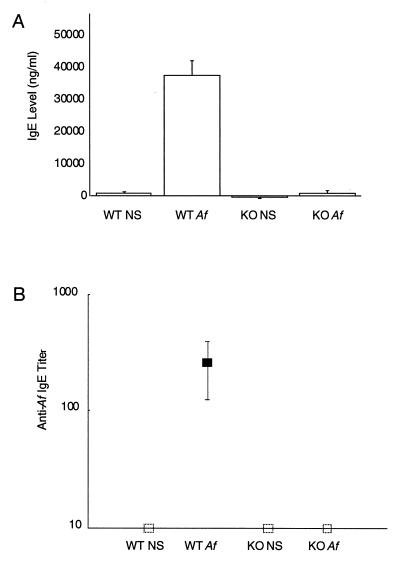
Figure 1
Figure 1
(A) Serum IgE levels in IgE-deficient (KO) and wild-type (WT) mice after treatment with NS or Af extract. Bars represent mean values for five mice within each treatment group ± SEM. (B) Heterologous PCA determination of anti-Af IgE. Titers represent the reciprocal of the greatest serum dilution giving a positive cutaneous reaction. Mean titers ± SEM are presented for the groups described in A. Open squares represent data groups in which no sera conferred a detectable reaction (titer <10).
Figure 2
Figure 2
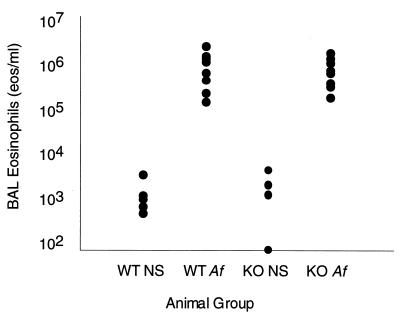
Eosinophil counts (eosinophils per ml) in BAL fluid from IgE-deficient (KO) and wild-type (WT) mice treated with NS or with Af extract. Each group includes 8–10 mice, and the data are combined from two independently performed experiments. (P < 0.01 for NS- vs. Af-treated groups for both WT and KO mice)
Figure 3
Figure 3
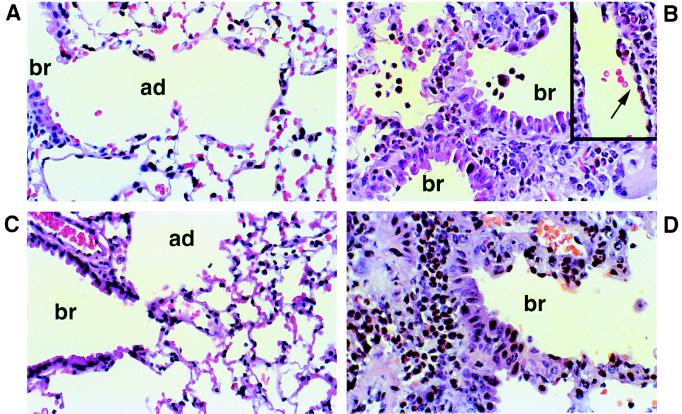
Lung histology from wild-type (WT) and IgE-deficient mice (KO) after treatment with NS or Af. (×600.) (A) WT mouse treated with NS. (B) WT mouse treated with intranasal Af extract shows a peribronchiolar inflammatory infiltrate consisting predominantly of eosinophils, admixed with lymphocytes. Involvement of the bronchiolar epithelium with associated epithelial damage is present. The airspaces contain numerous eosinophils and histiocytes. Vessels are surrounded by a cuff of inflammatory cells and contain marginating eosinophils with migration into the vessel wall (arrow in Inset). (C) KO mouse treated with NS. (D) KO mouse treated with intranasal Af shows essentially the same findings as those seen in WT mice. Br, bronchiole; ad, alveolar duct. These panels depict fields representative of the histology obtained from six or seven mice per group.
Figure 4
Figure 4
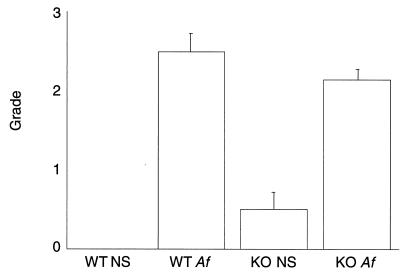
Intensity of pulmonary infiltrate in wild-type (WT) and IgE-deficient (KO) mice after treatment with NS or Af extract. The grading scheme is described in detail in the text. Each group contained six or seven animals. The average grade of the four groups of mice ± SEM is presented.
Figure 5
Figure 5
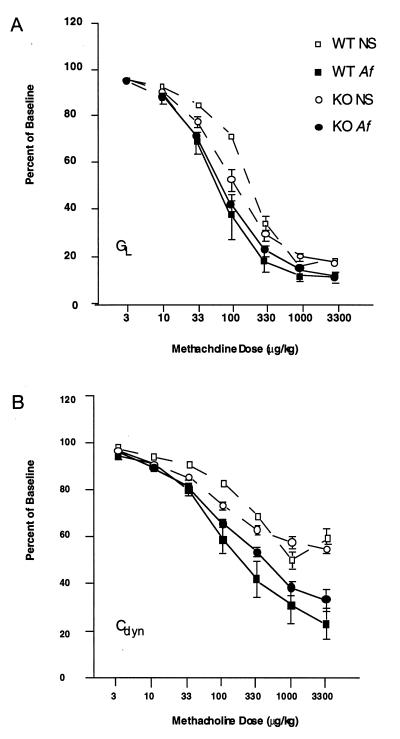
GL (A) and Cdyn (B)in IgE-deficient (KO) and wild-type (WT) mice after treatment with NS or Af extract. Treatment groups are WT NS (□), WTAf (▪), KO NS (○), and KO Af (•). After the establishment of baseline values, GL and Cdyn were determined after graded doses of i.v. methacholine. Individual points on each curve indicate the mean for each treatment group ± SEM (n = 4 for WT groups and 8–9 for KO groups). A two-way ANOVA was performed for the data used to derive these curves (treatment group and methacholine dose as independent variables and percent of baseline as dependent variable). Both GL and Cdyn responses to methacholine were significantly greater (P < 0.001) in Af-treated mice compared with NS-treated mice of the same (WT or KO) genotype. Both GL and Cdyn responses to methacholine were also significantly greater (P < 0.025) in NS-treated KO mice compared with NS-treated WT mice.

Comment in

  • Bronchial asthma: lessons from murine models.
    Gleich GJ, Kita H. Gleich GJ, et al. Proc Natl Acad Sci U S A. 1997 Mar 18;94(6):2101-2. doi: 10.1073/pnas.94.6.2101. Proc Natl Acad Sci U S A. 1997. PMID: 9122154 Free PMC article. Review. No abstract available.

References

    1. McFadden E R, Gilbert I A. N Engl J Med. 1992;327:1928–1937. - PubMed
    1. Hogg J C. J Allergy Clin Immunol. 1993;92:1–4. - PubMed
    1. Bentley A M, Menz G, Storz C, Robinson D S, Bradley B, Jeffery P K, Durham S R, Kay A B. Am Rev Respir Dis. 1992;146:500–506. - PubMed
    1. Burrows B, Martinez F D, Halonen M, Barbee R A, Cline M G. N Engl J Med. 1989;320:271–277. - PubMed
    1. Sears M R, Burrows B, Flannery E M, Herbison G P, Hewitt C J, Holdaway M D. N Engl J Med. 1991;325:1067–1071. - PubMed

Publication types

MeSH terms