Comparative Study
. 1997 Feb 18;94(4):1356-60.
doi: 10.1073/pnas.94.4.1356.

Identification of the B cell superantigen-binding site of HIV-1 gp120

Affiliations
Comparative Study

Identification of the B cell superantigen-binding site of HIV-1 gp120

S Karray et al. Proc Natl Acad Sci U S A. .

Abstract

Previous studies showed that the gp120 envelope protein of HIV-1 is able to crosslink membrane IgM on normal human B cells and to induce their activation in a V(H)3 immunoglobulin gene-family-specific manner. Because this V(H) gene family is the largest in the human repertoire, this superantigen (SAg) property is thought to have deleterious consequences for the host, including a progressive decline of B cells with progression of the HIV-1-induced disease. Here, we have identified the sequence motifs on gp120 involved in SAg binding to normal Igs. We show that this SAg-binding activity is present in gp120s from highly divergent isolates of HIV-1 belonging to clades derived from various geographical origins, and that carbohydrate residues are not essential for its expression. The SAg-binding site is formed by protein sequences from two regions of the gp120 molecule. The core motif is a discontinuous epitope spanning the V4 variable domain and the amino-terminal region flanking the C4 constant domain. The most critical residues appear to be Leu395-Asp397 and Ile425-Gln427. Residues from the C2 constant domain (positions 252-272) also seem to play an accessory role in SAg binding of gp120 to normal human Igs. These findings are important in the design of a successful gp120-based vaccine against HIV-1.


Figures
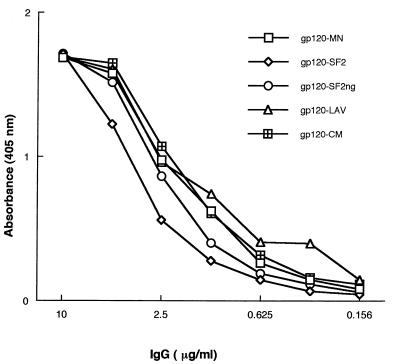
Figure 1
Figure 1
SAg binding of IgG SAU to rgp120s from different HIV-1 isolates. Microtiter wells were coated with 50 ng of rgp120s, and Ig binding was revealed by an alkaline phosphatase-labeled anti-IgG conjugate. The results are from one representative experiment. gp120-SF2 ng refers to an unglycosylated form of gp120SF2 that was heat inactivated.
Figure 2
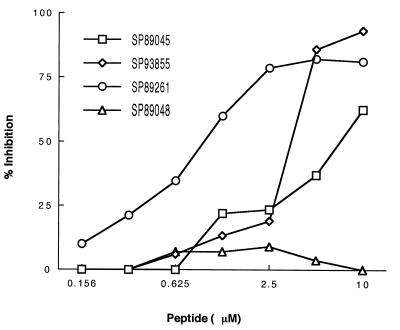
Figure 2
Inhibition of SAg binding by synthetic peptides from distant sites of gp120. Dilutions of the synthetic peptides were mixed with an equal volume of IgM LAN at a concentration that achieved 50% of maximal binding. After incubation, the mixtures were transferred to gp120MN-coated wells, and residual binding was revealed as indicated in the text. The results are from one representative experiment.
Figure 3
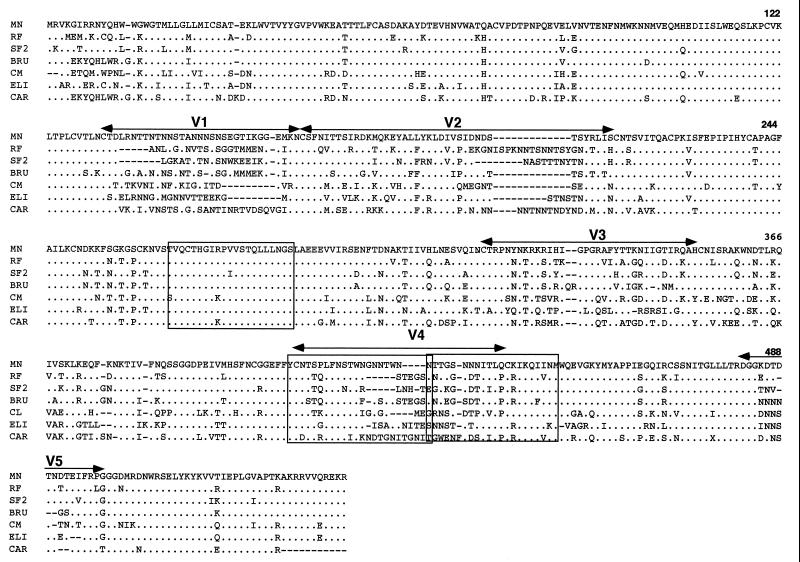
Figure 3
Sequence comparison of the gp120 molecules from different isolates. Shown are the locations of the variable regions. The sequences corresponding to the peptides that inhibit gp120 SAg binding are boxed. Gaps are introduced to maximize homology and dots indicate homology. Numbering is according to Ratner et al. (10).
Figure 4
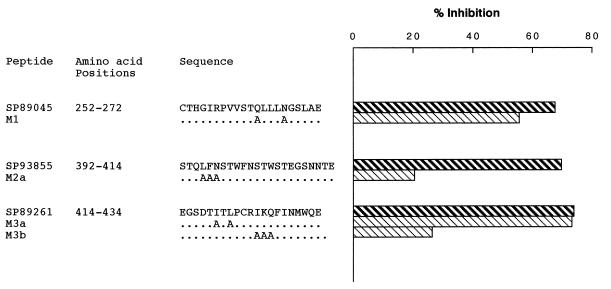
Figure 4
Mutagenesis analysis of the sequence motifs involved in SAg binding. Dilutions of the wild-type and mutant peptides (M1, M2a, M3a, and M3b) were mixed with an equal volume of IgM LAN at a concentration that achieved 50% of maximal binding. After incubation, the mixtures were transferred to gp120MN-coated wells, and residual binding was revealed as indicated in the text. Represented is the inhibition achieved by the peptides used at a 5 μM concentration. The results are from one representative experiment.

References

    1. Modrow S, Hahn B H, Shaw G M, Gallo R C, Wong-Staal F, Wolf H. J Virol. 1987;61:570–578. - PMC - PubMed
    1. Poignard P, Klasse P J, Sattentau Q J. Immunol Today. 1996;17:239–246. - PubMed
    1. Levy J A. Microbiol Rev. 1993;57:183–289. - PMC - PubMed
    1. Ziegler J L, Stites D P. Clin Immunol Immunopathol. 1986;41:305–313. - PubMed
    1. Robinson J, Edward W, Mitchell W M, Chambers W H, Schuffman S S, Montefiori D C, Oeltman T N. Hum Pathol. 1988;19:535–540. - PubMed

Publication types