


Suckling and sucrose ingestion suppress persistent hyperalgesia and spinal Fos expression after forepaw inflammation in infant rats
- PMID: 9037077
- PMCID: PMC19815
- DOI: 10.1073/pnas.94.4.1471
Suckling and sucrose ingestion suppress persistent hyperalgesia and spinal Fos expression after forepaw inflammation in infant rats
Abstract
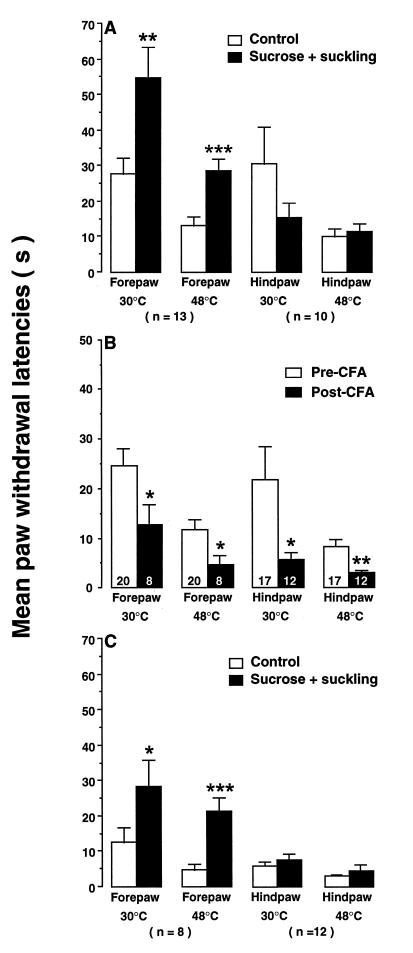
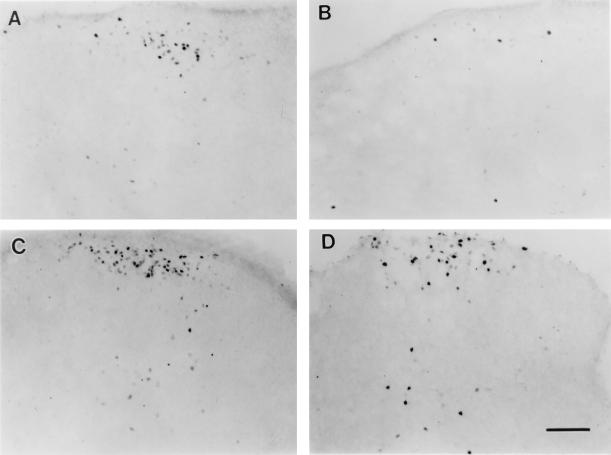
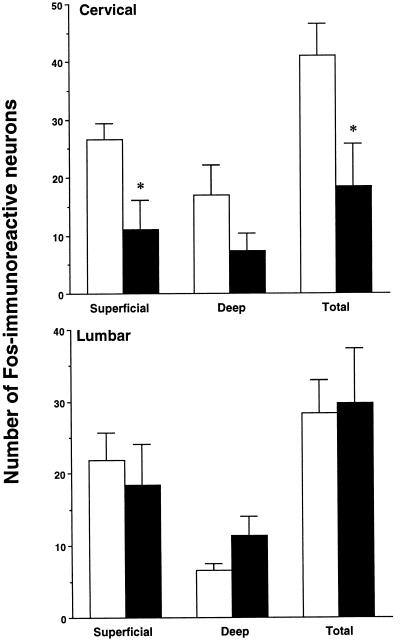
Sweet taste and nonnutritive suckling produce analgesia to transient noxious stimuli in infant rats and humans. The present study evaluated the pain-modulating effects of sucrose and suckling in a rat model of persistent pain and hyperalgesia that mimics the response to tissue injury in humans. Fore- and hindpaw withdrawal latencies from a 30 degrees or 48 degrees C brass stylus were determined in 10-day-old rats following paw inflammation induced by complete Freund's adjuvant (CFA; 1:1 injected s.c. in a 0.01 ml volume). CFA markedly decreased escape latencies to both 48 degrees and 30 degrees C stimulation, thereby demonstrating thermal hyperalgesia and mechanical allodynia. The combination of nonnutritive suckling and sucrose (7.5%, 0.01-0.06 ml/min) infusion markedly increased escape latencies to forepaw stimulation in both CFA-treated and control rats. In contrast, intraoral sucrose and suckling did not increase hindpaw withdrawal latencies in either control or CFA-inflamed rats. The effect was specific to sweet taste because neither water nor isotonic saline infusion affected forepaw escape latencies. Parallel findings were obtained for CFA-induced Fos-like immunoreactivity (Fos-LI), a marker of neuronal activation. Fos-LI was selectively induced in cervical and lumbar regions ipsilateral to forepaw and hindpaw inflammation, respectively. Suckling-sucrose treatment significantly reduced Fos-LI at the cervical but not at the lumbar regions. These findings demonstrate: (i) the development of persistent pain and hyperalgesia in 10-day-old rats that can be attenuated by endogenous pain-modulating systems activated by taste and nonnutritive suckling; (ii) the mediation of the sucrose-suckling analgesia and antihyperalgesia at the spinal level; and (iii) a differential rostrocaudal maturation of descending pain-modulating systems to the spinal cord of 10-day-old rats. These findings may provide new clinical approaches for engaging endogenous analgesic mechanisms in infants following tissue injury and inflammation.
Figures
References
-
- Schechter N L. Pediatr Clin North Am. 1989;36:781–794. - PubMed
-
- Purcell-Jones G, Dormon F, Sumner E. Pain. 1988;33:181–187. - PubMed
-
- Blass E M. Acta Paediatr (Stockholm) Suppl. 1994;397:71–76. - PubMed
-
- Blass, E. M. (1996) Regul. Pept., in press. - PubMed
-
- Blass E M, Fitzgerald E, Kehoe P. Pharmacol Biochem Behav. 1987;26:483–489. - PubMed
Publication types
MeSH terms
Substances
Grants and funding
LinkOut - more resources
Full Text Sources
Medical
