. 1997 Mar 4;94(5):1645-50.
doi: 10.1073/pnas.94.5.1645.

Persistence in muscle of an adenoviral vector that lacks all viral genes

Affiliations

Persistence in muscle of an adenoviral vector that lacks all viral genes

H H Chen et al. Proc Natl Acad Sci U S A. .

Abstract

Genetic correction of inherited muscle diseases, such as Duchenne muscular dystrophy, will require long term expression of the recombinant protein following gene transfer. We have shown previously that a new adenoviral vector that lacks all viral genes expressed both full-length dystrophin and beta-galactosidase in mdx (dystrophin-deficient) mouse muscle. We observed a significant histologic improvement of vector-transduced mdx muscle before the eventual loss of vector-encoded transgene expression. In this study, we investigated whether an immunological response against vector-encoded beta-galactosidase contributed to the loss of vector expression and affected vector persistence in muscle. Intramuscular vector injection in control normal mice resulted in an early and complete loss of beta-galactosidase expression accompanied by predominantly CD4+ and CD8+ lymphocytic infiltration and a significant loss of vector DNA. In contrast, intramuscular vector injection in lacZ transgenic mice resulted in persistent expression of beta-galactosidase for at least 84 days with no evidence of inflammation or significant loss of vector DNA. Our studies demonstrate that, in the absence of an immune response induced by beta-galactosidase expression, an adenoviral vector lacking all viral genes is stably maintained in muscle.


Figures
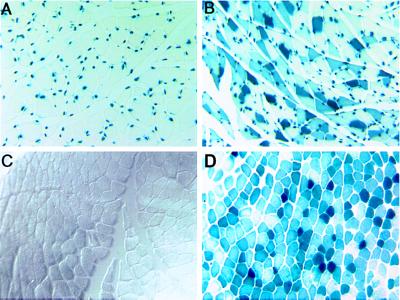
Figure 1
Figure 1
Expression and localization of β-galactosidase in lacZ transgenic and nontransgenic control mouse muscle. (A) Cross-section of a sham-injected gastrocnemius muscle from a lacZ transgenic mouse shows β-galactosidase localized to the nuclei of muscle fibers. In these mice, a lacZ transgene with the nuclear-localizing signal is expressed under the control of the muscle-specific myosin light chain 3F promoter and enhancer. (B) Cross-section of a gastrocnemius muscle from a lacZ transgenic mouse that received an intramuscular injection of AdDYSβgal. Vector-encoded β-galactosidase localizes to the cytoplasm. (C) Cross-section of a sham-injected gastrocnemius muscle from a control nontransgenic mouse. (D) Cross-section of a gastrocnemius muscle from a control mouse that received an intramuscular injection of AdDYSβgal. Vector-encoded β-galactosidase localizes to the cytoplasm. (×80).
Figure 2
Figure 2
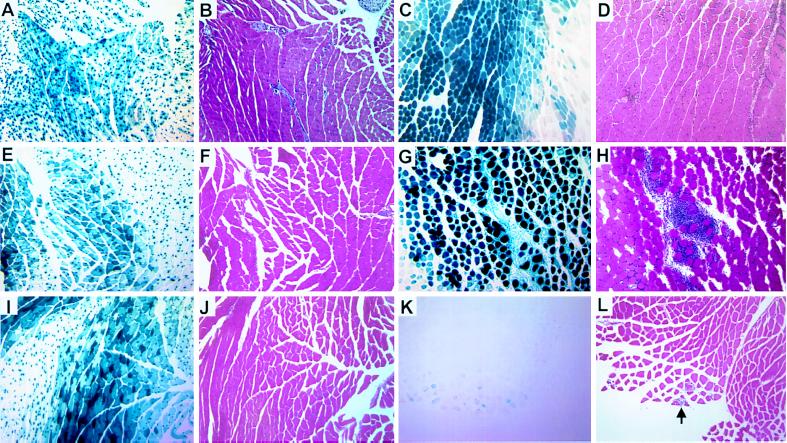
Expression of vector-encoded β-galactosidase is associated with inflammation in nontransgenic, but not lacZ transgenic mouse muscle. (A, E, and I) lacZ transgenic mouse muscle 14, 28, and 42 days after an intramuscular injection of AdDYSβgal, stained with X-Gal. (B, F, and J) Serial sections of A, E, and I, stained with hematoxylin and eosin show no inflammatory cellular infiltrate. (C, G, and K) Nontransgenic mouse muscle 14, 28, and 42 days after an intramuscular injection of AdDYSβgal, stained with X-Gal. (D, H, and L) Serial sections of C, G, and K, stained with hematoxylin and eosin show an inflammatory cellular infiltrate correlated with β-galactosidase expression. The arrow in L indicates a scant inflammatory infiltrate in proximity to rare β-galactosidase expressing nontransgenic muscle fibers at 42 days after injection. (×20).
Figure 3
Figure 3
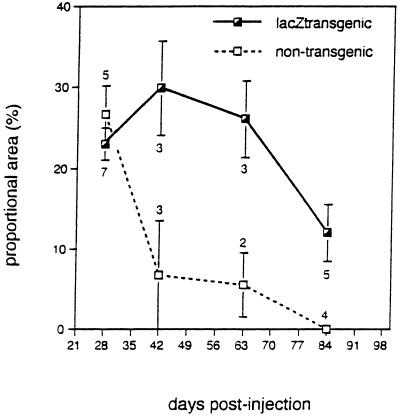
Time course of vector-encoded β-galactosidase expression in muscle of lacZ transgenic and nontransgenic mice. The proportional area of muscle sections expressing vector-encoded β-galactosidase after intramuscular AdDYSβgal injection was quantitated. The means at each time-point with their standard errors are shown. The numbers of transgenic and nontransgenic animals are indicated below and above the standard error bars, respectively.
Figure 4
Figure 4
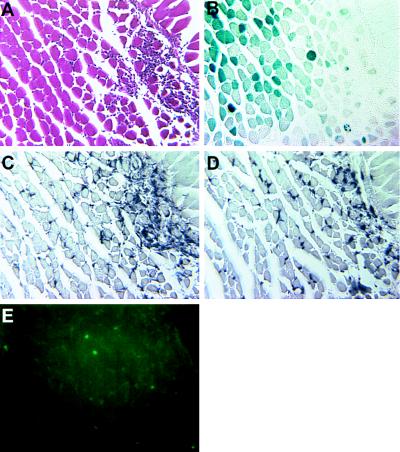
Detection of CD4+, CD8+ T cells, and macrophages at the site of vector-encoded β-galactosidase expression in nontransgenic mice. Serial sections of a nontransgenic mouse muscle 28 days after an intramuscular injection of AdDYSβgal. (A) Stained with hematoxylin and eosin; (B) stained with X-Gal; (C) immunostained with anti-CD4 monoclonal antibody; (D) immunostained with anti-CD8 monoclonal antibody; (E) immunostained with anti-macrophage antibody. (×80).
Figure 5
Figure 5
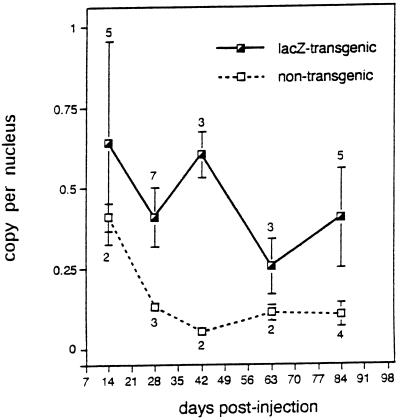
Viral vector DNA stability in lacZ transgenic and nontransgenic mice after intramuscular AdDYSβgal injection. Total muscle DNA samples extracted from vector-injected lacZ transgenic, and nontransgenic mouse muscles were assayed for viral vector DNA using PCR. Uninjected mouse muscle DNA was mixed with known copy numbers of pDYSβgal plasmid and amplified in parallel reactions to generate a standard curve for vector DNA quantitation. The data shown represent the result of PhosphorImager scanning of the PCR Southern blot analysis after normalizing input DNA to the adipsin PCR product. The means of vector copy number per nucleus are shown with their standard errors at each time point. The numbers of transgenic and nontransgenic animals are indicated above and below the standard error bars, respectively. Animals studied here were the same groups that were studied for the expression of vector-encoded β-galactosidase protein (see Fig. 3).

References

    1. Hoffman E P, Brown J R H, Kunkel L M. Cell. 1987;51:919–928. - PubMed
    1. Zubrzycka-Gaarn E E, Bulman D E, Karpati G, Burghes A H M, Belfall B, Klamut H J, Talbot J, Hodges R S, Ray P N, Worton R G. Nature (London) 1988;333:466–469. - PubMed
    1. Kozarsky K F, Wilson J M. Curr Opin Genet Dev. 1993;3:499–503. - PubMed
    1. Berkner K L. Biotechniques. 1988;6:616–629. - PubMed
    1. Quantin B, Perricaudet L D, Tajbakhsh S, Mandel J-L. Proc Natl Acad Sci USA. 1992;89:2581–2584. - PMC - PubMed

Publication types

MeSH terms