. 1997 Mar 4;94(5):1949-54.
doi: 10.1073/pnas.94.5.1949.

Functional characterization of ETV6 and ETV6/CBFA2 in the regulation of the MCSFR proximal promoter

Affiliations

Functional characterization of ETV6 and ETV6/CBFA2 in the regulation of the MCSFR proximal promoter

S Fears et al. Proc Natl Acad Sci U S A. .

Abstract

The ETV6/CBFA2 (TEL/AML1) fusion gene occurs as a result of the chromosome translocation t(12;21)(p13;q22) in up to 30% of children diagnosed with B cell precursor (cd10+, cd19+) acute lymphoblastic leukemia. Leukemic cells that have acquired the t(12;21) usually demonstrate loss of the remaining normal ETV6 (TEL) allele. Using reporter gene assays we have functionally characterized both the normal ETV6 and ETV6/CBFA2 fusion proteins in the regulation of the MCSFR proximal promoter. Neither ETV6 or ETV6/CBFA2 has any significant, detectable effect on the promoter by itself. However, both ETV6 and ETV6/CBFA2 inhibit the activation of the promoter by CBFA2B(AML1B) and C/EBPa. We have shown that a 29-bp region of the MCSFR promoter containing the binding sites for CBFA2B and C/EBPa is sufficient for the inhibition by ETV6 and ETV6/CBFA2. Mutational analysis of the MCSFR promoter revealed that binding of both CBFA2B and C/EBPa to their respective sites is necessary for the inhibition by ETV6 and ETV6/CBFA2. Deletion of the helix-loop-helix (HLH) region from the cDNAs of ETV6 and ETV6/CBFA2 decreased but did not completely abrogate the ability of either construct to inhibit promoter activation. We also found that the ETS DNA binding region of ETV6 is necessary for inhibition of the promoter. Addition of ETS1 and FLI1, two ETS family members that have homology in the 5' HLH region, but not Spi1, an ETS family member without the 5' HLH region, also inhibited reporter gene expression. Our data show that the inhibition mediated by ETV6 and ETV6/CBFA2, in the context of the MCSFR promoter, depend on interactions with other proteins, not just CBFA2B. Our results also indicate that the transactivation characteristics of ETV6/CBFA2 are a combination of positive and negative regulatory properties.


Figures
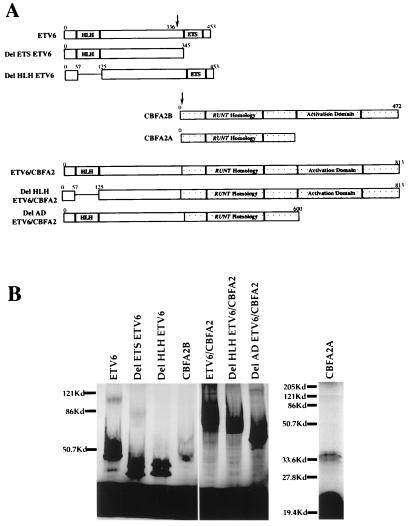
Figure 1
Figure 1
(A) Diagrammatic representation of the various cDNA constructs used. Arrows indicate location of the breakpoint in the coding regions. Numbers above the constructs refer to the amino acid residues. HLH, helix–loop–helix domain; ETS, ETS DNA binding domain. (B) Autoradiographic representation of an SDS/PAGE separation of the in vitro translated constructs.
Figure 2
Figure 2
Activation of the MCSFR proximal promoter by CBFA2B and ETV6 or ETV6/CBFA2 with or without C/EBPa. (A) ETV6 has no detectable effect on reporter gene by itself. Together CBFA2B and C/EBPa synergistically activate the reporter gene approximately 80-fold. This synergistic activation is inhibited by the addition of either ETV6 or ETV6/CBFA2. (B) In the absence of C/EBPa, CBFA2B only activates the reporter gene 5-fold above background. The cotransfection of ETV6 or ETV6/CBFA2 in the absence of C/EBPa slightly increases reporter gene activation. (C) C/EBPa activates the MCSFR promoter about 15-fold in the absence of cotransfected CBFA2. Both ETV6 and ETV6/CBFA2 inhibit the activation of the promoter by C/EBPa, even when CBFA2 is not included in the cotransfection assay. Note also that the cotransfection of ETV6, together with ETV6/CBFA2 in the presence of C/EBPa, inhibits the promoter to a relative activation of 0.035-fold.
Figure 3
Figure 3
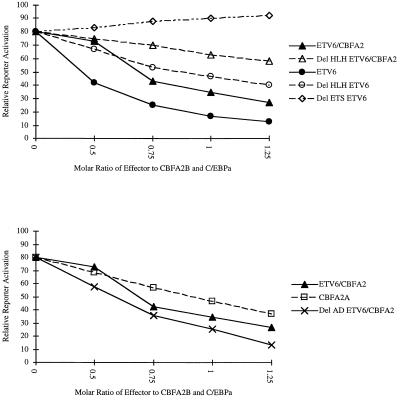
Inhibition of activation of the MCSFR promoter by increasing amounts of ETV6 or ETV6/CBFA2 plasmid. (Upper) Shows that increasing amounts of either ETV6 or ETV6/CBFA2 increases the level of reporter gene inhibition. It also shows that the removal of the HLH domain of either ETV6 or ETV6/CBFA2 results in a decrease in the ability of the respective constructs to inhibit promoter activation. (Lower) Results of cotransfecting the CBFA2 splice varient CBFA2A or the mutant ETV6/CBFA2 construct lacking the activation domain into the cotransfection system. The del AD ETV6/CBFA2 is able to inhibit reporter gene expression more than the full-length ETV6/CBFA2. CBFA2A, lacking the activation domain of CBFA2, is also able to decrease the synergistic activation of the promoter by CBFA2B and C/EBPa.
Figure 4
Figure 4
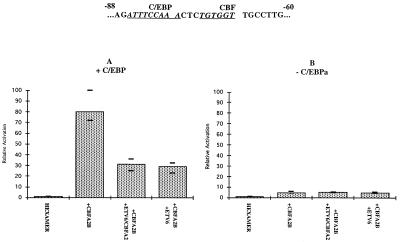
Activation of the hexamer reporter, a 29-bp region of the MCSFR proximal promoter containing the CBF and C/EBPa binding sites. (A) Addition of both CBFA2B and C/EBPa results in the synergistic activation of the hexamer reporter. Cotransfection of either ETV6 or ETV6/CBFA2 results in the inhibition of reporter gene activation. (B) Inhibition by ETV6 and ETV6/CBFA2 is not detectable in the absence of C/EBPa.
Figure 5
Figure 5
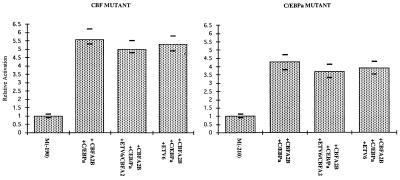
Activation of site-specific mutated promoters. If either the CBF site [m(−190) Left] or the C/EBPa site [m(−210) Right] is mutated synergistic activation of the reporter gene does not occur. Furthermore, the addition of ETV6 or ETV6/CBFA2 to either system does not produce a significant effect.
Figure 6
Figure 6
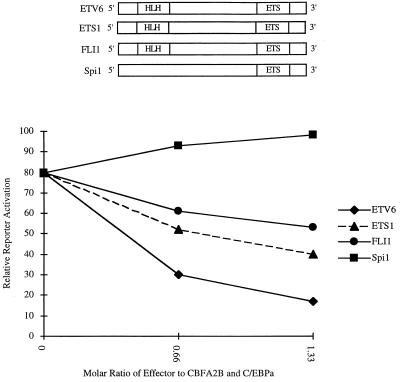
Effect of ETS family members on the activation of the MCSFR reporter gene. (Upper) Diagrammatic representation of the ETS family members used in the cotransfection experiments. All constructs share 3′ homology in the ETS domain. Only ETV6, ETS1, and FLI1 share homology in the 5′ HLH domain. Like ETV6, ETS1 and FLI1 inhibit reporter gene activation in the presence of both CBFA2B and C/EBPa. Spi1 (PU.1) shows additional activation of the reporter gene.
Figure 7
Figure 7
EMSA results using stably infected 32D cell nuclear extracts. The first lane represents probe alone. The second lane contains vector-alone infected 32D cells and lane 3 ETV6/CBFA2 infected 32D cells. Arrowhead, location of a possible ETV6/CBFA2 migrating band.

References

    1. Raimondi S C, Williams D L, Callihan T, Peiper S, Rivera G K, Murphy S B. Blood. 1986;68:69–75. - PubMed
    1. Cavé H, Gérard B, Martin E, Guidal C, Devaux I, Weissenbach J, Elion J, Vilmer E, Grandchamp B. Blood. 1995;86:3869–3875. - PubMed
    1. Höglund M, Johansson B, Pedersen-Bjergaard J, Marynen P, Mitelman F. Blood. 1996;87:324–330. - PubMed
    1. Wlodarska I, Marynen P, La Starza R, Mecucci C, Van den Berghe H. Cytogenet Cell Genet. 1996;72:229–235. - PubMed
    1. Shurtleff S A, Buijs A, Behm F G, Rubnitz J E, Raimondi S C, Hancock M L, Chan G C-F, Pui C-H, Grosveld G, Downing J R. Leukemia. 1995;9:1985–1989. - PubMed

Publication types

MeSH terms

LinkOut - more resources