


The relation of conjunctival pallor to the presence of anemia
- PMID: 9051559
- PMCID: PMC1497067
- DOI: 10.1046/j.1525-1497.1997.00014.x
The relation of conjunctival pallor to the presence of anemia
Abstract
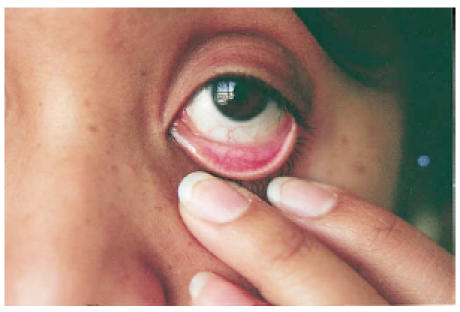
Objective: To determine the value of conjunctival pallor in ruling in or ruling out the presence of severe anemia (hemoglobin < or = 90 g/L) and to determine the interobserver agreement in assessing this sign.
Design: Patients were prospectively assessed for pallor by at least one of three observers. All observations were made without information of the patient's hemoglobin value or of another observer's assessment.
Setting: Tertiary-care, university-affiliated teaching hospital.
Patients: Three hundred and two medical and surgical inpatients.
Measurements and main results: Likelihood ratios (LRs) calculated for conjunctival pallor present, borderline, and absent were as follows: pallor present, LR 4.49 (95% confidence interval [CI] 1.80, 10.99); pallor borderline, LR 1.80 (95% CI 1.18, 2.62); pallor absent, LR 0.61 (95% CI 0.44, 0.80). Kappa scores of interobserver agreement between paired observers were 0.75 and 0.54.
Conclusions: The presence of conjunctival pallor, without other information suggesting anemia, is reason enough to perform a hemoglobin determination. The absence of conjunctival pallor is not likely to be of use in ruling out severe anemia. With well-defined criteria, interobserver agreement is good to very good.
Figures

Comment in
-
Conjunctival pallor and the presence of anemia.J Gen Intern Med. 1997 Jul;12(7):455. doi: 10.1046/j.1525-1497.1997.012007455.x. J Gen Intern Med. 1997. PMID: 9229286 Free PMC article. No abstract available.
References
-
- Bunn HF, Anemia . Harrison's Principles of Internal Medicine. In: Isselbacher KT, et al., editors. 13th ed. New York, NY: McGraw-Hill; 1994. p. 313.
-
- Nardone DA, Roth KM, Mazur DJ, McAfee JM. Usefulness of physical examination in detecting the presence or absence of anemia. Arch Intern Med. 1990;150:201–4. - PubMed
-
- Strobach RS, Anderson SK, Doll DC, Ringenberg S. The value of the physical examination in the diagnosis of anemia. Arch Intern Med. 1988;148:831–2. - PubMed
-
- Gjorup T, Rugge PM, Hendriksen C, Jensen AM. A critical evaluation of the clinical diagnosis of anemia. Am J Epidemiol. 1986;124:657–65. - PubMed
-
- Wong T, Detsky AS. Preoperative cardiac risk assessment for patients having peripheral vascular surgery. Ann Intern Med. 1992;116:743–53. - PubMed
Publication types
MeSH terms
Substances
LinkOut - more resources
Full Text Sources
Medical