


Enhancement of cellular immunity in melanoma patients immunized with a peptide from MART-1/Melan A
- PMID: 9072306
- PMCID: PMC2597550
Enhancement of cellular immunity in melanoma patients immunized with a peptide from MART-1/Melan A
Abstract
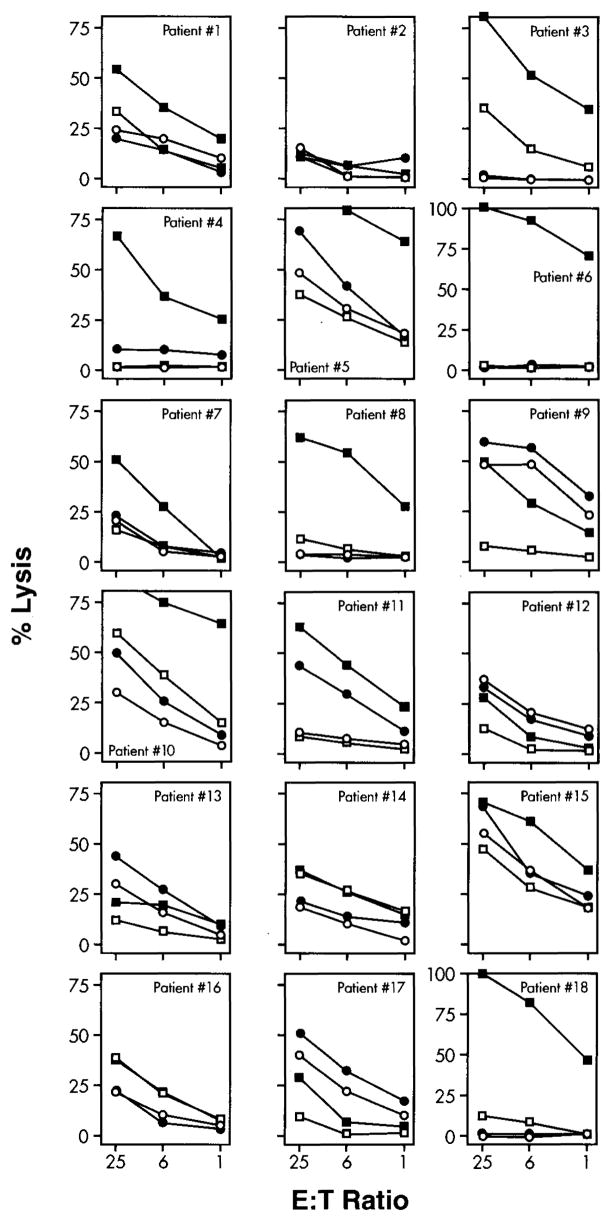
Purpose: In this study, we tested the effectiveness of a melanoma-associated antigen-derived peptide, MART-1(27-35), in eliciting cellular immune responses in vivo in the context of a phase I active immunization protocol. This peptide (AAGIGILTV) corresponds to residues 27-35 from the nonmutated melanoma-associated antigen MART-1/Melan A and is recognized by most melanoma-specific, HLA-A*0201-restricted, tumor-infiltrating lymphocytes. To test the in vivo induction of cytotoxic T lymphocyte (CTL) sensitization, we compared CTL reactivity in vitro from peripheral blood mononuclear cell (PBMC) pools obtained before and after vaccination.
Patients and methods: MART-1(27-35) was administered to HLA-A*0201 melanoma patients subcutaneously in an emulsification with incomplete Freund's adjuvant. A vaccination course included four inoculations of peptide at 3-week intervals. PBMC collected by leukapheresis and separated by Ficoll-Hypaque gradient before and after vaccination were analyzed in 18 patients by in vitro sensitization with MART-1(27-35). To induce MART-1(27-35)-specific CTL, PBMC were incubated with 1 microM peptide (on day 0) and interleukin-2 (IL-2) (300 IU/mL, on days 1 and 4 after each stimulation). At weekly intervals, cells were harvested and an aliquot was cryopreserved for later analysis. The remaining cells were replated and restimulated using irradiated autologous PBMC pulsed with 1 microM of relevant peptide. After three restimulations, all samples from one patient were tested simultaneously for HLA-A*0201-restricted anti-MART-1(27-35) reactivity by microcytotoxicity and cytokine (IFN-gamma) release assays.
Results: Toxicities were minimal and consisted of local irritation at the site of vaccine administration. None of the patients sustained a clinical response. The first eight patients were monitored by inducing CTL reactivity from PBMC obtained preimmunization and after two and four vaccinations. Only two prevaccination cultures were reactive to MART-1, compared with five and seven cultures from PBMC obtained after two and four vaccinations, respectively. Thus, an enhancement in cytotoxic activity could be detected in postvaccination CTL cultures, and serial vaccine administrations appeared to boost the detectability of cytotoxicity in vitro. For completeness, the analysis compared prevaccination with postvaccination PBMC cultures. Specific anti-MART-1(27-35) cytotoxicity (> or = 10 lytic units) could be detected in two prevaccination and 12 postvaccination cultures after two in vitro stimulations. In 15 postvaccination CTL cultures, a more than threefold increase in specific release of IFN-gamma was noted, compared with prevaccination.
Discussion: In vivo administration of a melanoma-associated antigen peptide, emulsified in incomplete Freund's adjuvant, could safely augment CTL reactivity against epitopes commonly expressed by melanoma cells. Although the enhancement of CTL reactivity did not achieve tumor regression, it is possible that the use of recombinant immunogens with increased immunomodulatory capabilities in future clinical trials could reach the threshold of CTL activation necessary for tumor regression.
Figures
Comment in
-
Times are a changin': the era of peptide immunization begins.Cancer J Sci Am. 1997 Jan-Feb;3(1):4-5. Cancer J Sci Am. 1997. PMID: 9072307 No abstract available.
References
-
- van der Bruggen P, Bastin J, Gajewski T, et al. A peptide encoded by human gene MAGE-3 and presented by HLA-A2 induces cytolytic T lymphocytes that recognize tumor cells expressing MAGE-3. Eur J Immunol. 1994;24:3038–3043. - PubMed
Publication types
MeSH terms
Substances
Grants and funding
LinkOut - more resources
Full Text Sources
Other Literature Sources
Medical
Research Materials