. 1997 May 1;17(9):3201-14.
doi: 10.1523/JNEUROSCI.17-09-03201.1997.

Spatial attention effects in macaque area V4

Affiliations

Spatial attention effects in macaque area V4

C E Connor et al. J Neurosci. .

Abstract

Focal visual attention typically produces enhanced perceptual processing at the psychological level and relatively stronger neural responses at the physiological level. A longstanding mechanistic question is whether these attentional effects pertain specifically to the attended (target) object or to the region of space it occupies. We show here that attentional response enhancement in macaque area V4 extends to behaviorally irrelevant objects in the vicinity of the target object, indicating that focal attention has a strong spatial component at the physiological level. In addition, we find that spatial attention effects typically show a striking directional asymmetry. The direction of the asymmetry varies between cells, so that some cells respond best when attention is directed to the left of the stimulus, some when attention is directed to the right, etc. Thus, attention involves not only enhanced responses to behavioral targets but also a complex modulation of responses to other stimuli in the surrounding visual space.


Figures
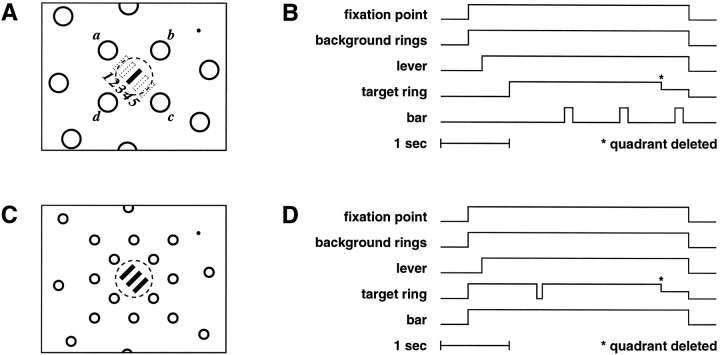
Fig. 1.
Fig. 1.
Stimuli and behavioral paradigms.A, Stimuli for the 4 ring/5 bar test. The dot in the top right represents the fixation point, and the dashed circle represents the CRF. Four rings surround the CRF at positions a–d, and the rest of the screen is filled with distractor rings. Ring diameter is 0.5 CRF diameter. Bars are presented (individually) at positions1–5, which span the CRF along the axis perpendicular to bar orientation. Bar length is 0.5 CRF diameter, and bar spacing is 0.25 CRF diameter. B, Sequence of trial events for the 4 ring/5 bar test (example). The trial begins with the appearance of the fixation point and background rings (including rings at three of the positions near the CRF). After the animal initiates fixation and depresses the response lever, there is a 500 msec delay, and then the target ring appears at the remaining position near the CRF. The delayed onset denotes the target position for that trial. Bars are flashed individually and in random order at the five locations spanning the CRF for 150 msec each at 1 sec intervals beginning 1 sec after target onset. At a random time point no less than 500 msec after target onset, a quadrant is deleted from the target ring. The animal must respond to this by releasing the response lever. C, Stimuli for12 ring test. The CRF is surrounded by 12 potential target rings, each with a diameter equal to 0.25 CRF diameter, arranged in a square array with a spacing equal to 0.75 CRF diameter. The stimulus is a set of three bars presented simultaneously in the center of the CRF. Bar length is 0.5 CRF diameter, and bar spacing is 0.25 CRF diameter.D, Sequence of trial events for the sustained bartest. The fixation point, background rings, and target rings appear simultaneously at the beginning of the trial. The animal must initiate fixation and depress the response lever. Then, after a 1 sec delay, the target ring blinks off for 100 msec. At a random time point no less than 500 msec after the blink, a quadrant is deleted from the target ring and the animal must respond by releasing the response lever.
Fig. 2.
Fig. 2.
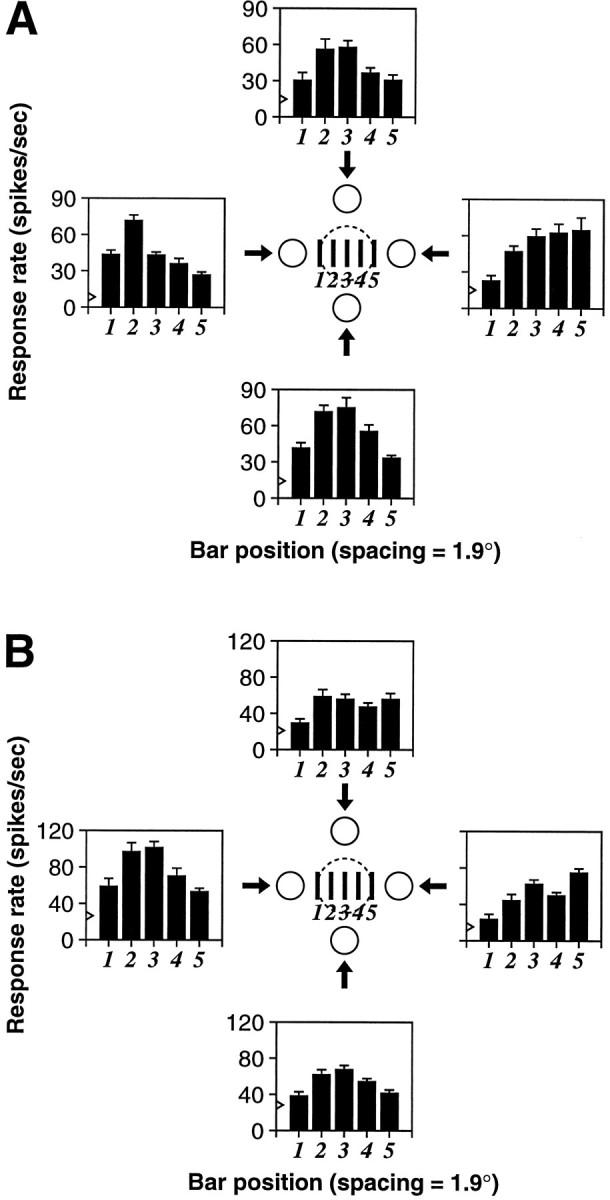
Response profile shift (example). This cell’s CRF had a diameter of 7.5° and was located 6.7° to the left and 8.8° below fixation. It responded to red bars at all orientations, so the response shift was tested along two axes, 45° clockwise (A) and 45° counterclockwise (B) from horizontal. Ring color was green. The center diagramsshow the bar positions and the four target ring positions. Each histogram shows the mean and SE of responses at the five bar positions when attention was directed to the target ring indicated by thearrow. Background response rates are indicated by thearrowheads along the vertical axes. In bothA and B, response profiles are shifted in the direction of the target ring.
Fig. 3.
Fig. 3.
Response profile shifts (population analysis).A, Fractional shift distribution in the 4 ring/5 bar test. The fractional shift is the proportion of the total response profile that shifted from one side of the CRF to the other with target ring position (see Materials and Methods). Positive values represent a shift toward the target ring, and negative values represent a shift in the opposite direction. The distribution is heavily weighted in the positive direction. Values significant at the 5% level according to a randomization test are shown inblack. None of the negative values was significant, indicating that those cells showing large negative shifts also had highly variable responses. B, Peak shift distribution in the4 ring/5 bar test. The peak shift is the distance by which the bar position producing maximum responses shifted with target ring position (see Materials and Methods). Positive values represent a shift toward the target ring, and negative values represent a shift in the opposite direction. Values associated with significant fractional shifts are shown in black. C, Fractional shift distribution in the 2 ring/7 bar test. D,Peak shift distribution in the 2 ring/7 bartest.
Fig. 4.
Fig. 4.
Average response profiles in the 2 ring/7 bar test. For each cell, average responses at the seven bar positions were normalized by dividing by the maximum average response. Normalized responses were averaged across cells for each bar position/target ring combination. Responses associated with the two target rings are differentiated by the halftone andstriped patterns. The two target ring centers are denoted by arrows. Average response profiles for the entire population of 52 cells are shown in A, and average response profiles for the 39 cells with significant fractional shift values are shown in B.
Fig. 5.
Fig. 5.
Directional asymmetry (example). This cell’s CRF had a diameter of 5.3° and was located 4.0° to the right and 5.5° below fixation. Bar orientation was 15° clockwise from vertical. Responses were tested with magenta bars; ring color was green. As in Figure 2, the individual histograms show mean bar responses and SEs associated with the four target ring positions. Background responses are indicated by arrowheads along the vertical axes. Responses were strong when attention was directed to the target ring below the CRF, moderate when attention was directed to the left, and weak when attention was directed above or to the right.
Fig. 6.
Fig. 6.
Fractional gain distribution in the 4 ring/5 bar test. Fractional gain is a measure of the directional asymmetry in spatial attention effects. It corresponds to the proportional difference in total response strength (summed across bar positions) between the two target positions producing the maximum and minimum responses (see Materials and Methods). Values for cells that showed effects significant at the 5% level according to a randomization ANOVA are shown in black. The arrowindicates the average fractional gain expected on the basis of random variation.
Fig. 7.
Fig. 7.
Vector sums in the 4 ring/5 bartest. For each cell, an arrow is used to represent the vector sum of the normalized response strengths associated with the four target positions. Each component vector in the sum originates at the CRF center, points toward the appropriate target ring, and has a magnitude proportional to the total response strength when attention was focused on that target ring. The sum of these vectors reflects the directionality of the attentional profile. A cell that responded only when attention was focused on one of the rings would have a large summed vector pointing in that direction, whereas a cell that gave equivalent responses under all attention conditions would have a summed vector of negligible magnitude. The magnitude of the summed vector was normalized by the sum of the magnitudes of the component vectors (i.e., by the cell’s total response strength), so that the final value would fall between 0.0 and 1.0. This normalized magnitude is represented in each case by the area of the arrow in the plot. The position of the arrow indicates the CRF position relative to fixation (the intersection of the degree axes), and the direction of thearrow indicates the direction of the vector sum. Normalized vector magnitude was used as a randomization statistic to test the null hypothesis that response strength was not related to the direction of attention relative to the CRF. A distribution was generated by randomly permuting response values across target ring position (within bar position) and recalculating the normalized vector magnitude 10,000 times. If the original magnitude fell within the top 5% of this distribution, the relationship between response strength and direction of attention was considered significant. Significant vectors are plotted in black. The large arrow pointing to the bottom left just below theasterisk corresponds to the example cell of Figure 5.
Fig. 8.
Fig. 8.
Distribution of vector sum directions in the4 ring/5 bar test. A, Vector direction in gravitational coordinates. Each normalized vector sum from Figure 7 is plotted as a dot, the angle of which represents direction in gravitational coordinates and the distance from the center of which represents magnitude. IPSI, Ipsilateral; CONTRA, contralateral. The asterisk corresponds to the example cell from Figure 5. The circle shows the spatial average across all the vectors. B, Vector direction in foveocentric coordinates. The angle of each dot represents vector direction relative to the axis running from the CRF center to the fixation point. CW, Clockwise; CCW, counterclockwise. The asterisk corresponds to the example cell from Figure 5. The circle shows the spatial average across the vectors.
Fig. 9.
Fig. 9.
Directional asymmetry in the 12 ringtest (examples). A, Results of the 12 ring testfor the cell shown in Figure 5. The CRF is represented by thedashed circle with the three bar stimulus inside. The average response to the three bar stimulus as the animal attended to each of the 12 target ring positions is indicated by block height at the corresponding position. The blocks are ruled in increments of 2 spikes/sec, and the SE is indicated by the projecting line. The plot has been rotated so that target positions above the CRF are toward the front and target positions below the CRF are toward the back. B, Background responses for the same cell.C, D, Other examples.
Fig. 10.
Fig. 10.
Directional asymmetry in the 12 ringtest (population analysis). A, Fractional area at half-height. The breadth of tuning for attention position was assessed by calculating the fraction of the 12 tested attention positions for which responses to the stimulus in the CRF equaled or exceeded half of the maximum response. Cells showing significant variation in response with target position according to a randomization ANOVA are shown inblack. B, Peak distance. The spatial relationship between the peak of the attentional profile and the CRF was characterized by the distance between the target ring associated with the largest bar stimulus response and the CRF center. The 12 ring procedure provided a test of four directions at two distances (0.75 and 1.5 RF diameters). Cells showing significant variation are shown in black.
Fig. 11.
Fig. 11.
Comparison between receptive field structure and directional effect. In each example (A–D), varying gray levels are used to plot the receptive field profile for the cell. The gray levels corresponding to the minimum value (left), 0 (center), and maximum value (right) in spikes/sec are shown below. Receptive field profiles were based on an automated plotting routine that involved presentation of a small bar stimulus at each of the mapped locations (see Materials and Methods). Response rates were smoothed with a two-dimensional spatial Gaussian of SD 0.125 CRF diameters. The position of the fovea is indicated by the cross, and the spatial scale is given by the 1° bar at the right. The CRF, as defined for the purpose of the 4 ring/5 bartest, is indicated by the dashed circle. The target rings in the 4 ring/5 bar test are shown aswhite circles. Near each target ring are two values given in spikes/sec; “bar” indicates the summed bar response (from the 4 ring/5 bar test) associated with attention to that ring, and “RF” indicates the average receptive field response in the region covered by the target ring and extending one-eighth of the CRF diameter beyond its boundary. The correlation between the two sets of four values is given below, along with the fractional gain effect for the cell.
Fig. 12.
Fig. 12.
Proposed strategy for local position coding. Attention is centered on the face (for example, around the nose or eyes), although the window of attention would encompass the entire head. A V4 receptive field (dashed outline) is shown at the position of the mouth. A cell with this receptive field location that was sensitive to horizontal stimuli and had the attention tuning profile on the left would respond well under these circumstances, because the position of attention (shaded block) is at the peak of the tuning profile. A cell with the tuning profile on the right would respond poorly. The selective activation of the cell on the left would represent the presence of a horizontal stimulus below the center of attention and thus contribute to perception of the face. The tuning profiles for the two cells are idealized versions in the format of Figure 9. Block height represents average response to horizontal stimuli in the CRF (dashed circle) when attention is centered on the corresponding location.

References

    1. Allman J, Miezin F, McGuinness E. Stimulus specific responses from beyond the classical receptive field: neurophysiological mechanisms for local-global comparisons in visual neurons. Annu Rev Neurosci. 1985;8:407–430. - PubMed
    1. Andersen RA, Essick GK, Siegel RM. Encoding of spatial location by posterior parietal neurons. Science. 1985;230:456–458. - PubMed
    1. Baylis GC, Driver J. Visual attention and objects: evidence for hierarchical coding of location. J Exp Psychol. 1993;19:451–470. - PubMed
    1. Connor CE, Gallant JL, Preddie DC, Van Essen DC. Responses in area V4 depend on the spatial relationship between stimulus and attention. J Neurophysiol. 1996;75:1306–1308. - PubMed
    1. Crick F. Function of the thalamic reticular complex: the searchlight hypothesis. Proc Natl Acad Sci USA. 1984;81:4586–4590. - PMC - PubMed

Publication types

LinkOut - more resources