. 1997 Apr 1;94(7):3436-41.
doi: 10.1073/pnas.94.7.3436.

Lack of mitochondrial and nuclear-encoded subunits of complex I and alteration of the respiratory chain in Nicotiana sylvestris mitochondrial deletion mutants

Affiliations

Lack of mitochondrial and nuclear-encoded subunits of complex I and alteration of the respiratory chain in Nicotiana sylvestris mitochondrial deletion mutants

S Gutierres et al. Proc Natl Acad Sci U S A. .

Abstract

We previously have shown that Nicotiana sylvestris cytoplasmic male sterile (CMS) mutants I and II present large mtDNA deletions and that the NAD7 subunit of complex I (the main dehydrogenase of the mitochondrial respiratory chain) is absent in CMS I. Here, we show that, despite a large difference in size in the mtDNA deletion, CMS I and II display similar alterations. Both have an impaired development from germination to flowering, with partial male sterility that becomes complete under low light. Besides NAD7, two other complex I subunits are missing (NAD9 and the nucleus-encoded, 38-kDa subunit), identified on two-dimensional patterns of mitochondrial proteins. Mitochondria isolated from CMS leaves showed altered respiration. Although their succinate oxidation through complex II was close to that of the wild type, oxidation of glycine, a priority substrate of plant mitochondria, was significantly reduced. The remaining activity was much less sensitive to rotenone, indicating the breakdown of Complex I activity. Oxidation of exogenous NADH (coupled to proton gradient generation and partly sensitive to rotenone) was strongly increased. These results suggest respiratory compensation mechanisms involving additional NADH dehydrogenases to complex I. Finally, the capacity of the cyanide-resistant alternative oxidase pathway was enhanced in CMS, and higher amounts of enzyme were evidenced by immunodetection.


Figures
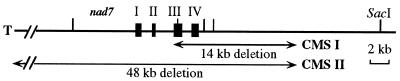
Figure 1
Figure 1
Deletions in the nad7 region of mtDNA in N. sylvestris CMS mutants (see text). CMS I lacks exons III and IV; CMS II lacks the entire gene.
Figure 2
Figure 2
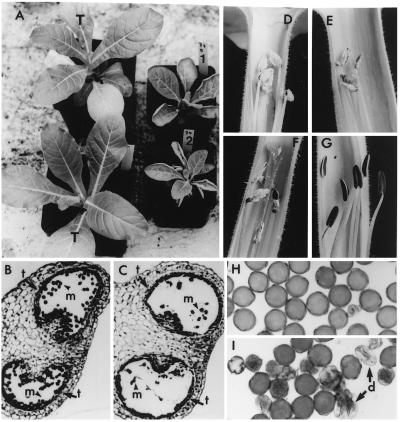
Morphological abnormalities and conditional male sterility in CMS genotypes. (A) Two-month old plants grown in the greenhouse under 16 h of artificial light; 1, CMS I; 2, CMS II. (B and C) Cross-section of T (B) or CMS I (C) half-anther at the microspore stage, collected during winter in the greenhouse; t, tapetum; m, microspores. (DG) Anthesis in T (D and E) and CMS II (F and G) flowers; plants were maintained for 3 weeks in controlled chambers with 16 h of light at 300 μmol of PAR photons m−2·s−1 (D and F) or 9 h at 30 μmol of PAR photons m−2·s−1 (E and G). (H and I) T (H) and CMS I (I) pollen collected at anthesis in summer and stained with Alexander dye; viable pollen is round and dark purple, dead pollen (d) is irregular and light green.
Figure 3
Figure 3
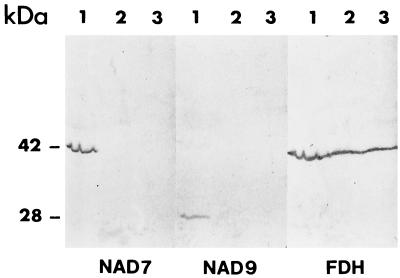
Western blots of T and CMS mitochondrial proteins of complex I. Immunodetection was performed with antisera against the N. crassa 49-kDa subunit (NAD7) and the wheat NAD9. Potato formate dehydrogenase (FDH) served as the control. Lanes: 1, T; 2, CMS I; and 3, CMS II.
Figure 4
Figure 4
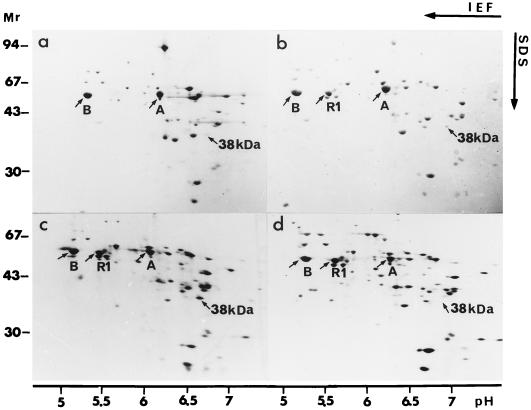
Two-dimensional SDS/PAGE of mitochondrial proteins from fertile T and CMS plants. (a and b) Coomassie blue staining of T leaf (a) and T pollen (b). (c and d) Silver nitrate staining of T (c) and CMS I (d) mature pollen collected during summer in the greenhouse. A and B, α and β subunits, respectively, of mitochondrial ATPase. R1, additional β subunit specific to pollen (14).
Figure 5
Figure 5
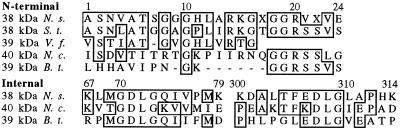
Sequence homologies of the N. sylvestris 38-kDa polypeptide with complex I subunits of other species (–28). N. s., Nicotiana sylvestris; S. t., Solanum tuberosum; V. f., Vicia faba; N. c., Neurospora crassa; B. t., Box taurus. Numbering refers to N. crassa mature protein. X, not determined. Homologous regions are boxed.
Figure 6
Figure 6
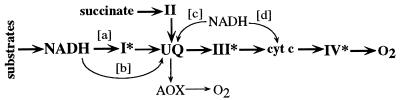
Scheme of plant respiratory chain. Bold, main chain; I–IV, respiratory complexes; ∗, coupled proton translocation; UQ, ubiquinone; [a]–[d], NADH dehydrogenation pathways. Arrows symbolize electron transfer.
Figure 7
Figure 7
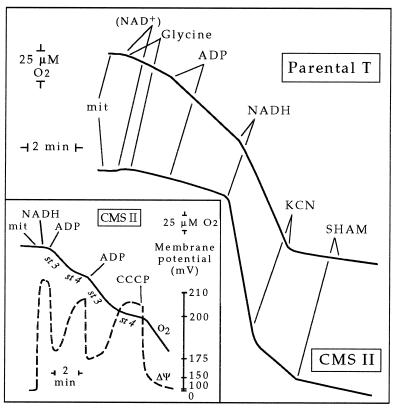
Recorder traces of respiration measured with purified mitochondria from parental T and mutant CMS II leaves (same with CMS I). Mitochondrial proteins: 150 μg in 3 ml of the assay medium [4 mM glycine/500 μM ADP (main traces) or 75 then 120 μM (Inset)/0.7 mM NADH/0.2 mM KCN/1 mM salicylhydroxamic acid (SHAM)]. (Inset) O2 uptake (solid line) and transmembrane potential ΔΨ (dashed line, with tetraphenylphosphonium+ electrode). st 3, state 3; st 4, state 4.
Figure 8
Figure 8
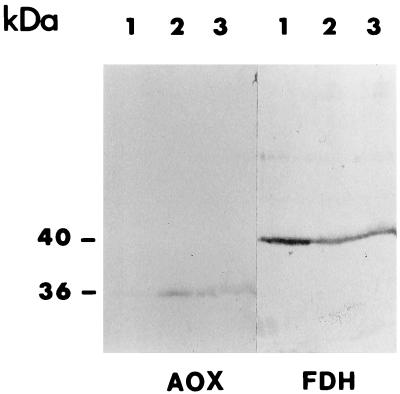
Western blots of T and CMS AOX. Immunodetection with antisera against S. guttatum AOX and potato formate dehydrogenase (FDH) serving as control. Lanes: 1, T; 2, CMS I; 3, CMS II. The T lane was overloaded to detect the weak AOX signal (20 μg of protein instead of 10 μg).

References

    1. Schuster W, Brennicke A. Annu Rev Plant Physiol Plant Mol Biol. 1994;45:61–78.
    1. Walker J E. Q Rev Biophys. 1992;25:253–324. - PubMed
    1. Weiss H, Friedrich T, Hofhaus G, Preis D. Eur J Biochem. 1991;197:563–576. - PubMed
    1. Chomyn A, Cleeter M W J, Ragan C I, Riley M, Doolitle R F, Attardi G. Science. 1986;234:614–618. - PubMed
    1. Lamattina L, Gonzalez D, Gualberto J, Grienenberger J M. Eur J Biochem. 1993;217:831–838. - PubMed

Publication types

LinkOut - more resources