Comparative Study
. 1997 Apr 7;185(7):1261-73.
doi: 10.1084/jem.185.7.1261.

Inducible nitric oxide is essential for host control of persistent but not acute infection with the intracellular pathogen Toxoplasma gondii

Affiliations
Comparative Study

Inducible nitric oxide is essential for host control of persistent but not acute infection with the intracellular pathogen Toxoplasma gondii

T M Scharton-Kersten et al. J Exp Med. .

Abstract

The induction by IFN-gamma of reactive nitrogen intermediates has been postulated as a major mechanism of host resistance to intracellular pathogens. To formally test this hypothesis in vivo, the course of Toxoplasma gondii infection was assessed in nitric oxide synthase (iNOS)-/- mice. As expected, macrophages from these animals displayed defective microbicidal activity against the parasite in vitro. Nevertheless, in contrast to IFN-gamma-/- or IL-12 p40-/- animals, iNOS-deficient mice survived acute infection and controlled parasite growth at the site of inoculation. This early resistance was ablated by neutralization of IFN-gamma or IL-12 in vivo and markedly diminished by depletion of neutrophils, demonstrating the existence of previously unappreciated NO independent mechanisms operating against the parasite during early infection. By 3-4 wk post infection, however, iNOS knockout mice did succumb to T. gondii. At that stage parasite expansion and pathology were evident in the central nervous system but not the periphery suggesting that the protective role of nitric oxide against this intracellular infection is tissue specific rather than systemic.


Figures
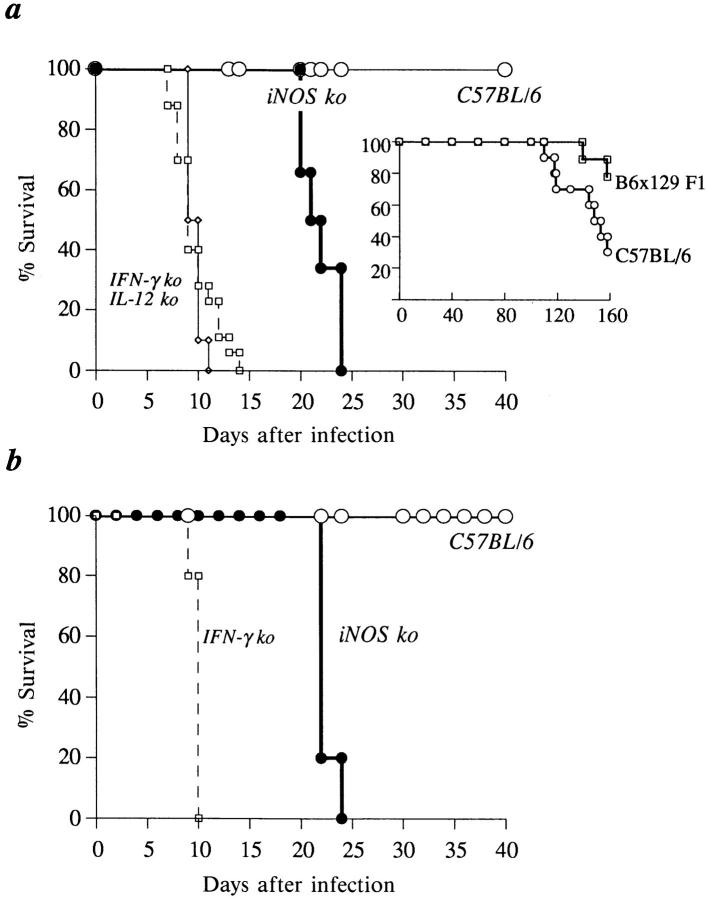
Figure 1
Figure 1
In contrast to IFN-γ ko and IL-12 p40−/− mice, iNOS ko animals survive acute infection with T. gondii (ME49). Mice were infected either by the i.p. (A) or p.o. (B) route of infection with 20 ME49 cysts. The data shown in A are pooled from three independent experiments and involve a minimum of 10 ko mice per group. The experiment presented in B involved five mice per group and is representative of three performed. As described in Materials and Methods, infected C57BL/6 × 129/J F1 and C57BL/6 animals displayed similar survival patterns (inset).
Figure 2
Figure 2
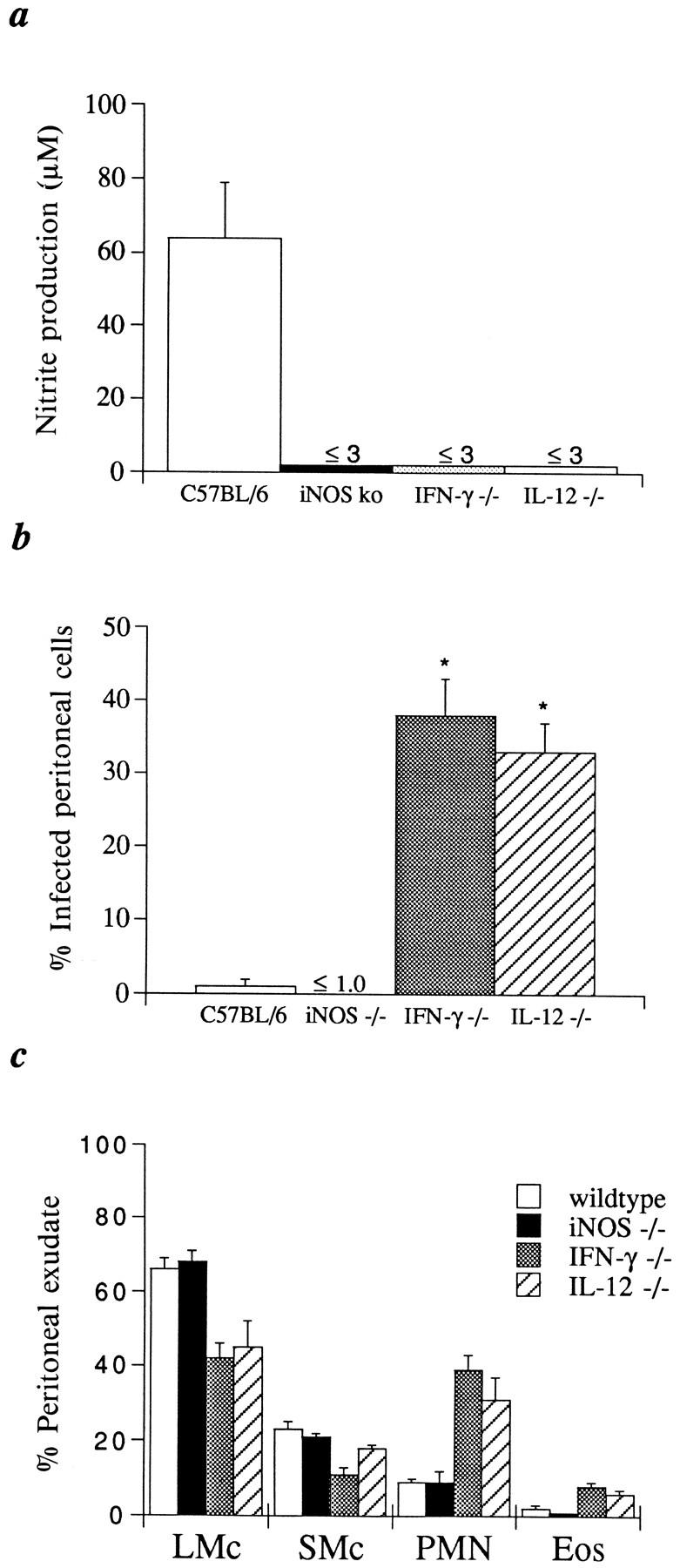
iNOS ko mice control acute tachyzoite replication effectively in the peritoneal cavity. (A) C57BL/6, iNOS ko, IL-12 p40−/− , and IFN-γ ko mice were infected i.p. with 20 cysts each and peritoneal cells harvested 5 d later. Nitrite levels were measured by the Griess reaction in 72-h supernatants of the cultured cell populations. The values shown are the mean ± SE of data points pooled from three different experiments involving a total of 6–12 animals per group. (B) The percentage of infected cells determined microscopically from cytospin preparations from the same animals studied in A, as detailed in Materials and Methods. (C) Differential counts of peritoneal exudate cells from the same animals studied in A and B. The mean ± SE cell recovery from the infected animals was: C57BL/6 (5.5 ± 0.8 × 10⁶), iNOS ko (7.5 ± 2.1 × 10⁶), IL-12 p40−/− (10.1 ± 1.8 × 10⁶), IFN-γ ko (10.9 ± 1.5 × 10⁶). Uninfected mice of each of the four strains did not differ significantly in the composition of their peritoneal cells (75–85% LMC, 10–20% SMC, 1–5% granulocytes) or cell yields (⩽1.5 × 10⁶).
Figure 3
Figure 3
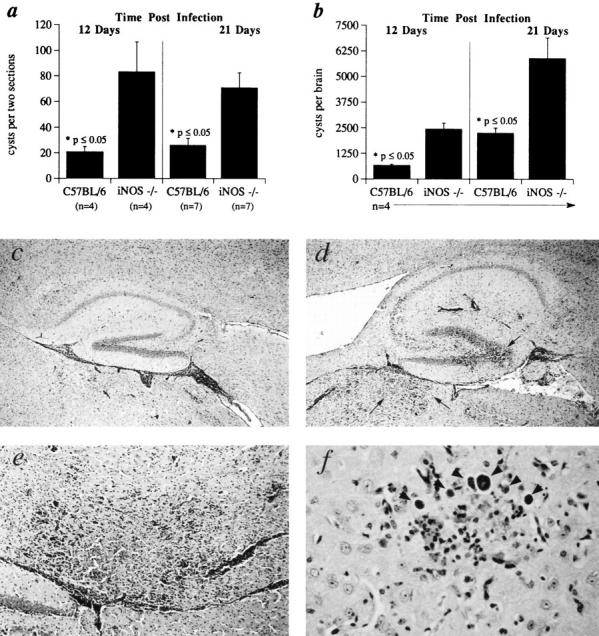
Brains of iNOS ko mice show increased cyst burdens as well as necrotizing encephalitis. C57BL/6 and iNOS ko mice were infected i.p. with 20 cysts each and brains harvested 12 and 21 d later for cyst enumeration in histological sections (A) or tissue homogenates (B). The mean cyst count and SE are shown for each group consisting of the number of animals indicated. (C–F) Photomicrographs of periodic acid–Schiff's stained, sagittal sections of brains from iNOS (D–F) and C57BL/6 (C) mice at 21 d after infection. Hippocampal regions of the brain in C57BL/6 (C) and iNOS ko (D) mice. Large areas of inflammation and necrosis seen in the iNOS brain (D) but not in C57BL/6 brain (C) are indicated by arrows. E shows a higher magnification of the same necrotizing lesion in D. (F) Brain section from iNOS ko mouse with numerous cysts (arrowheads) arranged in a satellite-like array, a feature frequently observed in these animals. Original magnification: (C and D) ×50; (E) ×200; (F) ×400.
Figure 4
Figure 4
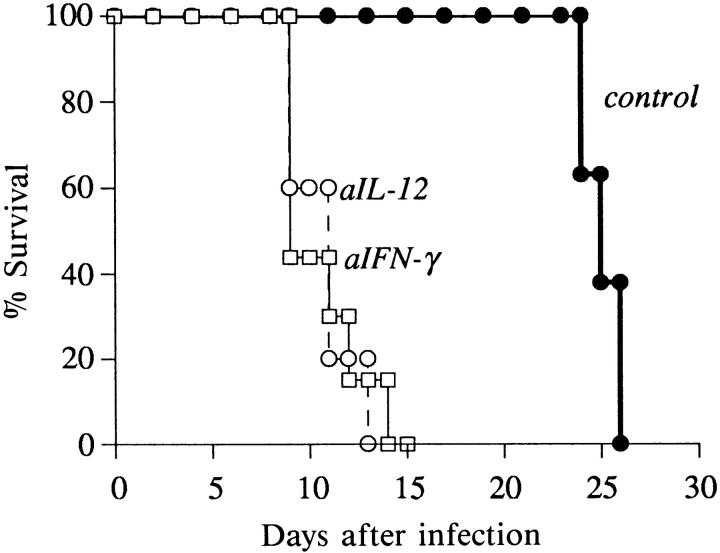
Innate resistance to T. gondii in iNOS ko mice is IL-12– and IFN-γ–dependent. iNOS ko animals were injected i.p. with 1 mg of either normal rat IgG (n = 8), anti–IFN-γ mAb XMG-6 (n = 7), or anti– IL-12 mAb C17.8 (n = 5) 1 d before infection with 20 cysts. Survival was monitored as in Fig. 1. The experiment shown is representative of three performed.
Figure 5
Figure 5
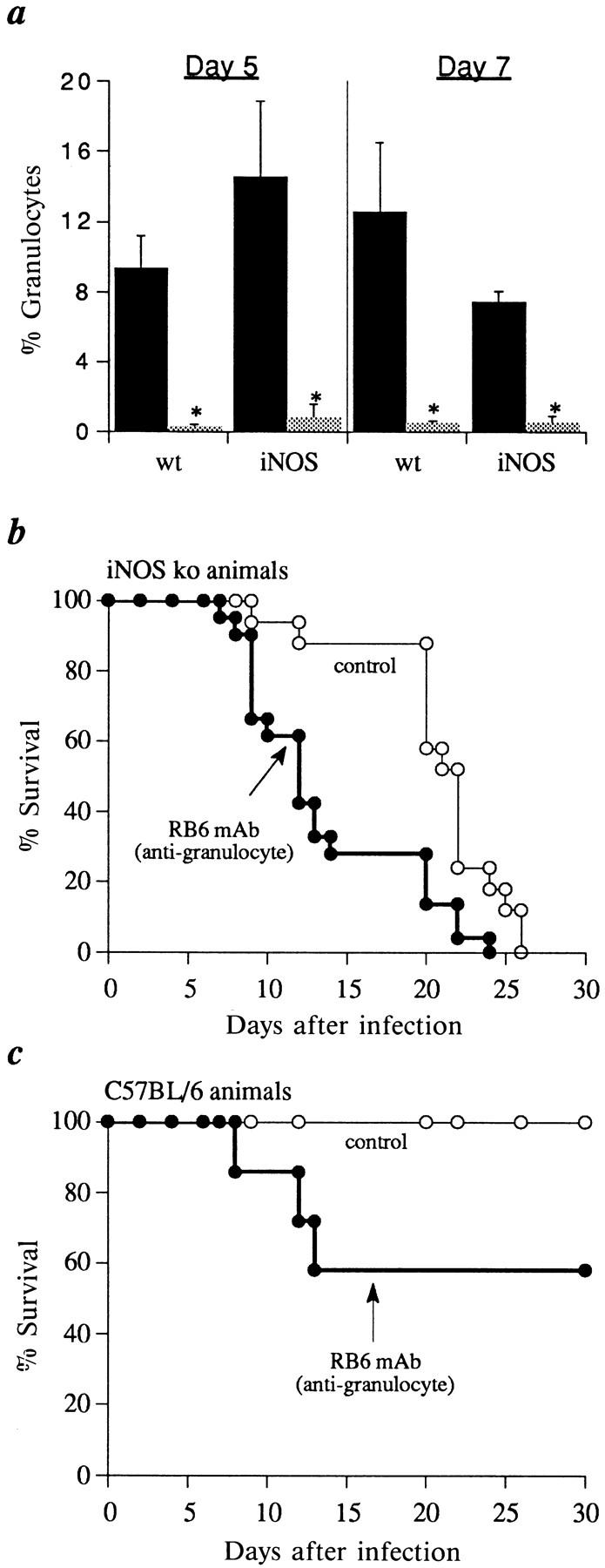
Treatment with anti-granulocyte mAb diminishes innate resistance to T. gondii in both iNOS and C57BL/6 (wt) mice. Groups of iNOS ko (n = 17–22, B) or C57BL/6 mice (n = 7–13, C) were treated at day 0, 2, and 4 with either the RB6-8C5 mAb or PBS as described in Materials and Methods. Differential counts (mean ± SE) were performed on peritoneal cells from animals killed at day 5 and 7 after infection (A, black bars, PBS treated; shaded bars, RB6-treated mice) and survival of the remaining animals determined as in Fig. 1 (B and C). The asterisks (*) indicate statistically significant differences (P ⩽0.05) in granulocyte composition. The experiment shown is representative of three performed.

References

    1. James S. Role of nitric oxide in parasitic infections. Microb Rev. 1995;59:533–547. - PMC - PubMed
    1. Nathan C, Xie Q. Nitric oxide synthases: roles, tolls and controls. Cell. 1994;78:915–918. - PubMed
    1. James SL, Glaven J. Macrophage cytotoxicity against schistosomula of Schistosoma mansoniinvolves arginine-dependent production of reactive nitrogen intermediates. J Immunol. 1989;143:4208–4212. - PubMed
    1. Green SJ, Meltzer JB, Hibbs JB, Jr, Nacy CA. Activated macrophages destroy intracellular Leishmania majoramastigotes by an L-arginine dependent killing mechanism. J Immunol. 1990;144:278–283. - PubMed
    1. Liew FY, Yun L, Millott S. TNF-alpha synergizes with IFN-gamma in mediating killing of Leishmania majorthrough the induction of nitric oxide. J Immunol. 1990;145:4306–4310. - PubMed

Publication types

MeSH terms