. 1997 Apr 7;185(7):1327-35.
doi: 10.1084/jem.185.7.1327.

CTLA-4-B7 interaction is sufficient to costimulate T cell clonal expansion

Affiliations

CTLA-4-B7 interaction is sufficient to costimulate T cell clonal expansion

Y Wu et al. J Exp Med. .

Abstract

T cell costimulation, particularly by the B7 family members B7-1 and B7-2, plays a critical role in regulating T cell-mediated immunity. Two molecules on T cells, CD28 and CTLA-4, are known to bind to B7. It has been suggested that CD28-B7 interaction promotes T cell response, whereas B7-CTLA-4 interaction downregulates T cell clonal expansion. However, the proposed responses of individual receptors to B7 have not been verified directly. Here, we report that B7-1 promotes clonal expansion of CD28-deficient T cells, and that the CD28-independent costimulatory activity is mediated by CTLA-4, as it is completely blocked by intact and Fab of anti-CTLA-4 mAb. In addition, a mutant B7-1 molecule, B7W88 >A, which has lost binding to CD28 but retained significant CTLA-4 binding activity, promotes T cell clonal expansion. Furthermore, while presence of CD28 enhances T cell response to B7-1, such response is also completely blocked by anti-CTLA-4 mAb. Taken together, our results demonstrate that B7-CTLA-4 interaction promotes T cell clonal expansion, and that optimal T cell response to B7 is achieved when both CD28 and CTLA-4 interact with B7. These results establish an important function of CTLA-4 in promoting T cell activation, and suggest an alternative interpretation of the function of CTLA-4 in T cell activation.


Figures
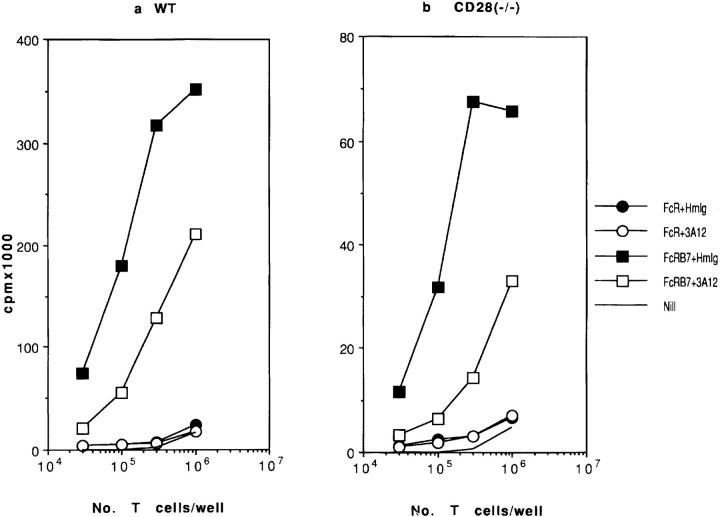
Figure 1
Figure 1
Costimulatory molecule B7-1 significantly enhances antiCD3–induced proliferative responses of CD4 T cells from either wildtype (a) or CD28-deficient (b) mice. Varying numbers of the wild-type (a) and CD28-deficient (b) CD4 T cells were stimulated with anti-CD3 mAb and mitomycin C–treated CHO cells that were transfected with either FcR (CHOFcR) or FcR plus murine B7-1 (CHOFcRB7) (104/well). The cultures were maintained for 42 h, and were pulsed with [3H]TdR (1.25 μCi/well) for an additional 6 h. Either normal hamster Ig or anti-B7 mAb 3A12 was added at the beginning of the culture to evaluate the contribution of B7-1 to T cell proliferation. cpm of [3H]TdR incorporated into mitomycin-treated CHO cells: CHOFcR, 326; CHOFcRB7, 1474. The CD28-independent costimulatory activity of B7-1 has been repeated 10 times.
Figure 2
Figure 2
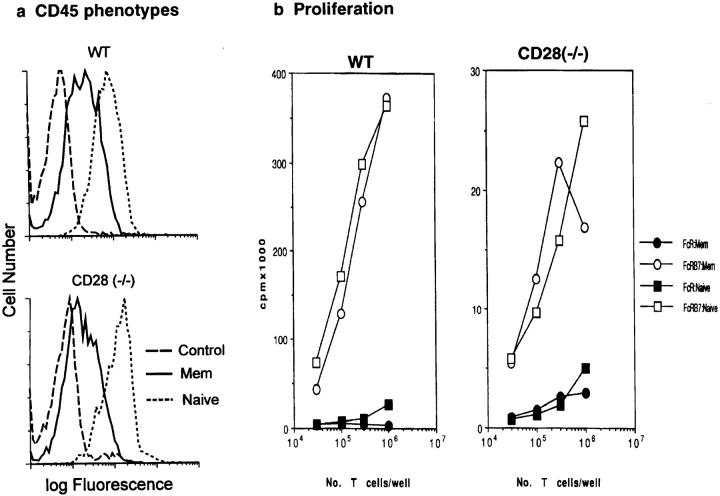
CD4 T cells expressing either naive or memory markers are capable of responding to B7-1 by a CD28-independent mechanism. (a) CD45RB profiles of the subsets of CD4 T cells used in the study. (b) Proliferative responses of CD4 T subsets from either wild-type (WT ) or CD28(−/−) mice to soluble anti-CD3 using CHO cells transfected with either FcR or FcR plus murine B7-1 as accessory cells.
Figure 3
Figure 3
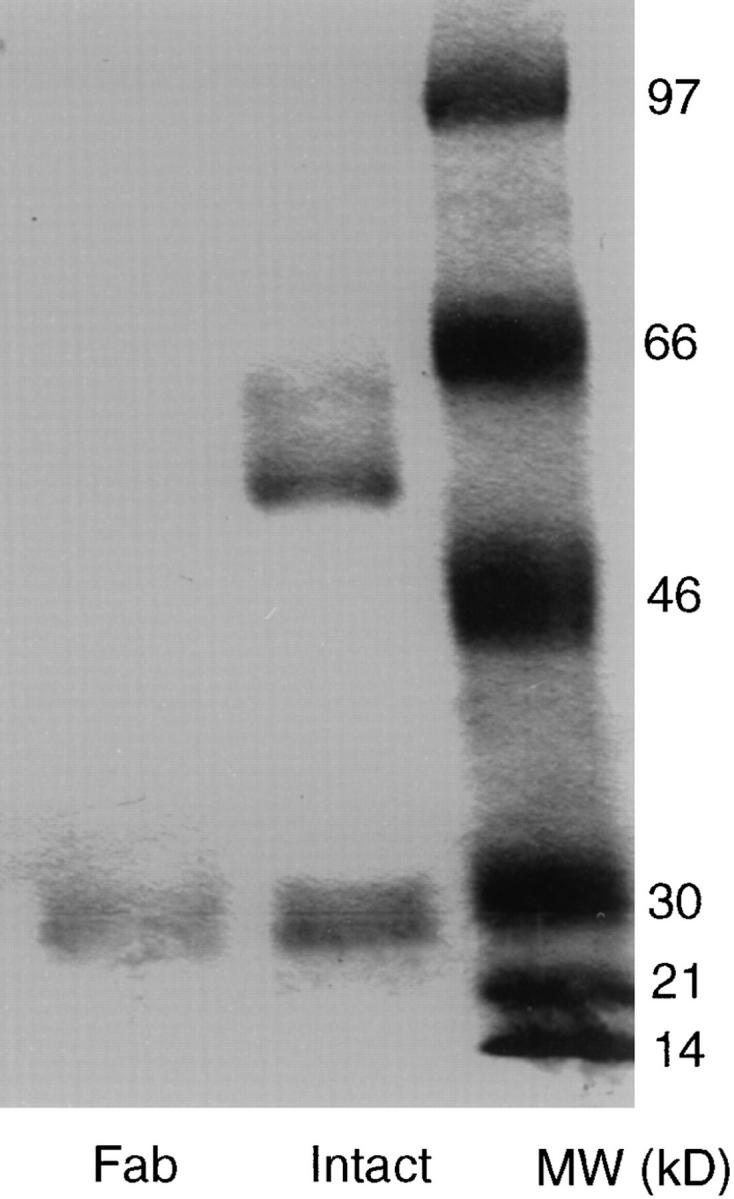
Fab preparation used in the study does not contain intact mAb. Anti–CTLA-4 mAb 4F10 was purified by affinity purification. Purified mAb was digested with papain, and Fc-containing molecules removed using immobilized protein A. 5 μg of intact and 2 μg of Fab were analyzed by 105 SDS-PAGE under reducing conditions.
Figure 4
Figure 4
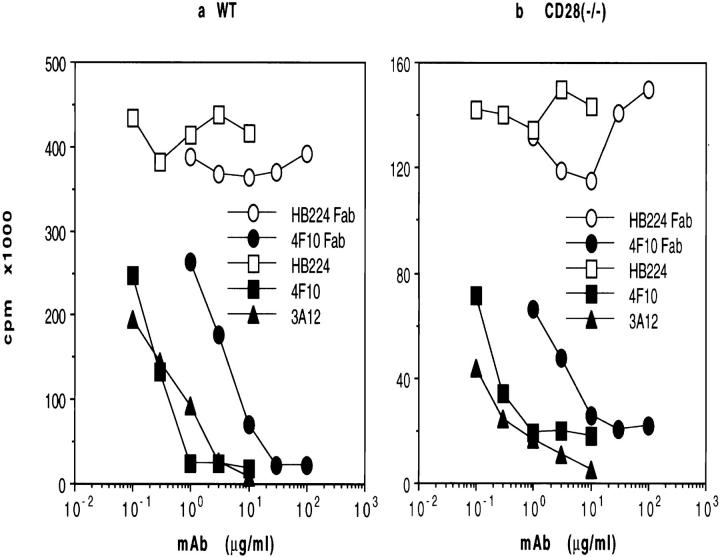
Both intact and Fab fragments of anti–CTLA-4 mAb block the costimulatory activity of B7-1. Purified CD4 T cells (105/well) either wild-type (a) and CD28-deficient (b) mice were stimulated with soluble anti-CD3 mAb (0.25 μg/ml) in the presence of mitomycin C–treated CHO cells (3 × 10³/well) transfected with FcR plus B7-1 (FcRB7) for 48 h. The proliferation of CD4 T cells was determined by incorporation of [3H]TdR in the last 6 h of culture. Given concentrations of intact or Fab fragment of anti–CTLA-4 mAb 4F10, or control mAb HB224 were added at the beginning of the culture. Data shown represent five independent experiments.
Figure 5
Figure 5
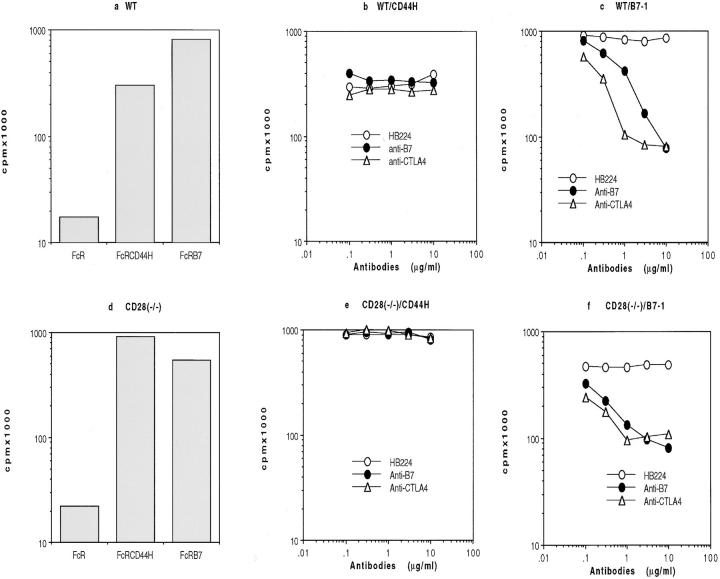
Specificity of inhibition by anti–CTLA-4 mAb. Wild-type (a–c, 5 × 10⁴/well) or CD28(−/−) (d–f, 105/well) CD4 T cells were stimulated with anti-CD3 mAb and CHO cells (mitomycin C–treated, 3,000/well) transfected with either FcR, FcR plus B7-1 (FcRB7), or FcR plus CD44H (FcRCD44H) for 48 h in the presence of control mAb HB224, anti–B7-1 mAb 10.16A, and anti–CTLA-4 mAb 4F10. (a and d) Proliferation of wildtype and CD28(−/−) T cells to anti-CD3 in the presence of CHOFcR, CHOFcRB7, and CHOFcR CD44H. Note that twice as many CD28(−/−) CD4 T cells were used to ensure a comparable total proliferative response. (b and e) Lack of inhibition by anti–CTLA-4 mAb when CD44H was used as costimulator. (c and f  ) Inhibition by anti–B7-1 and anti–CTLA-4 when B7-1 was used as costimulators.
Figure 6
Figure 6
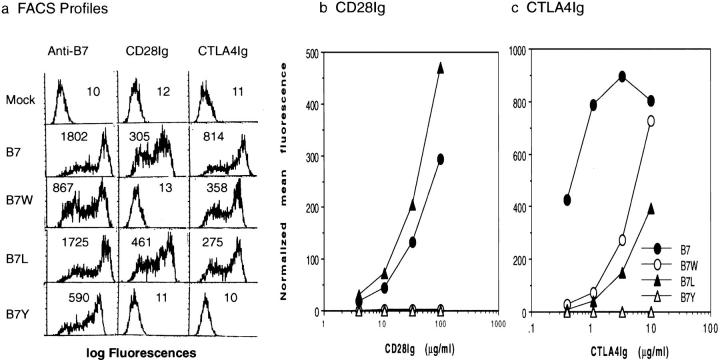
Characterization of B7-1 mutants. (a) FACS® profiles for the binding of wild-type and mutant B7 molecules, expressed on COS cells by transient transfection, to saturating amount of CD28Ig (100 μg/ml) and CTLA-4Ig (10 μg/ml) and anti-B7-1 mAb 10.16A (10 μg/ml). Numbers in each panel are mean fluorescences. (b and c) Quantitative analysis of CD28Ig and CTLA-4Ig binding to wild-type and mutant B7-1 (16, 23). COS cells were either mock-transfected or transfected with wild-type and mutant B7 cDNA. The COS cells were used to determine ability of wild-type and mutant B7 to bind varying concentration of either CD28Ig or CTLA-4Ig. The data shown are mean fluorescences normalized for the cell surface expression of B7-1 according to the following formula: Normalized MF for receptor binding = (MFmutant − MFmock) × k, where k = (MFmutant − MFmock) / (MFWT − MFmock) when anti-B7-1 mAb 10.16A is used to measure cell surface expression of wild-type or mutant B7-1. Representative of three independent experiments.
Figure 7
Figure 7
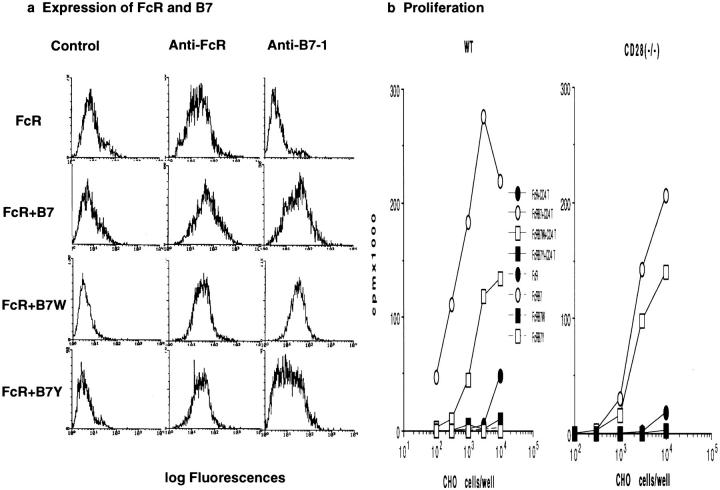
CTLA-4 binding activity is required for CD28-independent costimulation by B7-1. (a) Levels of FcR and B7 on CHO cells transfected with wild-type and mutant B7-1 measured by antiFcR mAb 2.4G2 or anti–B7-1 mAb 3A12. (b and c) Costimulatory activity of wild-type and B7 mutant B7W (88W >A) and B7Y (201Y >A) for either wild-type (b) or CD28(−/−) (c) T cells. Wild-type and CD28-deficient CD4 T cells were stimulated with anti-CD3 mAb and 104/well of mitomycin C–treated CHO cells. Data presented are representatives of three independent experiments.
Figure 8
Figure 8
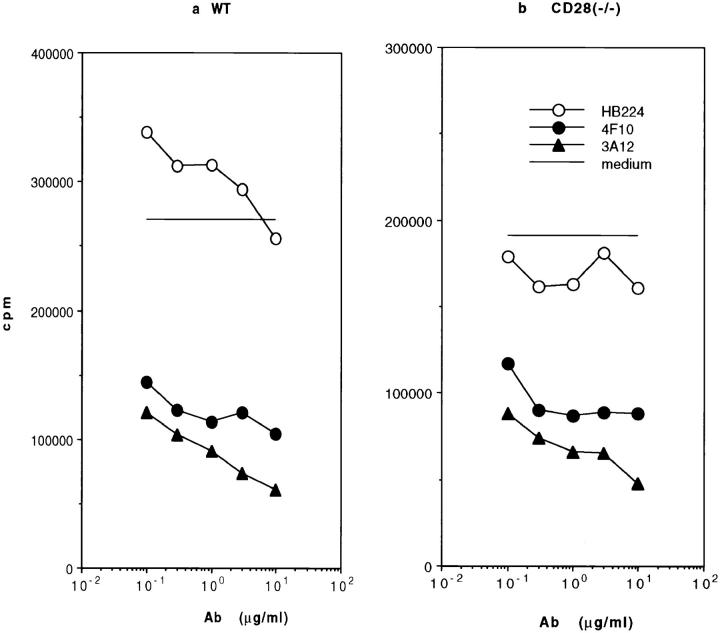
Anti–CTLA-4 mAb inhibits B7W-mediated costimulation for clonal expansion of T cells from wild-type and CD28-deficient mice. CD4 T cells (105/well) were stimulated for 48 h by anti-CD3 mAb and mitomycin C–treated CHO cells that have been transfected with both FcR and B7W (104/well). Given concentration of anti–CTLA-4 mAb 4F10, anti–B7-1 mAb 3A12, and control anti-CD11c mAb HB224 was added at the beginning of culture. Data presented are representatives of three independent experiments.

References

    1. Brestcher P, Cohn M. A theory of self–nonself discrimination. Science (Wash DC) 1970;169:1042–1049. - PubMed
    1. Lafferty KJ, Prowse SJ, Simeonovich CJ, Warren HS. Immunobiology of tissue transplantation: a return to passenger leukocyte concept. Annu Rev Immunol. 1983;1:143–173. - PubMed
    1. Mueller DL, Jenkins MK, Schwartz RH. Clonal expansion vs functional clonal inactivation: a costimulatory signalling pathway determines the outcome of T cell antigen occupancy. Annu Rev Immunol. 1989;7:445–480. - PubMed
    1. Liu Y, Linsley PS. T cell costimulation. Curr Opin Immunol. 1992;4:265–270. - PubMed
    1. Linsley PS, Clark EA, Ledbetter JA. The T cell antigen, CD28, mediates adhesion with B cells by interacting with the activation antigen B7. Proc Natl Acad Sci USA. 1990;87:5031–5035. - PMC - PubMed

Publication types

MeSH terms