. 1997 Apr 15;94(8):3748-52.
doi: 10.1073/pnas.94.8.3748.

Generation of Alzheimer beta-amyloid protein in the trans-Golgi network in the apparent absence of vesicle formation

Affiliations

Generation of Alzheimer beta-amyloid protein in the trans-Golgi network in the apparent absence of vesicle formation

H Xu et al. Proc Natl Acad Sci U S A. .

Abstract

beta-amyloid protein (A beta) formation was reconstituted in permeabilized neuroblastoma cells expressing human Alzheimer beta-amyloid precursor protein (beta APP) harboring the Swedish double mutation associated with familial early-onset Alzheimer disease. Permeabilized cells were prepared following metabolic labeling and incubation at 20 degrees C, a temperature that allows beta APP to accumulate in the trans-Golgi network (TGN) without concomitant A beta formation. Subsequent incubation at 37 degrees C led to the generation of A beta. A beta production in the TGN persisted even under conditions in which formation of nascent post-TGN vesicles was inhibited by addition of guanosine 5'-O-(3-thiotriphosphate), a nonhydrolyzable GTP analogue, or by omission of cytosol. These and other results indicate that vesicle budding and trafficking may not be required for proteolytic metabolism of beta APP to A beta, a process that includes "gamma-secretase" cleavage within the beta APP transmembrane domain.


Figures
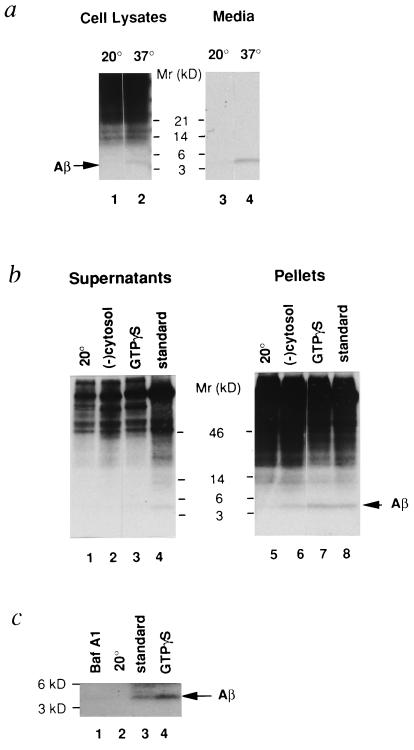
Figure 1
Figure 1
Aβ formation from Swedish βAPP in intact cells (a), permeabilized cells (b), and purified TGN (c). (a) A 20°C block prevents Aβ generation in intact cells. N2a cells expressing Swedish βAPP were pulse-labeled with [35S]methionine at 37°C for 10 min and then further incubated at either 20°C (lanes 1 and 3) or 37°C (lanes 2 and 4) for 2 hr. Samples of medium and cell lysate were immunoprecipitated with antibody 4G8 and analyzed on 10–20% Tricine SDS/PAGE. Arrow indicates Aβ peptide. (b) Aβ generation in permeabilized cells. Cells were pulse-labeled with [35S]methionine at 37°C for 10 min and incubated at 20°C for 2 hr. Permeabilized cells were then prepared as described. Aliquots of permeabilized cells were incubated for 90 min either under standard conditions at 20°C (lanes 1 and 5) or 37°C (lanes 4 and 8), or at 37°C in the absence of added cytosol (lanes 2 and 6), or at 37°C in the presence of 30 μM GTPγS (lanes 3 and 7). Following fractionation, samples of supernatant and pellet were immunoprecipitated with antibody 4G8 and analyzed on 10–20% Tricine SDS/PAGE. (c) Aβ generated in permeabilized cells is recovered in a TGN-enriched fraction. Permeabilized cells that were previously incubated for 90 min at 20°C under standard conditions (lane 2) or at 37°C either under the standard conditions (lane 3) or in the presence of 1 μM baf A1 (lane 1) or 30 μM GTPγS (lane 4) were homogenized, and the postnuclear supernatant was applied to an equilibrium sucrose gradient (12). The TGN-enriched fractions were immunoprecipitated with antibody 4G8 and analyzed on 10–20% Tricine SDS/PAGE.
Figure 2
Figure 2
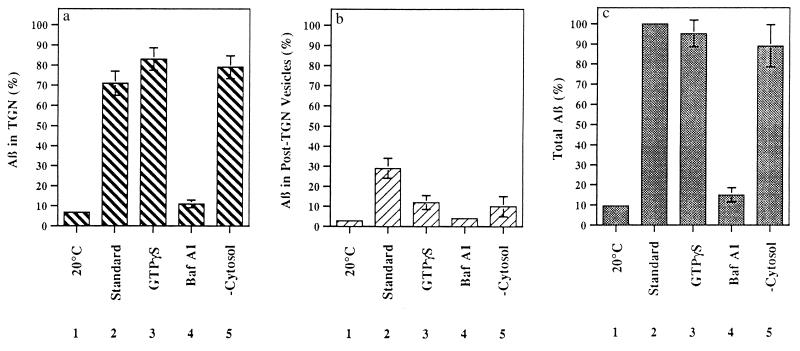
Quantitative analysis of Aβ formation in permeabilized cells. Cells were incubated for 90 min at 20°C under standard conditions or at 37°C under the conditions indicated. The histograms show the amount of Aβ present in the TGN (a), in post-TGN nascent vesicles (b), and in TGN plus post-TGN nascent vesicles (c). Autoradiographic densities were quantitated using a Bio-Rad PhosphorImager, software version 2.0. In each experiment, data were normalized to total Aβ formed under standard conditions. Data represent means ± SEM for three experiments.
Figure 3
Figure 3
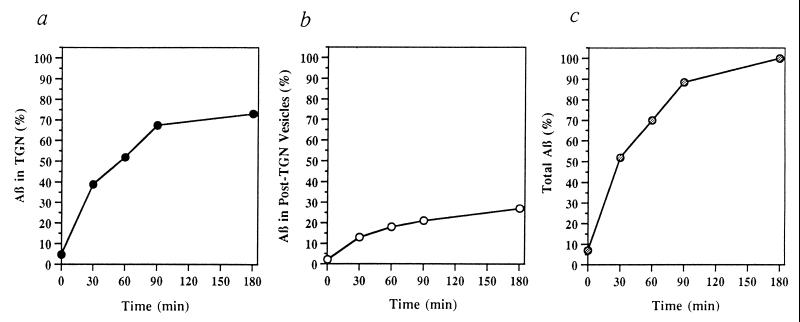
Time dependence of Aβ formation in permeabilized cells. Aβ present in the TGN (a), post-TGN nascent vesicles (b), and TGN plus post-TGN nascent vesicles (c) is shown as a function of incubation time at 37°C. Data represent means for two experiments.
Figure 4
Figure 4
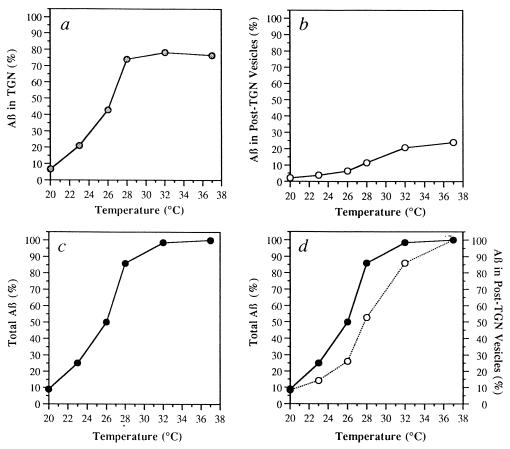
Temperature dependence of Aβ formation in permeabilized cells. Aβ present in the TGN (a), post-TGN nascent vesicles (b and d) and TGN plus post-TGN nascent vesicles (c and d) is shown following incubation for 90 min at the indicated temperature. (ac) In each experiment, data were normalized to total Aβ formed at 37°C. (d) In each experiment, data representing total Aβ (•) and Aβ in the post-TGN nascent vesicles (○) were normalized to their respective values at 37°C. Data represent means for two experiments.

References

    1. Gandy S, Greengard P. Int Rev Neurobiol. 1994;36:29–50. - PubMed
    1. Sisodia S S, Koo E H, Beyreuther K, Unterbeck A, Price D L. Science. 1990;248:492–495. - PubMed
    1. Seubert P, Oltersdorf T, Lee M G, Barbour R, Blomquist C, Davis D L, Bryant K, Galasko D, Thal L J, Fritz L, Lieberburg I, Schenk D. Nature (London) 1993;361:260–263. - PubMed
    1. Seubert P, Vigo-Pelfrey C, Esch F, Lee M, Dovey H, Davis D, Sinha S, Schlossmacher M, Whaley J, Swindlehurst C, McCormack R, Wolfert R, Selkoe D J, Lieberburg I, Schenk D. Nature (London) 1992;359:325–327. - PubMed
    1. Shoji M, Golde T E, Ghiso J, Cheung T T, Estus S, Shaffer L M, Cai X, McKay D M, Tintner R, Frangione B, Younkin S G. Science. 1992;258:126–129. - PubMed

Publication types

MeSH terms

Substances

LinkOut - more resources