. 1997 Apr 15;94(8):3783-8.
doi: 10.1073/pnas.94.8.3783.

Retrograde transport of mutant ricin to the endoplasmic reticulum with subsequent translocation to cytosol

Affiliations

Retrograde transport of mutant ricin to the endoplasmic reticulum with subsequent translocation to cytosol

A Rapak et al. Proc Natl Acad Sci U S A. .

Abstract

Translocation of ricin A chain to the cytosol has been proposed to take place from the endoplasmic reticulum (ER), but attempts to visualize ricin in this organelle have failed. Here we modified ricin A chain to contain a tyrosine sulfation site alone or in combination with N-glycosylation sites. When reconstituted with ricin B chain and incubated with cells in the presence of Na(2)(35)SO(4), the modified A chains were labeled. The labeling was prevented by brefeldin A and ilimaquinone, and it appears to take place in the Golgi apparatus. This method allows selective labeling of ricin molecules that have already been transported retrograde to this organelle. A chain containing C-terminal N-glycosylation sites became core glycosylated, indicating retrograde transport to the ER. In part of the toxin molecules, the A chain was released from the B chain and translocated to the cytosol. The finding that glycosylated A chain was present in the cytosol indicates that translocation takes place after transport of the toxin to the ER.


Figures
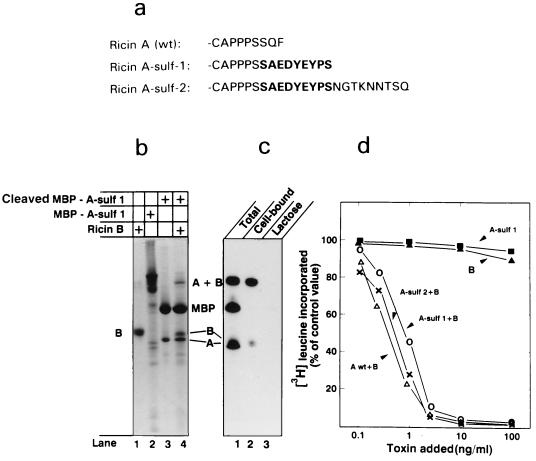
Figure 1
Figure 1
Formation of modified ricin A chains and their reconstitution with the B chain to form holotoxin. (a) The C-terminal end of wild-type ricin A chain and A chain modified to contain sulfation and glycosylation sites. The C-terminal nonapeptide of rat cholecystokinin precursor (indicated with boldface type) was added to the C-terminal end of ricin A chain to form ricin A-sulf-1. To form ricin A-sulf-2, a nonapeptide containing three partially overlapping N-glycosylation sites was added to the C terminus of ricin A-sulf-1. The constructs were produced as fusion proteins with maltose-binding protein (MBP) and purified on an amylose column. (b) Lanes: 1, ricin B chain; 2, uncleaved fusion protein containing ricin A-sulf-1; 3, the same as lane 2, but after cleavage with factor Xa; 4, reconstituted ricin obtained by dialyzing together material as in lanes 1 and 3. (c) Material as in b, lane 4, labeled with 125I (lane 1) was added to Vero cells at 4°C for 30 min in the absence (lane 2) and presence (lane 3) of 10 mM lactose. The cells were then washed and analyzed by SDS/PAGE under nonreducing conditions. (d) Increasing amounts of wild-type and reconstituted ricin or the free A and B chains were added to Vero cells and incubated for 4 h. Then the ability of the cells to incorporate [3H]leucine was measured.
Figure 2
Figure 2
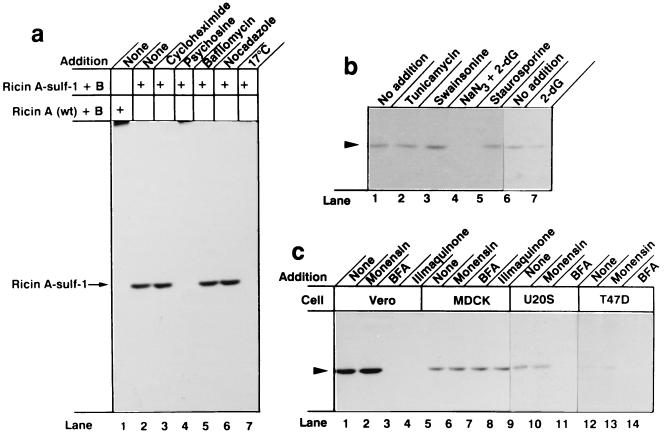
Sulfation of ricin A-sulf-1 upon incubation of reconstituted toxin with different cells. (a) Near confluent Vero cells growing in 5-cm2 dishes were washed twice with DMEM without sulfate and incubated with the same medium containing 100 μCi/ml Na235SO4 for 3 h. The indicated compounds were added, and after 30 min, 200 ng/ml reconstituted ricin containing ricin A-wt (lane 1) or ricin A-sulf-1 (lanes 2–7) was added and the incubation was continued for 4 h. Then the cells were washed with PBS and lysed, the nuclei were removed by centrifugation, and the clear supernatant was submitted to immunoprecipitation with rabbit anti-ricin antibodies immobilized on CNBr-Sepharose 4B. The adsorbed material was analyzed by SDS/PAGE under reducing conditions. The additions were as follows: lane 3, 20 μg/ml cycloheximide; lane 4, 20 μM psychosine; lane 5, 0.1 μM bafilomycin A1; lane 6, 30 μM nocodazole; lane 7, the incubation temperature was 17°C. (b) Conditions were as in a, lane 2, but the additions were as follows: lane 2, 1 μM tunicamycin; lane 3, 1 μg/ml swainsonine; lane 4, 10 mM NaN3 and 50 mM 2-deoxyglucose; lane 5, 0.1 μM staurosporil; lane 7, 50 mM 2-deoxyglucose. (c) Cells as indicated were treated as in b with the following additions: lanes 2, 6, 10, and 13, 10 μM monensin; lanes 3, 7, 11, and 14, 2 μg/ml brefeldin A; lanes 4 and 8, 30 μM ilimaquinone.
Figure 3
Figure 3
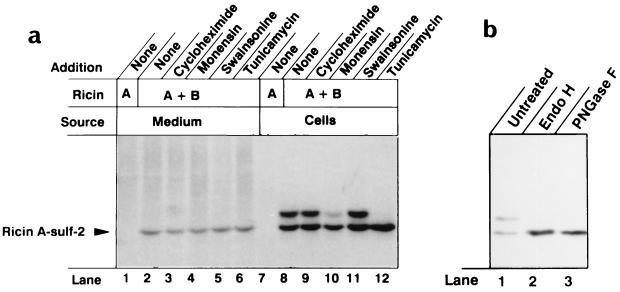
Sulfation and glycosylation of ricin A-sulf-2. (a) Vero cells were incubated with 35SO42− and ricin A-sulf-2 alone (lanes 1 and 7) or ricin A-sulf-2 reconstituted with ricin B chain (lanes 2–6 and 8–12). The immunoprecipitated material in the medium (lanes 1–6) and in the dissolved cells (lanes 7–12) was analyzed by SDS/PAGE under reducing conditions. The additions were as follows: lanes 3 and 9, 20 μg/ml cycloheximide; lanes 4 and 10, 10 μM monensin; lanes 5 and 11, 1 μg/ml swainsonine; lanes 6 and 12, 1 μM tunicamycin. (b) Vero cells incubated with 35SO42− and reconstituted ricin containing A-sulf-2 were lysed and immunoprecipitated with immobilized anti-ricin. The samples were either kept untreated or treated with Endo H and PNGase F, as indicated. Then sample buffer was added, and the samples were boiled for 5 min and submitted to SDS/PAGE under reducing conditions.
Figure 4
Figure 4
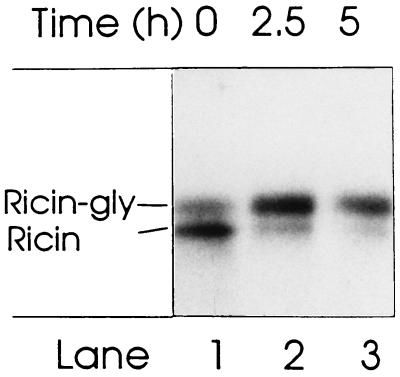
Time course of glycosylation of sulfate-labeled ricin. Ricin A-sulf-2 reconstituted with ricin B chain was incubated with Vero cells for 4 h in the presence of 35SO42−, then the cells were washed and incubated further in medium without toxin and isotope. After the indicated periods of time, cells were harvested and analyzed by SDS/PAGE under nonreducing conditions.
Figure 5
Figure 5
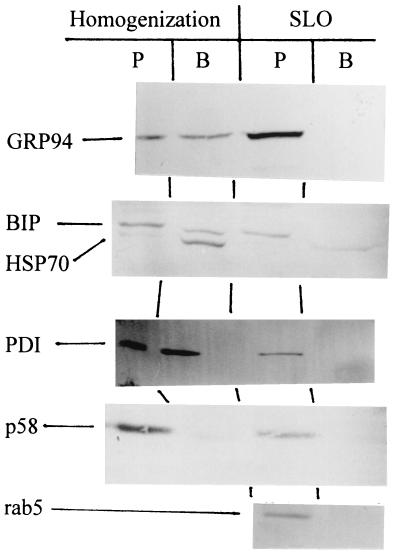
Effect of cell permeabilization on release of resident organellar proteins. Vero cells were either homogenized or permeabilized with SLO as described in Materials and Methods. For homogenization, the cells were removed from the plastic by scraping and disrupted in PBS by passing them 10 times up and down through a 0.5-mm gauge syringe. The suspension was then centrifuged for 10 min in an Eppendorf centrifuge to remove nuclei and mitochondria. The postmitochondrial supernatant as well as the buffer fraction obtained after the SLO treatment were centrifuged at 128,000 × g for 30 min. In both cases, the pellet (P) was taken as the membrane fraction and the supernatant (B, buffer) as the cytosolic fraction. Both fractions were fractionated by SDS/PAGE, transferred to Immobilon membranes, and probed with antibodies against GRP94, BIP, HSP70, PDI, p58, and rab5.
Figure 6
Figure 6
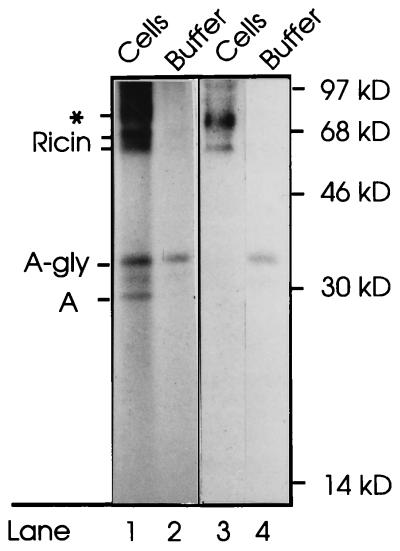
Translocation of ricin A chain to the cytosol. Vero cells were incubated with Na235SO4 and ricin containing A-sulf-2 for 4 h. Then N-ethylmaleimide (10 mM) was added and the cells were further incubated for 10 min and then washed twice with PBS containing 0.1 M lactose. The cells were permeabilized with SLO. After collection of the buffer, the cells were lysed in Triton X-100 and centrifuged to remove the nuclei. Both supernatant fractions were treated with immobilized anti-ricin, and the adsorbed material was submitted to SDS/PAGE under nonreducing conditions. Lanes 1 and 2, and lanes 3 and 4 represent two different experiments. On the left, the positions of glycosylated and unglycosylated ricin holotoxin, and of glycosylated and unglycosylated free ricin A-sulf-2 are indicated. The band marked by an asterisk indicates the position of a contaminant, presumably a sticky sulfate-containing proteoglycan, that often comes down together with the immunoprecipitate. Molecular mass markers are indicated on the right.

References

    1. Olsnes S, Sandvig K, Petersen O W, van Deurs B. Immunol Today. 1989;10:291–295. - PubMed
    1. Vitetta E S, Thorpe P E. Semin Cell Biol. 1991;2:47–58. - PubMed
    1. Thrush G R, Lark L R, Clinchy B C, Vitetta E S. Annu Rev Immunol. 1996;14:49–71. - PubMed
    1. Olsnes S, Pihl A. Biochemistry. 1973;12:3121–3126. - PubMed
    1. Endo Y, Mitsui K, Motizuki M, Tsurugi K. J Biol Chem. 1987;262:5908–5912. - PubMed

Publication types

LinkOut - more resources