. 1997 Apr 15;94(8):3854-9.
doi: 10.1073/pnas.94.8.3854.

Specific chromosomal imbalances in human papillomavirus-transfected cells during progression toward immortality

Affiliations

Specific chromosomal imbalances in human papillomavirus-transfected cells during progression toward immortality

S Solinas-Toldo et al. Proc Natl Acad Sci U S A. .

Abstract

High risk human papillomaviruses (HPVs) known to be closely associated with cervical cancer, such as HPV16 and HPV18, have the potential to immortalize human epithelial cells in culture. Four lines of HPV-transfected keratinocytes were analyzed by comparative genomic hybridization at different time points after transfection. A number of chromosomal imbalances was found to be highly characteristic for the cultures progressing toward immortality. Whereas several of these were new and previously not found as recurrent aberrations in cervical tumors, some were identical to chromosomal changes observed during cervical carcinogenesis. The data put new emphasis on the studied cell system as a relevant model for HPV-induced pathogenesis.


Figures
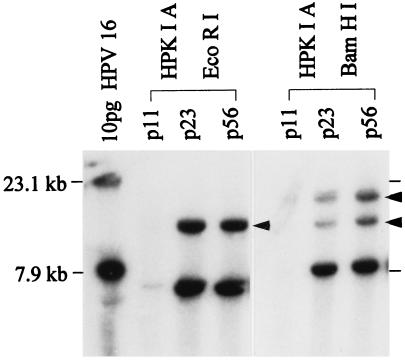
Figure 1
Figure 1
Detection of HPV16 DNA in a keratinocyte cell culture (HPK IA) by Southern blot analysis at different time points after transfection. Ten picograms of HPV16 DNA excised from vector by BamHI digestion (7.9 kb) is included as a sensitivity marker for hybridization and represents approximately one viral copy per cell. Total genomic cell line DNA was digested with EcoRI or BamHI. The 7.3-kb EcoRI band and the 7.9-kb BamHI band are characteristic for cleavage of the full length HPV16 genome whereas high molecular mass EcoRI and BamHI bands (arrowheads) are indicative of viral integration.
Figure 2
Figure 2
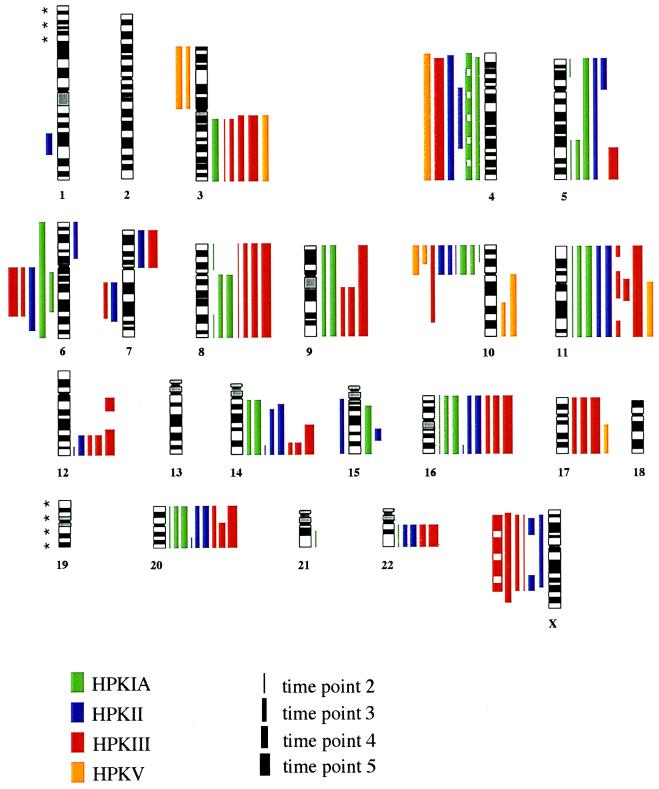
Summary of the chromosomal imbalances detected in four HPV-immortalized keratinocyte cell lines at different time points. Vertical lines on the left of chromosome ideograms indicate loss of genetic material; vertical lines on the right indicate gain of genetic material. Each line is presented by a color as indicated at the bottom. Chromosomal imbalances were not found at the first time point analyzed; imbalances found at the second, third, fourth, and fifth time points are drawn with lines of increasing thickness as indicated at the bottom. Interrupted lines indicate ratio values close to, but not reaching, the diagnostic threshold, possibly because of the presence of a subclone carrying this chromosomal imbalance (see text). ∗, The distal part of chromosome 1p and the chromosome 19 are labeled with asterisks because imbalances found in these two regions were not scored for reasons mentioned in Materials and Methods.
Figure 3
Figure 3
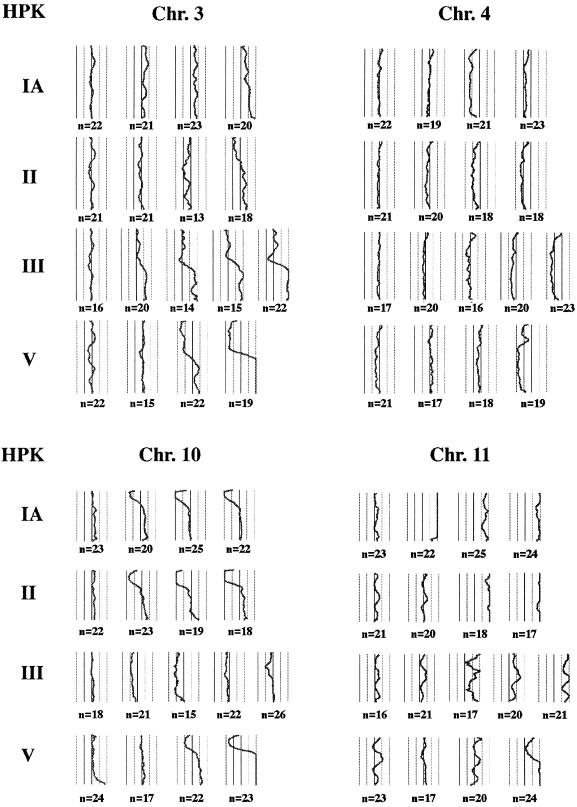
CGH average ratio profiles of chromosomes 3, 4, 10, and 11 at the different time points analyzed for each of the four HPK cell lines. The ratios of fluorescein isothiocyanate/tetramethylrhodamine B isothiocyanate fluorescence are plotted along the chromosome ideograms. The central line indicates the intensity ratio of a balanced copy number (value of 1), and the thresholds for over- (value of 1.25) and underrepresentation (value of 0.75) are indicated by the adjacent right and left lines, respectively (the far right and left lines represent the values of 1.5 and 0.5, respectively). This figure is comprised of black and white prints of CGH profiles obtained with the cytovision CGH software package.

References

    1. zur Hausen H. Curr Top Microbiol Immunol. 1994;186:131–156. - PubMed
    1. zur Hausen H. Cancer Res. 1989;49:4677–4681. - PubMed
    1. Dürst M, Dzarlieva-Petrusevska R T, Boukamp P, Fusenig N E, Gissmann L. Oncogene. 1987;1:251–256. - PubMed
    1. Pirisi L, Yasumoto S, Feller M, Doniger J, DiPaolo J A. J Virol. 1987;6:1061–1066. - PMC - PubMed
    1. Schlegel R, Phelps W C, Zhang Y-L, Barbosa M. EMBO J. 1988;7:3181–3187. - PMC - PubMed

LinkOut - more resources