. 1997 Apr 15;94(8):4143-8.
doi: 10.1073/pnas.94.8.4143.

Mice devoid of gamma-aminobutyrate type A receptor beta3 subunit have epilepsy, cleft palate, and hypersensitive behavior

Affiliations

Mice devoid of gamma-aminobutyrate type A receptor beta3 subunit have epilepsy, cleft palate, and hypersensitive behavior

G E Homanics et al. Proc Natl Acad Sci U S A. .

Abstract

gamma-Aminobutyric acid type A receptors (GABA(A)-Rs) mediate the bulk of rapid inhibitory synaptic transmission in the central nervous system. The beta3 subunit is an essential component of the GABA(A)-R in many brain regions, especially during development, and is implicated in several pathophysiologic processes. We examined mice harboring a beta3 gene inactivated by gene targeting. GABA(A)-R density is approximately halved in brain of beta3-deficient mice, and GABA(A)-R function is severely impaired. Most beta3-deficient mice die as neonates; some neonatal mortality, but not all, is accompanied by cleft palate. beta3-deficient mice that survive are runted until weaning but achieve normal body size by adulthood, although with reduced life span. These mice are fertile but mothers fail to nurture offspring. Brain morphology is grossly normal, but a number of behaviors are abnormal, consistent with the widespread location of the beta3 subunit. The mice are very hyperactive and hyperresponsive to human contact and other sensory stimuli, and often run continuously in tight circles. When held by the tail, they hold all paws in like a ball, which is frequently a sign of neurological impairment. They have difficulty swimming, walking on grids, and fall off platforms and rotarods, although they do not have a jerky gait. beta3-deficient mice display frequent myoclonus and occasional epileptic seizures, documented by electroencephalographic recording. Hyperactivity, lack of coordination, and seizures are consistent with reduced presynaptic inhibition in spinal cord and impaired inhibition in higher cortical centers and/or pleiotropic developmental defects.


Figures
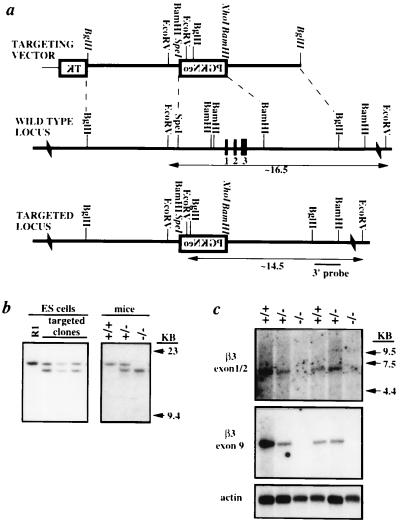
Figure 1
Figure 1
Targeted disruption of the β3 locus. (a) A replacement vector was constructed to replace ≈2.8 kb of β3 genomic DNA including ≈1.8 kb of promoter and exons 1–3 with the selectable marker neomycin phosphotransferase (PGKNeo). (Note that restriction sites set in italics were destroyed during vector construction.) (b) Southern blot analyses of the parental cell line (R1), three correctly targeted ES cell clones, and mice demonstrating all genotypes. (c) Northern blot analysis of neonatal mouse brain poly(A)+ RNA that demonstrates the absence of β3 mRNA in brain of β3−/− mice.
Figure 2
Figure 2
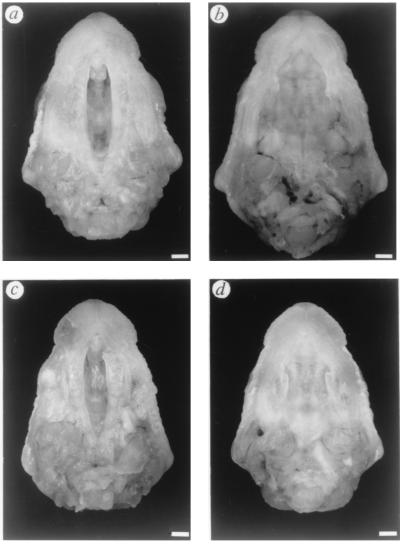
Palate morphology of pcp and targeted β3 neonates. (a) pcp/pcp. (b) pcp/p6H. (c) β3−/−. (d) β3+/−. The pcp/p6H and the β3+/− mice each have one wild-type β3 gene and do not exhibit cleft palate. (Bar = 1 mm.)
Figure 3
Figure 3
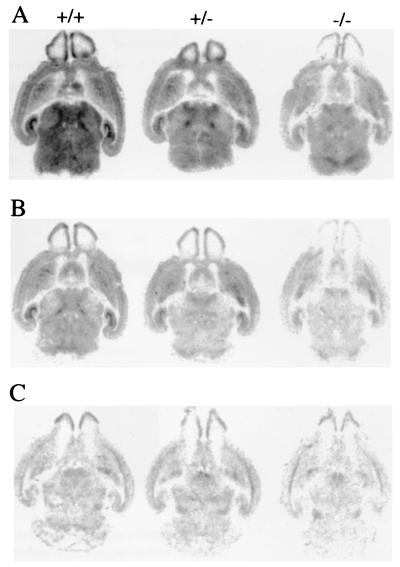
Autoradiographic binding of a GABA site ligand ([3H]muscimol) and a benzodiazepine site ligand ([3H]Ro15-4513) to representative horizontal brain sections from newborn wild-type (+/+), heterozygous (+/−), and homozygous (−/−) mice. (A) Total binding of 5 nM [3H]Ro15-4513. (B) Binding of [3H]Ro15-4513 in the presence of 30 μM zolpidem. (C) Total binding of 20 nM [3H]muscimol. All images represent specific binding since [3H]Ro15-4513 and [3H]muscimol failed to label any sites in the presence of 10 μM flumazenil and 100 μM GABA, respectively.
Figure 4
Figure 4
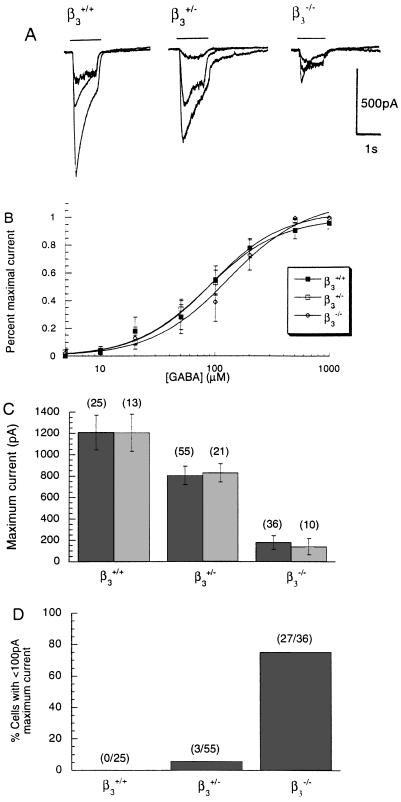
GABA-evoked whole cell currents from acutely dissociated DRG neurons of newborn β3+/+, β3+/−, and β3−/− mice. (A) Representative currents from individual neurons from each group in response to GABA (10 μM, 100 μM, and 1 mM). The bar above the trace represents duration of GABA application. (B) Pooled GABA concentration-response curves (4 < n < 7), yielding EC50 values of 86.1 ± 9.3 μM (+/+), 92.1 ± 6.0 μM (+/−), and 131.0 ± 23.0 μM (−/−). Hill coefficients were 1.4, 1.4, and 1.3. (C) Pooled data for maximal GABA current amplitudes (mean ± SEM) expressed for all neurons tested (dark shading) and for the average current from neurons in each mouse (light shading). (D) The majority of neurons from β3−/− mice produced <100 pA maximal current. In contrast, only a small minority of neurons from β3+/− mice and none from β3+/+ animals produced such small currents in response to GABA.
Figure 5
Figure 5
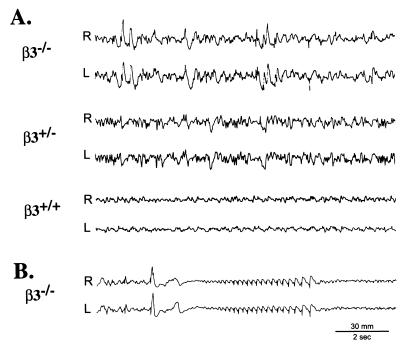
Electroencephalographic recordings. (A) Three animals (β3−/−, β3+/−, β3+/+) were simultaneously recorded at 2 months of age. The β3−/− record (Top) is abnormal, displaying abundant paroxysmal slow and sharp wave activity, in marked contrast to the normal pattern of β3+/+ littermate controls (Bottom). β3+/− mice display a pattern intermediate between that of β3−/− and β3+/+ records. (B) Seizure in β3−/− mouse at 5 months of age, followed by suppression of electrocortical activity.

References

    1. Stephenson F A. Biochem J. 1995;310:1–9. - PMC - PubMed
    1. McKernan R, Whiting P. Trends Neurosci. 1996;19:139–143. - PubMed
    1. Laurie B J, Wisden W, Seeburg P H. J Neurosci. 1992;12:4151–4172. - PMC - PubMed
    1. Wisden W, Laurie D J, Monyer H, Seeburg P H. J Neurosci. 1992;12:1040–1062. - PMC - PubMed
    1. Nakatsu Y, Tyndale R F, DeLorey T M, Durham-Pierre D, Gardner J M, McDanel H J, Nguyen Q, Wagstaff J, Lalande M, Sikela J M, Olsen R W, Tobin A J, Brilliant M H. Nature (London) 1993;364:448–450. - PubMed

Publication types

Substances