. 1997 Apr 15;94(8):4211-6.
doi: 10.1073/pnas.94.8.4211.

Expression of a borage desaturase cDNA containing an N-terminal cytochrome b5 domain results in the accumulation of high levels of delta6-desaturated fatty acids in transgenic tobacco

Affiliations

Expression of a borage desaturase cDNA containing an N-terminal cytochrome b5 domain results in the accumulation of high levels of delta6-desaturated fatty acids in transgenic tobacco

O Sayanova et al. Proc Natl Acad Sci U S A. .

Abstract

gamma-Linolenic acid (GLA; C18:3 delta(6,9,12)) is a component of the seed oils of evening primrose (Oenothera spp.), borage (Borago officinalis L.), and some other plants. It is widely used as a dietary supplement and for treatment of various medical conditions. GLA is synthesized by a delta6-fatty acid desaturase using linoleic acid (C18:2 delta(9,12)) as a substrate. To enable the production of GLA in conventional oilseeds, we have isolated a cDNA encoding the delta6-fatty acid desaturase from developing seeds of borage and confirmed its function by expression in transgenic tobacco plants. Analysis of leaf lipids from a transformed plant demonstrated the accumulation of GLA and octadecatetraenoic acid (C18:4 delta(6,9,12,15)) to levels of 13.2% and 9.6% of the total fatty acids, respectively. The borage delta6-fatty acid desaturase differs from other desaturase enzymes, characterized from higher plants previously, by the presence of an N-terminal domain related to cytochrome b5.


Figures
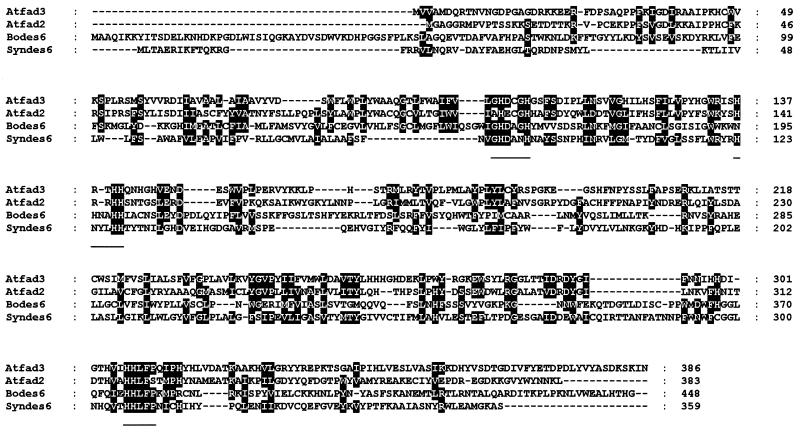
Figure 1
Figure 1
Comparison of the deduced amino acid sequence of pBdes6 (labeled bodes6) with other desaturases. The entire coding sequence of pBdes6 was compared with the Arabidopsis FAD2 (atfad2) and FAD3 (atfad3) microsomal desaturases, as well as the cyanobacterial Δ6 desaturase (syndes6). Identical or conserved residues are boxed, and the conserved histidine boxes are underlined. The sequence of pBdes6 has been deposited in the GenBank database (accession no. U79010U79010).
Figure 2
Figure 2
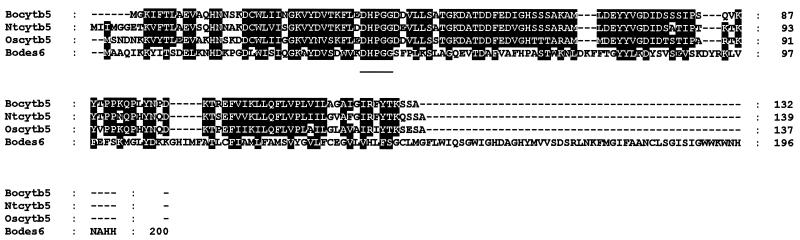
Comparison of the deduced amino acid sequence of pBdes6 with plant cytochrome b5 sequences. The first 196 residues of pBdes6 (bodes6) were compared with cytochrome b5 sequences from borage (bocytb5), rice (oscytb5), and tobacco (ntcytb5). The conserved heme-binding domain is underlined. The sequence of borage cytochrome b5 has been deposited in the GenBank database (accession no. U79011U79011).
Figure 3
Figure 3
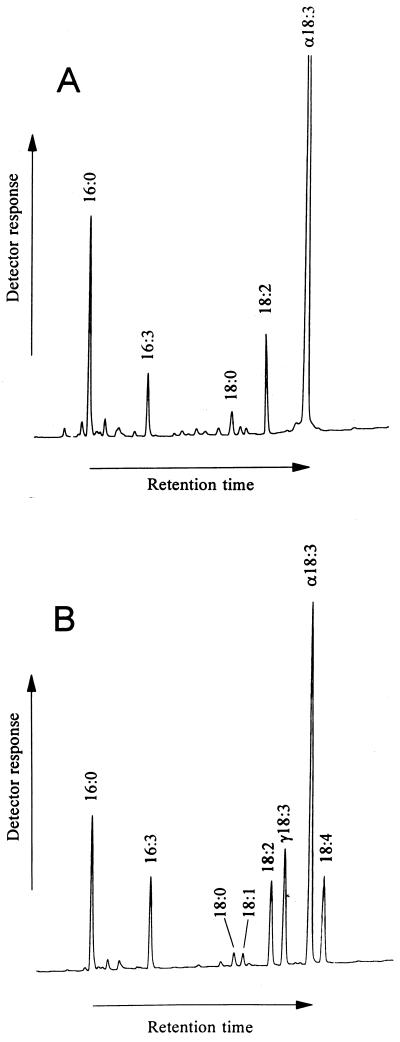
Identification of GLA and OTA in transgenic tobacco by GC. Chromatograms of FAMes from leaf tissue of control tobacco plant (A) or plant transformed with pBdes6 (B). Two novel peaks are seen in B; these peaks have retention times identical to FAMe standards of GLA and OTA. The identity of peaks (as determined by comparison of retention times with those of known standards) is indicated. Detection was by flame ionization.
Figure 4
Figure 4
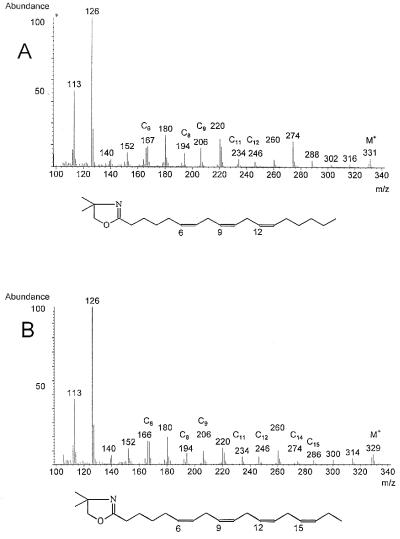
Mass spectra of DMOX-derivatized fatty acids. Spectra of the fatty acids identified in Fig. 3 as GLA (A) and OTA (B). Details of the interpretation of the spectra are given in the text. The deduced structures of the fatty acid derivatives are shown.
Figure 5
Figure 5
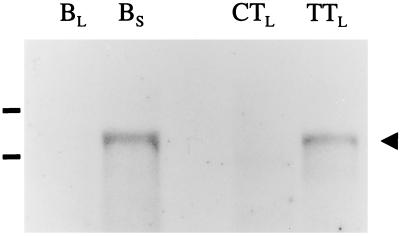
Northern blot analysis of pBdes6 expression in borage and in transgenic tobacco. Total RNA (10 μg), extracted from borage leaves (BL), borage seeds (BS), control tobacco leaves (CTL) or transgenic tobacco leaves (TTL) was probed with 32P-labeled pBdes6. After hybridization and high stringency washing, the resulting autoradiograph indicated expression of the pBdes6 transcript (≈2,000 bp; marked with the arrowhead) in borage seeds and transgenic tobacco leaves. The positions of the rRNA bands are indicated.

References

    1. Horrobin D F. Prog Lipid Res. 1992;31:163–194. - PubMed
    1. Horrobin D F. Rev Contemp Pharmacother. 1990;1:1–45.
    1. Gunstone F D. Prog Lipid Res. 1992;31:145–161. - PubMed
    1. Fieldsend A F. Biologist. 1995;42:203–207.
    1. Heinz E. In: Lipid Metabolism in Plants. Moore T S, editor. Boca Raton, FL: CRC; 1993. pp. 34–89.

Publication types

MeSH terms

Associated data

LinkOut - more resources