. 1997 Apr 29;94(9):4647-52.
doi: 10.1073/pnas.94.9.4647.

Increased atherosclerosis in mice reconstituted with apolipoprotein E null macrophages

Affiliations

Increased atherosclerosis in mice reconstituted with apolipoprotein E null macrophages

S Fazio et al. Proc Natl Acad Sci U S A. .

Abstract

Macrophage-derived foam cells express apolipoprotein E (apoE) abundantly in atherosclerotic lesions. To examine the physiologic role of apoE secretion by the macrophage in atherogenesis, bone marrow transplantation was used to reconstitute C57BL/6 mice with macrophages that were either null or wild type for the apoE gene. After 13 weeks on an atherogenic diet, C57BL/6 mice reconstituted with apoE null marrow developed 10-fold more atherosclerosis than controls in the absence of significant differences in serum cholesterol levels or lipoprotein profiles. ApoE expression was absent in the macrophage-derived foam cells of C57BL/6 mice reconstituted with apoE null marrow. Thus, lack of apoE expression by the macrophage promotes foam cell formation. These data support a protective role for apoE expression by the macrophage in early atherogenesis.


Figures
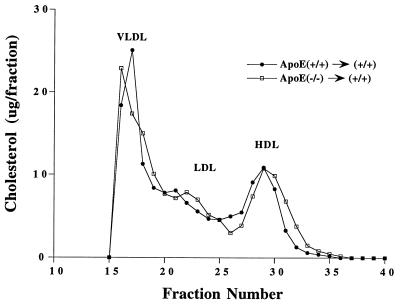
Figure 1
Figure 1
Distribution of serum lipoprotein cholesterol in apoE(−/−)→apoE(+/+) experimental mice and apoE(+/+)→apoE(+/+) control mice after 13 weeks on the atherogenic diet. Gel filtration chromatography was performed using a Superose 6 column (Pharmacia) on a Waters 600 FPLC system. A 100-μl aliquot of mouse serum was injected onto the column and separated as described above. Cholesterol determinations were done with the Sigma kit 352 in the microplate assay. Data points represent mean values for cholesterol from five control and three experimental mice.
Figure 2
Figure 2
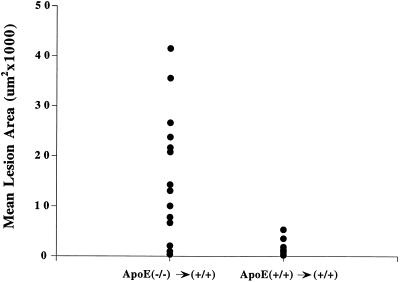
Mean area of the aortic atherosclerotic lesions per section per animal for the apoE(−/−) →apoE(+/+) experimental mice and apoE(+/+)→apoE(+/+) control mice on the atherogenic diet. The analysis was performed on alternate 10 μm sections starting at the end of the aortic sinus and extending 300 μm distally. Frozen sections (10 μm) were fixed with 4% paraformaldehyde and stained with oil red O. The areas of lipid-stainable lesions were measured by digitizing morphometry in a blinded fashion. Data are from 14 experimental apoE(−/−)→apoE(+/+) mice and 11 control apoE(+/+)→ apoE(+/+) mice after 13 weeks on the atherogenic diet.
Figure 3
Figure 3
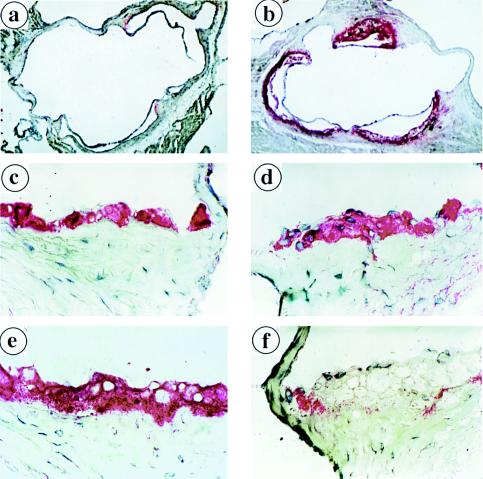
Increased aortic atherosclerosis in C57BL/6 recipients of apoE(−/−) marrow. (a and b) Comparison of the extent of lipid staining by oil red O in representative sections of the proximal aorta of control apoE(+/+)→apoE(+/+) and experimental apoE(−/−)→apoE(+/+) mice after 13 weeks on the atherogenic diet (10×). Cryosections 10 μm thick were fixed with 4.0% paraformaldehyde, stained with oil red O, and counterstained with hematoxylin. (c and e) Serial sections from control animals. (d and f) Serial sections from apoE(−/−)→apoE(+/+) mice. (c and d) Immunocytochemical staining for macrophages reveals that foam cell lesions consist primarily of macrophages in experimental and control mice (63×). (e and f) Immunocytochemical staining of serial aortic sections for apoE (63×). ApoE staining in control mice colocalizes with macrophages, but the macrophages in the experimental mice do not stain with apoE.
Figure 4
Figure 4
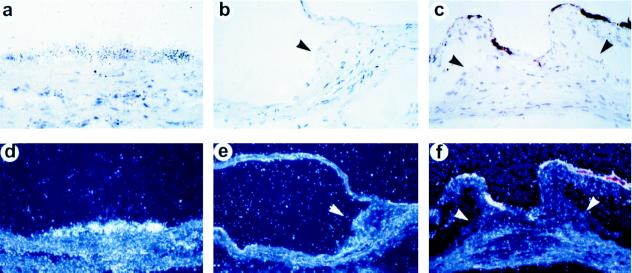
Decreased apoE gene expression in the aortic root of apoE(−/−)→apoE(+/+) mice by in situ hybridization. The hybridization signals of the apoE antisense probe appears as black grains located in aortic foam cell lesion of apoE(+/+)→apoE(+/+) mice on bright field (a, 40×), or as white dots on dark field (d, 20×). (b and e) The sense probe did not produce hybridization with foam cell lesions under the same conditions on bright field (40×) or dark field (20×), respectively. (c and f) Absence of apoE expression in foam cell lesions of the proximal aorta in an apoE(−/−)→apoE(+/+) mouse after hybridization with the antisense probe on bright field (40×) and dark field (20×). The intense coloration of the borders of the aortic valve stumps visible in c and f is an artifact not related to hybridization-specific silver grain exposure.
Figure 5
Figure 5
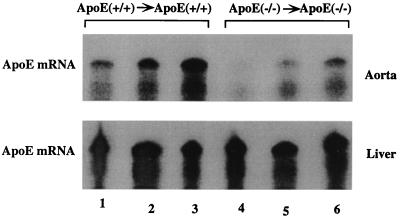
Ribonuclease protection assay of total RNA extracted from ascending and descending aorta and from liver of C57BL/6 mice 13 weeks after transplantation with either wild-type C57BL/6 or apoE(−/−) marrow (apoE(+/+)→(+/+), and apoE(−/−)→(+/+), respectively. Solution hybridization and RNase protection were carried out with 2 × 10⁵ cpm of probe and 5 μg of RNA, using the Ambion RPA II kit. There were seven mice in the control group [apoE(+/+)→(+/+)] and nine mice in the experimental group [apoE(−/−)→(+/+)]. The RNase protection experiment was repeated three times using different 5-μg aliquots of the same RNA preparations. After electrophoresis, the gels were dried and incubated in a PhosphoImager 445 SI from Molecular Dynamics. Quantitative comparison of radioactivity in the protected bands showed a 47% reduction in counts in the apoE(−/−)→(+/+) mice relative to the controls. Mean ± standard error was 256,860 ± 43,389 counts for the seven apoE(+/+)→(+/+) mice and 135,262 ± 49,003 counts for the nine apoE(−/−)→(+/+) mice (P = 0.054 at the Mann–Whitney rank sum test). No differences were observed in liver samples between experimental and control mice. This figure reports data for three mice in each group. Lanes 1–3, control apoE(+/+)→(+/+) mice; lanes 4–6, experimental apoE(−/−)→(+/+) mice.

References

    1. Basu S K, Brown M S, Ho Y K, Havel R J, Goldstein J L. Proc Natl Acad Sci USA. 1981;78:7545–7549. - PMC - PubMed
    1. Basu S K, Ho Y K, Brown M S, Bilheimer D W, Anderson R G W, Goldstein J L. J Biol Chem. 1982;257:9788–9795. - PubMed
    1. Mazzone T. Curr Opin Lipidol. 1996;7:303–307. - PubMed
    1. Mahley R W. Science. 1988;240:622–630. - PubMed
    1. Ghiselli G, Schaefer E J, Gascon P, Brewer H B., Jr Science. 1981;214:1239–1241. - PubMed

Publication types

LinkOut - more resources