Targeting of HIV-1 antigens for rapid intracellular degradation enhances cytotoxic T lymphocyte (CTL) recognition and the induction of de novo CTL responses in vivo after immunization
- PMID: 9120397
- PMCID: PMC2196169
- DOI: 10.1084/jem.185.5.909
Targeting of HIV-1 antigens for rapid intracellular degradation enhances cytotoxic T lymphocyte (CTL) recognition and the induction of de novo CTL responses in vivo after immunization
Abstract
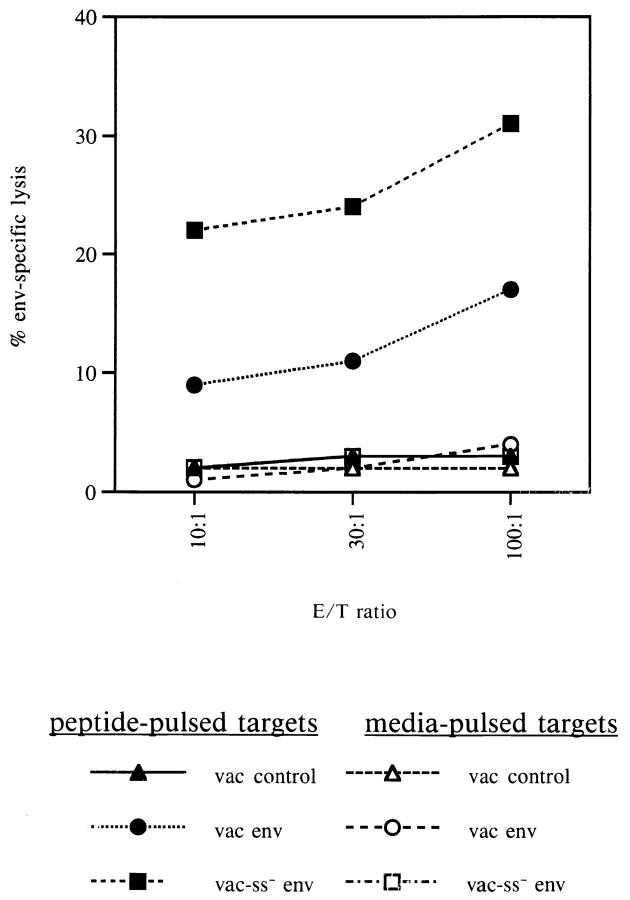
CD8+ cytotoxic T lymphocytes (CTLs) have the ability to recognize and eliminate virally infected cells before new virions are produced within that cell. Therefore, a rapid and vigorous CD8+ CTL response, induced by vaccination, can, in principle, prevent disseminated infection in vaccinated individuals who are exposed to the relevant virus. There has thus been interest in novel vaccine strategies that will enhance the induction of CD8+ CTLs. In this study, we have tested the hypothesis that targeting an antigen to undergo more efficient processing by the class I processing pathway will elicit a more vigorous CD8+ CTL response against that antigen. Targeting a type I transmembrane protein, the HIV-1 envelope (env) protein, for expression in the cytoplasm, rather than allowing its normal co-translational translocation into the endoplasmic reticulum, sensitized target cells expressing this mutant more rapidly for lysis by an env-specific CTL clone. Additionally, a greatly enhanced de novo env-specific CTL response was induced in vivo after immunization of mice with recombinant vaccinia vectors expressing the cytoplasmic env mutant. Similarly, targeting a cytoplasmic protein, HIV-1 nef, to undergo rapid cytoplasmic degradation induced a greatly enhanced de novo nef-specific CD8+ CTL response in vivo after immunization of mice with either recombinant vaccinia vectors or DNA expression plasmids expressing the degradation targeted nef mutant. The targeting of viral antigens for rapid cytoplasmic degradation represents a novel and highly effective vaccine strategy for the induction of enhanced de novo CTL responses in vivo.
Figures




References
-
- Klavinskis LS, Tishon A, Oldstone MB. Efficiency and effectiveness of cloned virus-specific cytotoxic T lymphocytes in vivo. J Immunol. 1989;143:2013–2016. - PubMed
-
- Riddell SR, Watanabe KS, Goodrich JM, Li CR, Agha ME, Greenberg PD. Restoration of viral immunity in immunodeficient humans by the adoptive transfer of T cell clones. Science (Wash DC) 1992;257:238–241. - PubMed
-
- Braciale TJ, Braciale VL. Viral antigen presentation and MHC assembly. Semin Immunol. 1992;4:81–84. - PubMed
-
- Yewdell JW, Bennink JR. Antigen processing: a critical factor in rational vaccine design. Semin Hematol. 1993;30:26–32. - PubMed
Publication types
MeSH terms
Substances
Grants and funding
LinkOut - more resources
Full Text Sources
Other Literature Sources
Research Materials