Comparative Study
. 1997 Mar 18;94(6):2433-7.
doi: 10.1073/pnas.94.6.2433.

egl-17 encodes an invertebrate fibroblast growth factor family member required specifically for sex myoblast migration in Caenorhabditis elegans

Affiliations
Comparative Study

egl-17 encodes an invertebrate fibroblast growth factor family member required specifically for sex myoblast migration in Caenorhabditis elegans

R D Burdine et al. Proc Natl Acad Sci U S A. .

Abstract

The proper guidance of the Caenorhabditis elegans hermaphrodite sex myoblasts (SMs) requires the genes egl-15 and egl-17. egl-15 has been shown to encode the C. elegans orthologue of the fibroblast growth factor receptor (FGFR). Here we clone egl-17 and show it to be a member of the fibroblast growth factor (FGF) family, one of the first functional invertebrate FGFs known. egl-17 shares homology with other FGF members, conserving the key residues required to form the distinctive tertiary structure common to FGFs. Genetic and molecular evidence demonstrates that the SM migration defect seen in egl-17 mutant animals represents complete loss of egl-17 function. While mutations in egl-17 affect only SM migration, mutations in egl-15 can result in larval arrest, scrawny body morphology, and the ability to suppress mutations in clr-1. We propose that EGL-17 (FGF) acts as a ligand for EGL-15 (FGFR) specifically during SM migration and that another ligand(s) activates EGL-15 for its other functions.


Figures
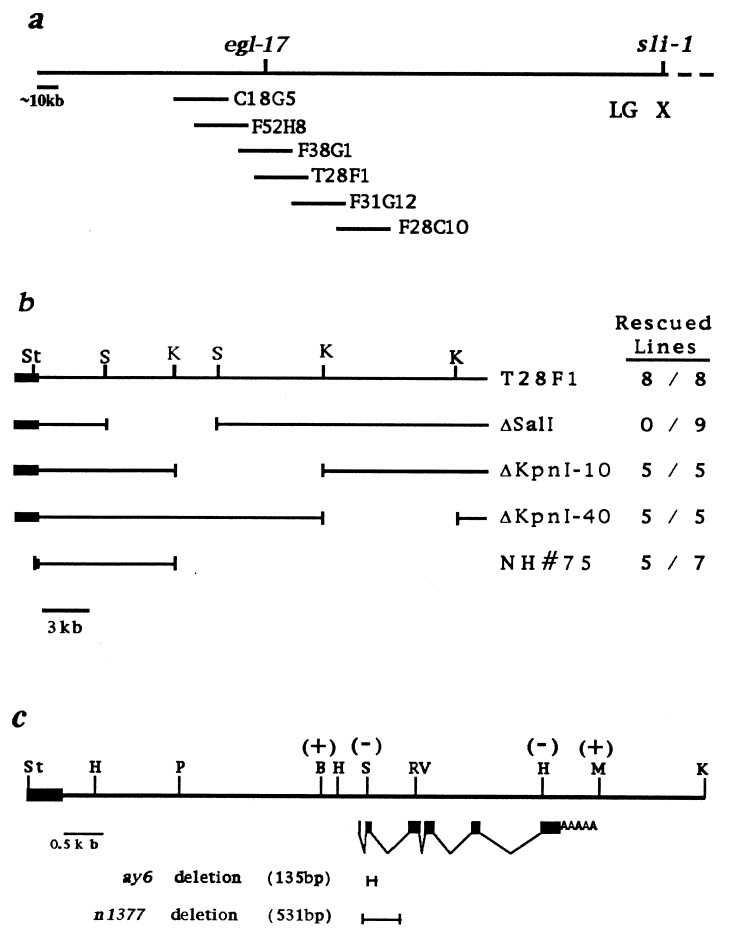
Figure 1
Figure 1
Molecular mapping of egl-17. (a) Cosmids from the left end of the X chromosome contig are shown. The Egl defect of egl-17 mutants is rescued by cosmids F38G1 and T28F1, but not by the adjacent cosmids shown. (b) Restriction map of cosmid T28F1 and subclones used to determine the smallest region containing egl-17-rescuing activity. Rescued lines, fraction of stable lines rescued out of the total number of lines scored. The solid bar represents cosmid vector sequences. (c) Genomic structure of the egl-17 transcript within the 9.1-kb rescuing fragment. The 7.0-kb PstI–KpnI fragment also shows egl-17 rescuing activity albeit at somewhat reduced efficiency. Vector sequences are depicted as in b. Solid boxes represent exons; poly(A) tail is indicated. The effects of 4-bp insertion mutations are indicated within parenthesis: +, rescuing activity retained; −, rescuing activity abolished. Extent of allele-specific deletions are depicted by bracket bars. B, BglII; RV, EcoRV; H, HindIII; K, KpnI; M, MluI; P, PstI; S, SalI; St, StuI.
Figure 2
Figure 2
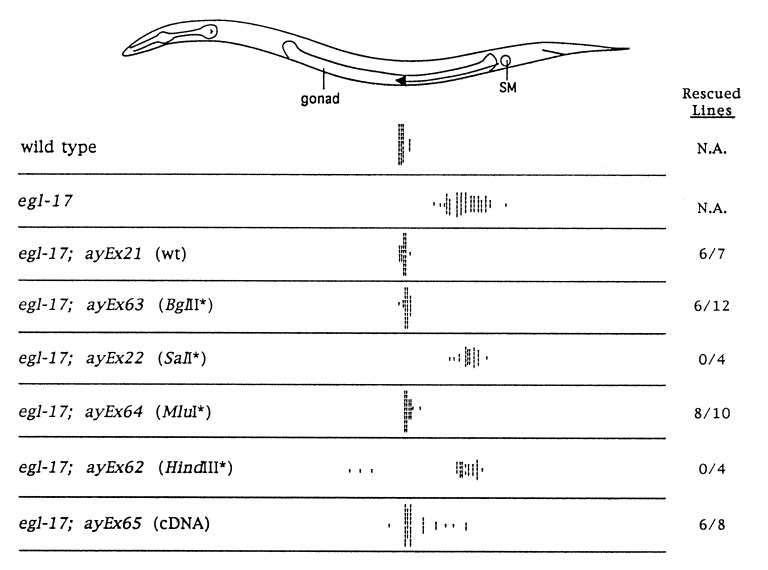
SM positions in wild-type, egl-17, and transgenic animals. Hash marks represent the final positions of individual SMs. Data are shown for individual transgenic lines; similar SM distributions were observed for additional lines obtained with the same transformation mixture. Rescued lines, fraction of stable lines rescued for the Egl phenotype of egl-17(n1377). N.A., not applicable. The nature of the egl-17 portion of the extragenic array is shown in parentheses. All are modifications of the 9.1-kb genomic rescuing fragment of NH#75 shown in Fig. 1b. wt, wild type; ∗, 4-bp insertions at the respective sites; cDNA, SalI–HindIII portion of the cDNA inserted into the corresponding sites of the genomic rescuing fragment. The cDNA construct does not remove the first intron from the 5′ untranslated region of egl-17. SM distributions from wild-type (3) and egl-17 (2) hermaphrodites are shown for comparison. The split SM distribution seen in egl-17; ayEx62 animals has been observed previously in egl-17 animals with partially ablated gonads (2).
Figure 3
Figure 3
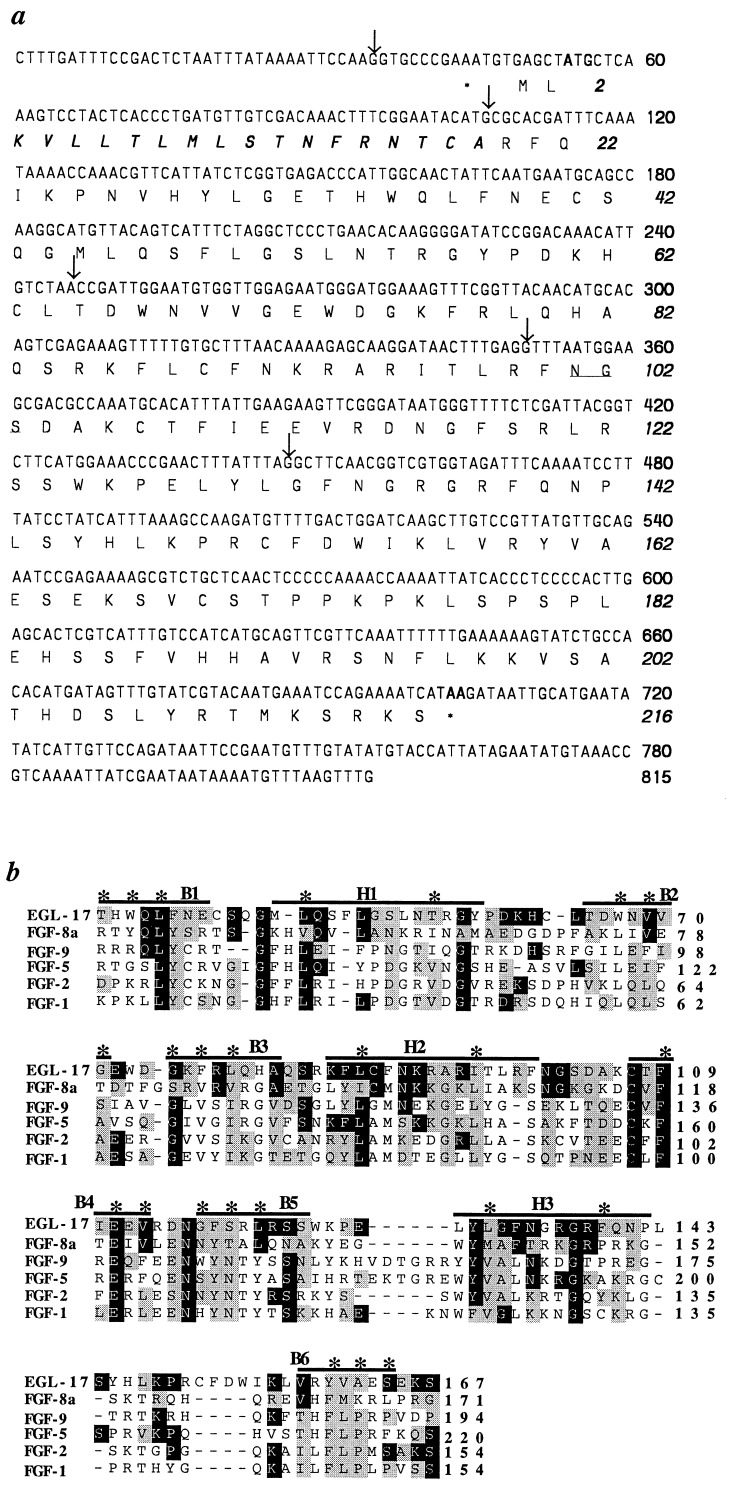
(a) Nucleotide sequence of the egl-17 cDNA and its predicted amino acid sequence. Nucleotides and amino acids are numbered at the right in roman and italic, respectively. Asterisks mark in-frame stop codons just upstream of the putative start methionine and at the end of egl-17. The putative signal sequence is in boldface italics, the potential glycosylation sequence is underlined, and splice site positions are marked with arrows. (b) Alignment of EGL-17 with other members of the FGF family. The internal homologous region common to all FGFs is shown. Amino acid positions are numbered at the right. Horizontal lines mark the 12 β-sheets that form the six barrel strands (B) and three hairpin regions (H) that make up the β-trefoil fold (17). The asterisks mark the residues inside the barrels and between the hairpins, based on crystallographic studies of FGFs 1 and 2 (17, 18). Residues identical or similar to those in EGL-17 are shaded in dark grey or light grey, respectively.
Figure 4
Figure 4
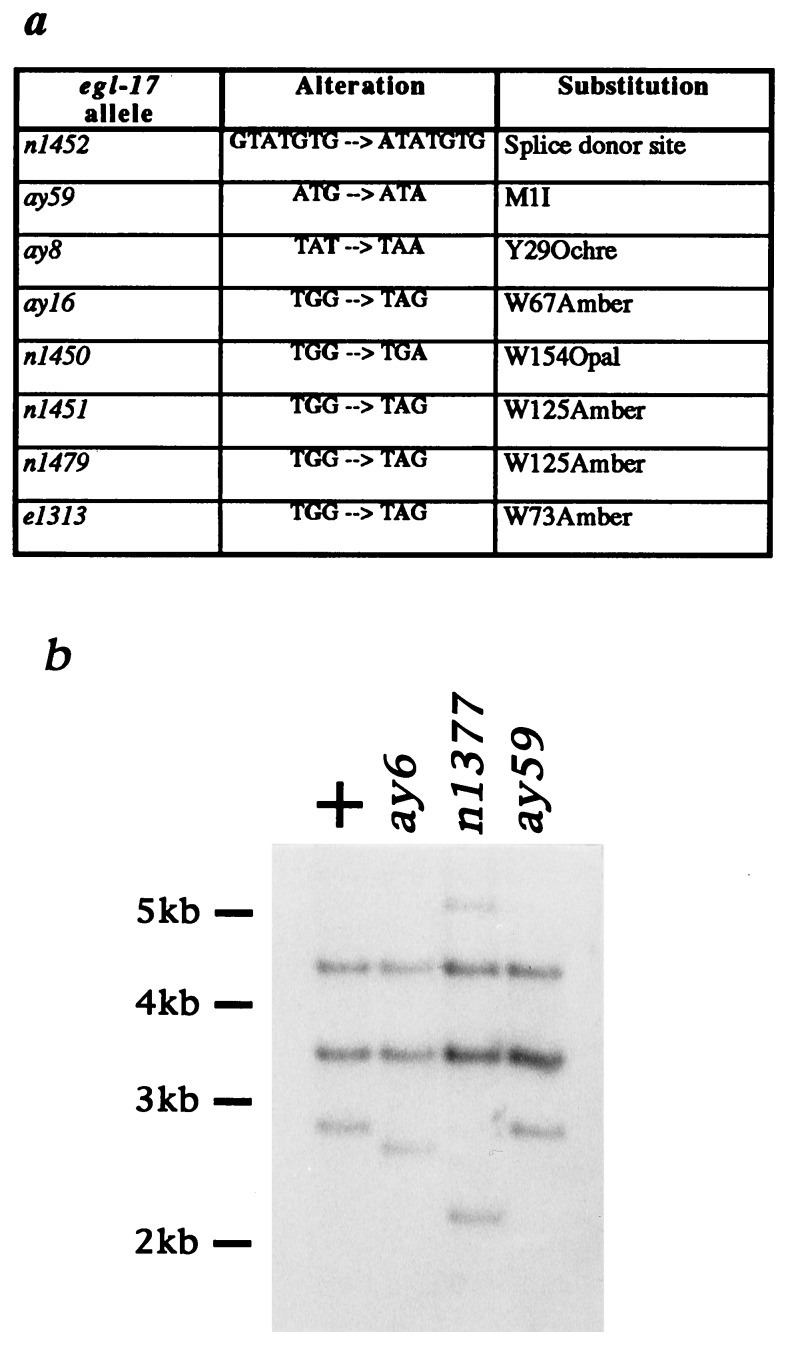
Mutational analysis of egl-17. (a) Point mutation alterations. The alteration corresponding to n1452 changes the essential guanosine residue at the splice donor junction of exon 5. (b) Southern blotting analysis of deletion mutations ay6 and n1377.

References

    1. Sulston J E, Horvitz H R. Dev Biol. 1977;56:110–156. - PubMed
    1. Stern M J, Horvitz H R. Development. 1991;113:797–803. - PubMed
    1. Thomas J H, Stern M J, Horvitz H R. Cell. 1990;62:1041–1052. - PubMed
    1. DeVore D L, Horvitz H R, Stern M J. Cell. 1995;83:611–620. - PubMed
    1. Chen E B, Branda C S, Stern M J. Dev Biol. 1997;182:88–100. - PubMed

Publication types

MeSH terms

Substances

Associated data

LinkOut - more resources