Comparative Study
. 1997 Mar 18;94(6):2438-43.
doi: 10.1073/pnas.94.6.2438.

Nonsense mutation at Tyr-4046 in the DNA-dependent protein kinase catalytic subunit of severe combined immune deficiency mice

Affiliations
Comparative Study

Nonsense mutation at Tyr-4046 in the DNA-dependent protein kinase catalytic subunit of severe combined immune deficiency mice

R Araki et al. Proc Natl Acad Sci U S A. .

Abstract

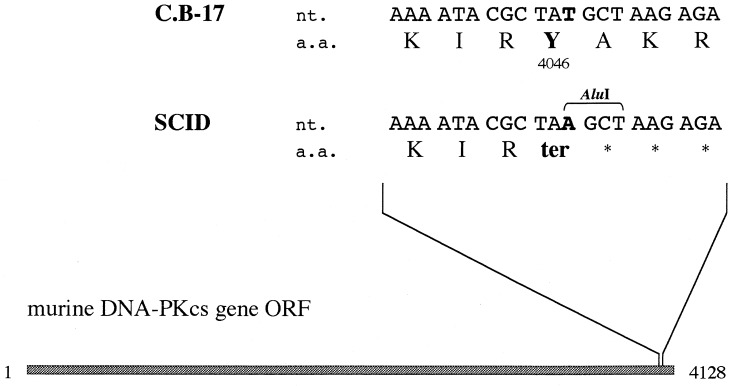
The severe combined immune deficiency (SCID) mouse was reported as an animal model for human immune deficiency. Through the course of several studies, the DNA-dependent protein kinase catalytic subunit (DNA-PKcs) gene came to be considered a candidate for the SCID-responsible gene. We isolated an ORF of the murine DNA-PKcs gene from SCID mice and their parent strain C.B-17 mice and determined the DNA sequences. The ORF of the murine DNA-PKcs gene contained 4128-aa residues and had 78.9% homology with the human DNA-PKcs gene. A particularly important finding is that a T to A transversion results in the substitution of termination codon in SCID mice for the Tyr-4046 in C.B-17 mice. No other mutation was detected in the ORF of the gene. The generality of this transversion was confirmed using four individual SCID and wild-type mice. The substitution took place in the phosphatidylinositol 3-kinase domain, and the mutated gene encodes the truncated products missing 83 residues of wild-type DNA-PKcs products. Furthermore, the quantity of DNA-PKcs transcript in wild-type and SCID cells was almost equal. These observations indicate that the DNA-PKcs gene is the SCID-responsible gene itself and that the detected mutation leads to the SCID aberration.


Figures
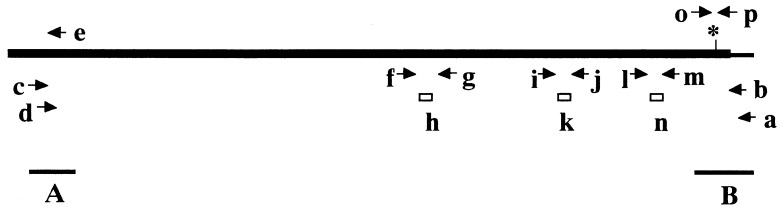
Figure 1
Figure 1
Location of the primers used for the sequencing and quantitative assay of DNA-PKcs RNA. The DNA-PKcs genes were obtained from C.B-17 and SCID cell lines by long and accurate PCR methods with the indicated primers b, c, and d after the first strand synthesis using the primer a. The 5′ rapid amplification of cDNA ends (RACE) was accomplished using primer e. These primers (a–d) were designed based on the DNA sequence data from the clones (A and B) isolated from the mouse cDNA library. A pair of primers (o and p) were used to verify the generality of the SCID mutation (indicated by an asterisk). Three pairs of primers (f and g, i and j, and l and m) were used with the respective Taqman probes (h, k, and n) for the quantitation of the DNA-PKcs gene expression.
Figure 2
Figure 2
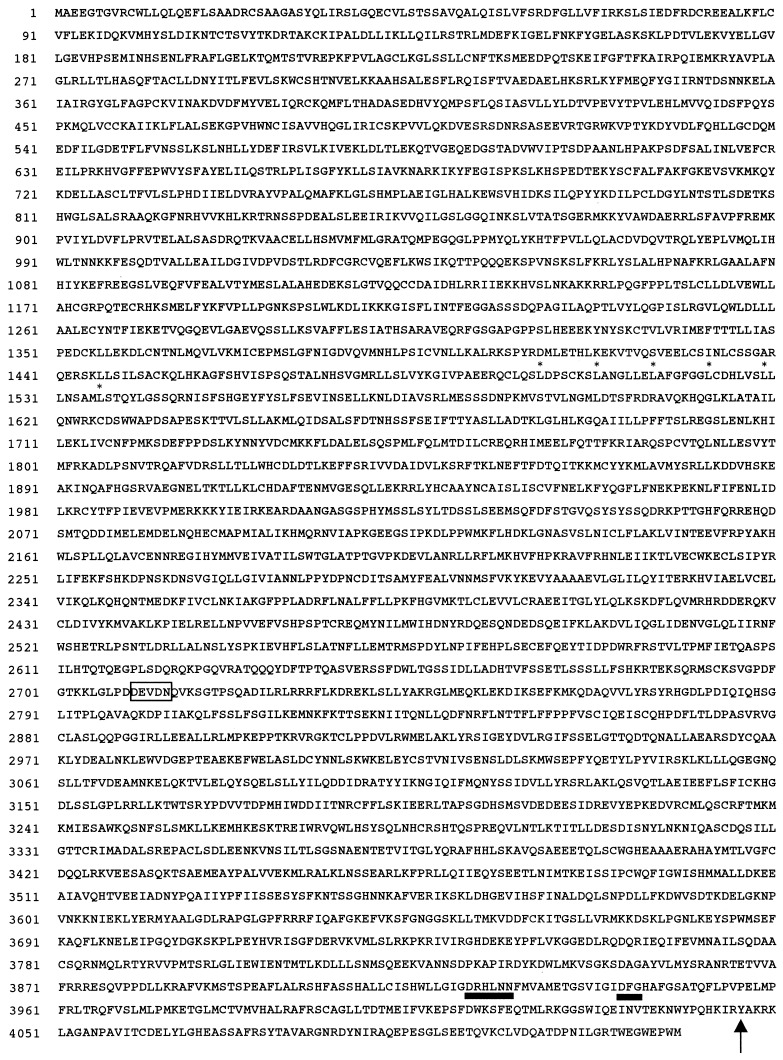
Deduced amino acid sequence from the nucleotide sequence of murine DNA-PKcs gene. The phosphatidylinositol 3-kinase (PI3K) motifs are indicated with solid bars. Tyr-4046 is indicated by an arrow, which is terminated in the SCID DNA-PKcs gene (see also Fig. 4). The leucin zipper motif is conserved (asterisks). The box indicates the potential recognition sites of CPP32 (apopine) (31, 32).
Figure 3
Figure 3
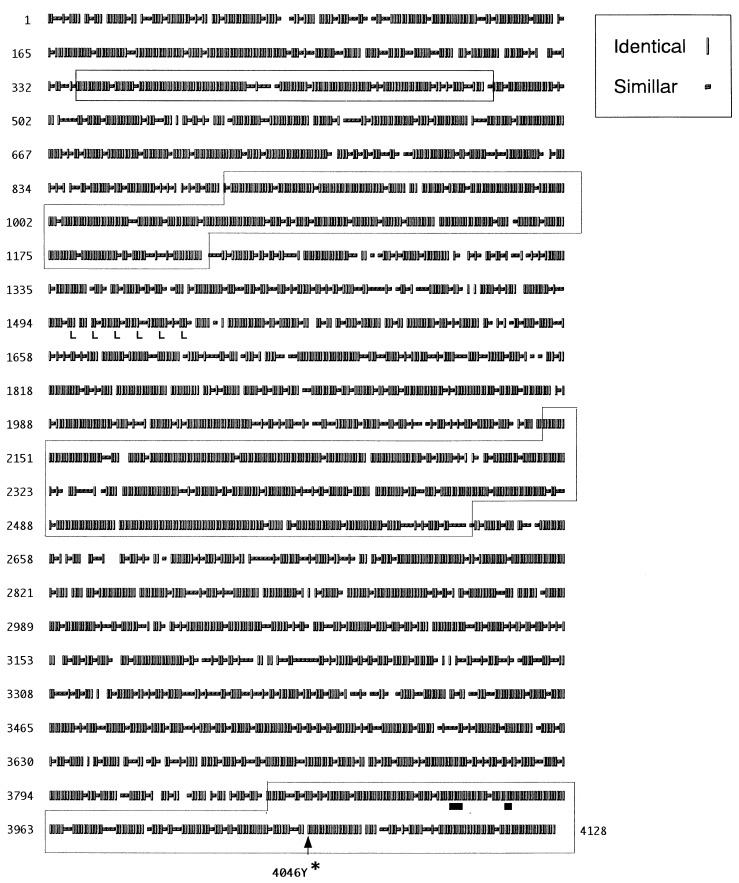
Comparison of the amino acid sequence of the DNA-PKcs between human and mouse. All amino acid residues are indicated by three symbols; vertical bars (∥) are for the identical residues and small horizontal bars (−) are for the residues with similar biochemical features; spaces are for the residues with no similarity between the human and mouse counterparts. There are some extremely conserved regions, which are surrounded by open squares. Solid bars (▪) are for the consensus sequence of PI3K.
Figure 4
Figure 4
Nonsense mutation in DNA-PKcs gene in SCID mice. The dark box indicates the ORF (1-4128). Only the mutated region is indicated above. nt. and a.a. indicate the nucleotide sequence and amino acid sequence, respectively. The replaced nucleotides and amino acid residues are shown in boldface type. The one-letter symbols are used to specify amino acids. AluI indicates the recognition sequence of restriction enzyme AluI.
Figure 5
Figure 5
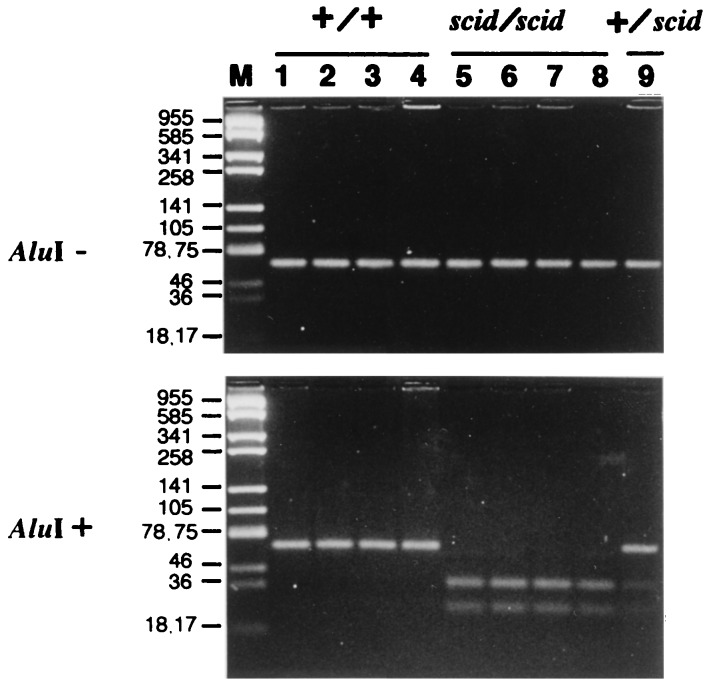
Confirmation for generality of the mutation. The single bands of 64 bp were amplified by PCR (Upper) followed by AluI digestion (Lower). The products containing the mutation were digested into 38- and 26-bp bands. Four individuals of C.B-17 (+/+) (lanes 1–4), scid/scid (lanes 5–8), and +/scid (lane 9) were analyzed. (Lane M) pUC19 digested with Sau3AI was used for molecular weight marker and the molecular weight of each band is indicated (bp). Samples were resolved by electrophoresis with 5% Nu Sieve agarose (FMC).
Figure 6
Figure 6
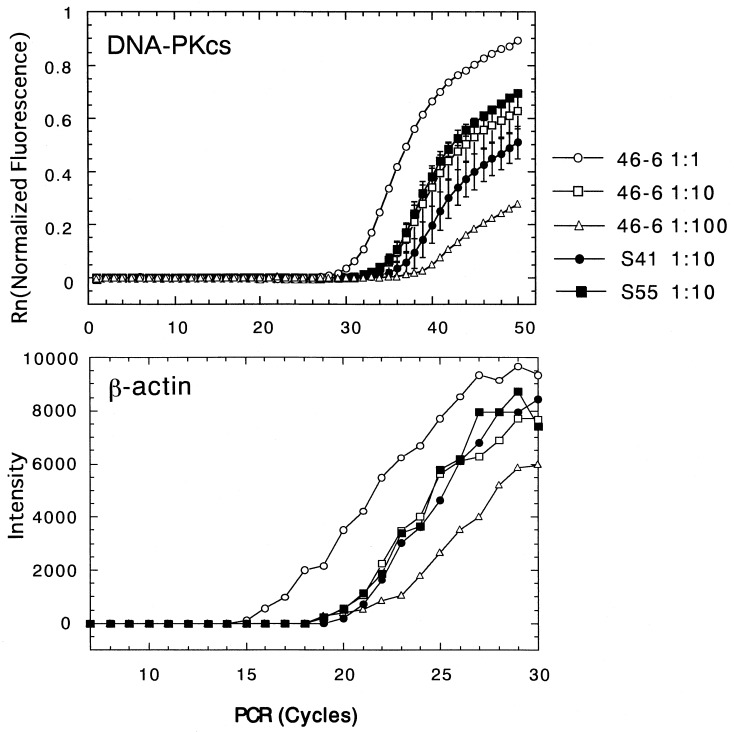
Measurement of the DNA-PKcs gene expression between wild-type and SCID cell lines. DNA-PKcs gene expression was measured by the RT-PCR method using the Applied Biosystems Prism 7700 (Perkin–Elmar) as described. The representative fluorescence intensity (Rn) was indicated as the function of the frequency of the PCRs with the probe n (Upper). The wild-type 46–6 was tested with RNA samples of different dilutions; 1:1 (○), 1:10 (□), and 1:100 (▵). For the SCID cell lines, the samples from S41 (•) and S55 (▪) were both tested with 1:10 diluted samples. Standard deviation is indicated as a vertical bar. The initial RNA samples were normalized by the number of the exponentially growing culture cells. (Lower) For reference, β-actin gene expression was measured from the identical RNA samples.

References

    1. Bosma G C, Custer R P, Bosma M J. Nature (London) 1983;301:527–530. - PubMed
    1. Schuler W, Weiler I J, Schuler A, Phillips R A, Rosenberg N, Mak T W, Kearney J F, Perry R P, Bosma M. Cell. 1986;46:963–972. - PubMed
    1. Hendrickson E A, Schatz D G, Weaver D T. Genes Dev. 1988;2:817–829. - PubMed
    1. Kim M G, Schuler W, Bosma M J, Marcu K B. J Immunol. 1988;141:1341–1347. - PubMed
    1. Malynn B A, Blackwell T K, Fulop G M, Rathbun O A, Furley A J W, Ferrier P, Heinke L B, Phillips R A, Yancopoulos G D, Alt F W. Cell. 1988;54:453–460. - PubMed

Publication types

MeSH terms

Associated data