Exploring the effects of age of alcohol use initiation and psychosocial risk factors on subsequent alcohol misuse
- PMID: 9130220
- PMCID: PMC1894758
- DOI: 10.15288/jsa.1997.58.280
Exploring the effects of age of alcohol use initiation and psychosocial risk factors on subsequent alcohol misuse
Abstract
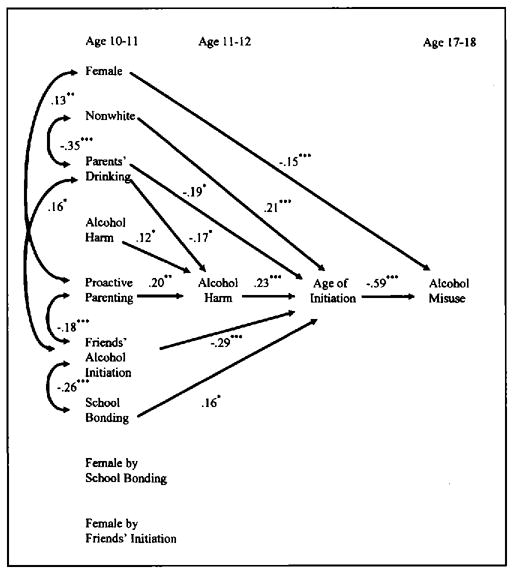
Objective: This study examines whether the age of initiation of alcohol use mediates the effects of other variables that predict alcohol misuse among adolescents and also whether the age of initiation of alcohol use accounts for known gender differences in the severity of alcohol misuse.
Method: Data were taken from an ethnically diverse sample of 808 (412 male) students who were recruited in grade 5 at age 10-11 and followed prospectively on an annual basis for the next 7 years to age 17-18. State-of-the-art missing data methodology was used to address nonresponse due to noninitiation of alcohol use. Structural equation modeling was used to examine hypotheses for the prediction of alcohol misuse.
Results: A younger age of alcohol initiation was strongly related to a higher level of alcohol misuse at age 17-18 and fully mediated the effects of parent drinking, proactive parenting, school bonding, peer alcohol initiation and ethnicity, all measured at age 10-11, and perceived harmfulness of alcohol use, measured at age 10-11 and age 11-12. However, age of alcohol initiation did not fully account for gender differences in the level of alcohol misuse at age 17-18. To further examine the role of gender, interactions between gender and school bonding, and gender and friend's alcohol initiation, were evaluated. However, neither of the interaction terms had direct effects on either age of initiation or level of alcohol-related problems.
Conclusions: Most measured risk factors for alcohol misuse were mediated through age of alcohol initiation. Only gender differences in alcohol misuse at age 17-18 were not mediated by age of alcohol initiation. Variables associated with these differences require further study. The results of this study indicate the importance of prevention strategies to delay the age of initiation of alcohol use.
Figures
References
-
- Allison PO. Estimation of linear models with incomplete data. In: Clogg C, editor. Sociological Methodology 1987. San Francisco: Jossey-Bass, Inc., Pubs.; 1987. pp. 71–103.
-
- Arbuckle JL. Amos Users' Guide. Chicago: Small Waters; 1995.
-
- Barnes GM, Welte JW. Patterns and predictors of alcohol use among 7–12th grade students in New York State. J Stud Alcohol. 1986;47:53–62. - PubMed
-
- Baron RM, Kenny DA. The moderator-mediator distinction in social psychological research: Conceptual, strategic, and statistical considerations. J Pers Social Psychol. 1182;51:1986. - PubMed
-
- Baumrind D. Why Adolescents Take Chances and Why They Don't. Invited address for the National Institute for Child Health and Human Development; Bethesda, Md.: 1983.
Publication types
MeSH terms
LinkOut - more resources
Full Text Sources
Medical