. 1997 May 15;17(10):3476-87.
doi: 10.1523/JNEUROSCI.17-10-03476.1997.

Arachidonic acid inhibits transient potassium currents and broadens action potentials during electrographic seizures in hippocampal pyramidal and inhibitory interneurons

Affiliations

Arachidonic acid inhibits transient potassium currents and broadens action potentials during electrographic seizures in hippocampal pyramidal and inhibitory interneurons

S Keros et al. J Neurosci. .

Abstract

The transient outward potassium current was studied in outside-out macropatches excised from the soma of CA1 pyramidal neurons and stratum (st.) oriens-alveus inhibitory interneurons in rat hippocampal slices. Arachidonic acid dose dependently decreased the charge transfer associated with the transient current, concomitant with an increase in the rate of current inactivation. Arachidonic acid (AA) did not affect the voltage dependence of steady state inactivation but did prolong the period required for complete recovery from inactivation. The effects of AA were mimicked by the nonmetabolizable analog of AA, 5,8,11,14-eicosatetraynoic acid, suggesting that metabolic products of AA were not responsible for the observed blocking action. In addition, AA blocked st. oriens-alveus-lacunosum-moleculare interneuron transient currents but not currents recorded from basket cell interneurons. In current clamp experiments, AA was without effect on the action potential waveform of CA1 pyramidal neurons under control recording conditions. In voltage-clamp experiments, the use of a test pulse paradigm, designed to mimic the action potential voltage trajectory, revealed that the transient current normally associated with a single spike deactivates too rapidly for AA to have an effect. Transient currents activated by longer duration "action potential" waveforms, however, were attenuated by AA. Consistent with this finding was the observation that AA broadened interictal spikes recorded in the elevated [K+]o model of epilepsy. These data suggest that AA liberated from hippocampal neurons may act to block the transient current selectively in both CA1 pyramidal neurons and inhibitory interneurons and to broaden action potentials selectively under pathological conditions.


Figures
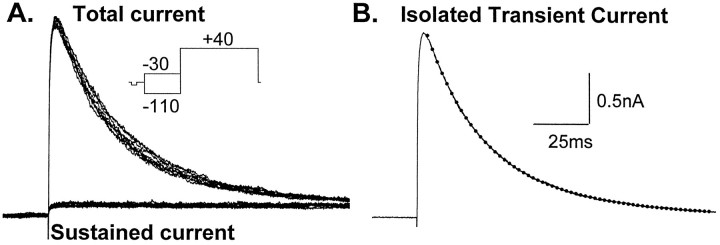
Fig. 1.
Fig. 1.
Isolation of the transient current in outside-out macropatches excised from hippocampal pyramidal neurons.A, Transient currents were isolated from the total outward current by alternating prepulses to −30 and −110 mV before a test pulse to +40 mV. Inclusion of a prepulse to −30 mV resulted in the complete inactivation of the transient current and left only the isolated sustained current phenotype. In contrast, inclusion of a prepulse to −110 mV activated both transient and sustained current phenotypes. Digital subtraction of the family of currents obtained with a prepulse at −30 mV (nine trials) from those obtained with a prepulse to −110 mV (nine trials) yielded the isolated transient current.B, The isolated transient currents were then averaged to generate the mean current for analysis. Under control conditions the current inactivation could be fit by a single exponential (dotted line) with a time constant of 21.5 msec.
Fig. 2.
Fig. 2.
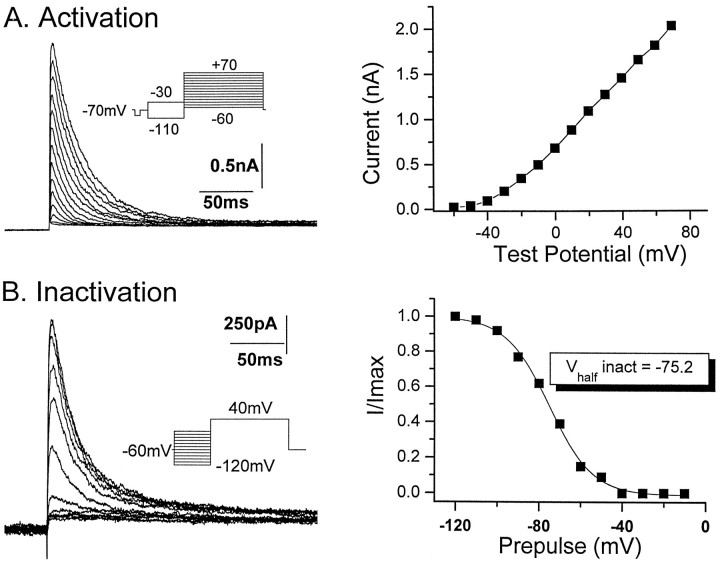
Activation and inactivation properties of CA1 pyramidal neuron transient currents in outside-out patches.A, Transient currents were activated at test potentials positive to −60 mV and up to +70 mV (10 mV increments). Interleaved with each cycle to activate the transient current (prepulse to −110 mV) was a test pulse cycle including a prepulse to −30 mV (seeinset). Inclusion of alternating prepulses to −110 and −30 mV allowed the isolation of the transient current from the total current for each test potential as described in Figure 1. A plot of the current–voltage relationship of the isolated transient current reveals that transient currents were a steep function of the test potential.B, Steady state inactivation of the transient current was determined by the use of a test pulse to +40 mV preceded by a series of prepulse conditioning potentials ranging from −120 to −10 mV. The transient current was completely inactivated at potentials positive to −40 mV. The relative amplitudes of the transient current were plotted as a function of the prepotential and fit with a Boltzmann equation to generate the steady-state inactivation curve (right panel). Half-inactivation of the transient current occurred at a voltage of −75.2 mV.
Fig. 3.
Fig. 3.
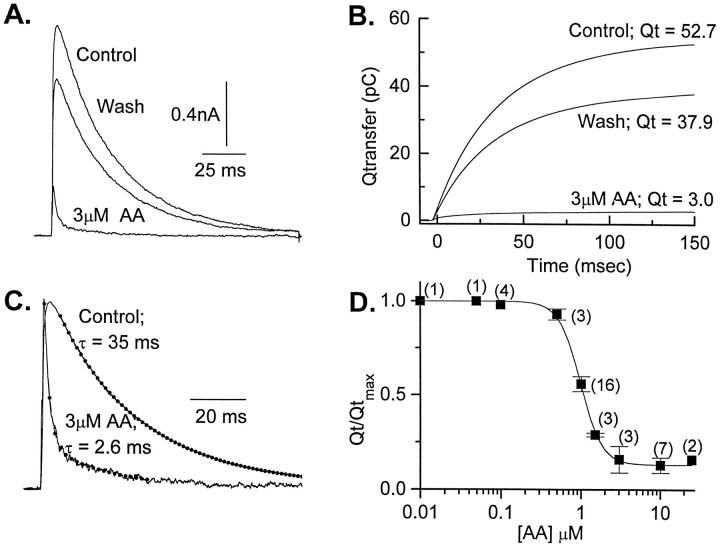
Arachidonic acid dose dependently blocks the transient current in CA1 pyramidal neurons. A, Both the amplitude and time course of the transient current were attenuated by AA (3 μm). The effects of AA were readily reversible on washing. B, Plot of the cumulative charge transfer associated with the transient current. Integration of the transient current with respect to time allowed the calculation of the charge transfer. The transient current charge transfer was markedly attenuated in the presence of AA. The effect of AA was partially reversed on washing. C, AA dose dependently increased the rate of transient current inactivation. Normalization of the transient currents obtained in the control and in the presence of AA demonstrates an increase in the rate of steady-state inactivation in the presence of AA. The rate of current inactivation in both the control and in the presence of AA were fit by a single exponential function. In the presence of AA, the rate of current inactivation was 2.6 msec compared with 35 msec in the control (dotted line). D,Dose–response relationship of the effect of AA on the transient current charge transfer reveals an IC50 of ∼1 μm. The numbers indicated above each data point reflect the numbers of patches used to construct the points.
Fig. 4.
Fig. 4.
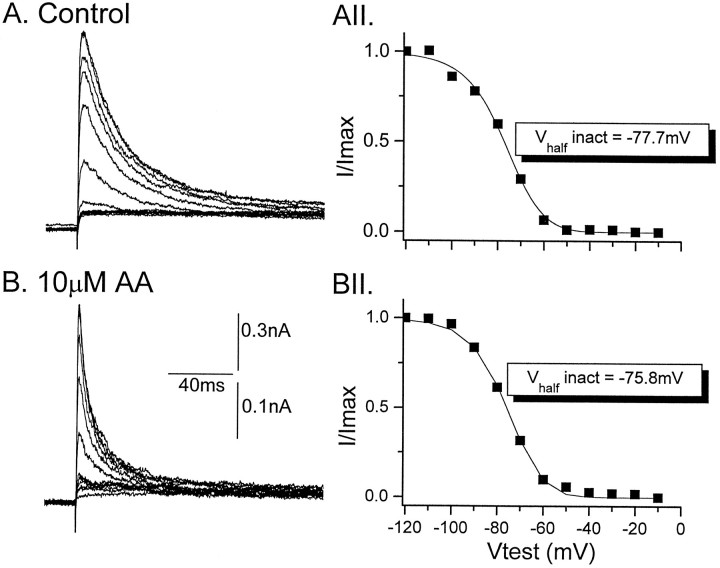
AA does not alter the voltage dependence of inactivation. Despite increasing the rate of transient current inactivation, AA does not alter the voltage dependence of inactivation. AII, BII, The relative amplitudes of the transient current were plotted as a function of the prepotential and fit with a Boltzmann equation to generate the steady-state inactivation curve (see Fig. 2). In the presence of 10 μm AA, the half-inactivation voltage (−75.8 mV) is similar to that observed in the control (−77.7 mV). All currents were obtained from the same patch.
Fig. 5.
Fig. 5.
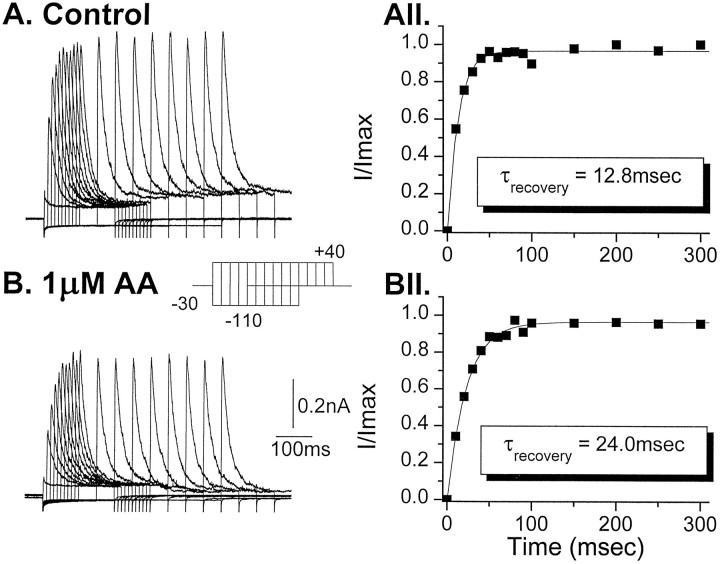
AA decreases the rate of recovery from inactivation. Outside-out patches were voltage clamped at −30 mV to fully inactivate the transient current. A prepulse to −110 mV of increasing duration preceded the test pulse (10 msec increments up to the 100 msec prepulse duration, then 50 msec increments up to 550 msec; the inset shows only 50 msec increments for clarity). A test pulse to +40 mV (200 msec duration) was then made to activate the transient current. A plot of the transient current peak amplitude against the prepulse duration allowed the determination of the rate of recovery from current inactivation. Under control conditions the rate of recovery from steady-state inactivation proceeded with a single exponential of 12.8 msec. In the presence of AA (1 μm) the time constant of the rate of recovery from inactivation increased by 88% to 24 msec.
Fig. 6.
Fig. 6.
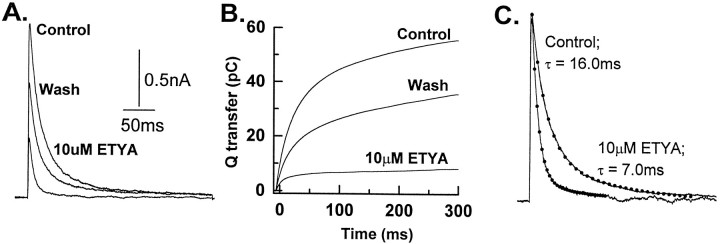
ETYA mimics the effects of AA on the transient current. The nonmetabolizable analog of AA, ETYA, mimicked the effects of AA on transient current charge transfer. In the presence of 10 μm ETYA both the amplitude (A) and the charge transfer (B) of the transient current were inhibited. The effects of ETYA were partially reversed on return to control. C, Normalization of the transient current obtained in both the control and 10 μmETYA reveal that the rate of steady-state inactivation is increased in the presence of ETYA, similar to the effects of AA (Fig. 3). Single exponentials adequately described the current inactivation in both the control and 10 μm ETYA (dotted line). The time constants of inactivation in control and ETYA were 16.0 and 7.0 msec, respectively.
Fig. 7.
Fig. 7.
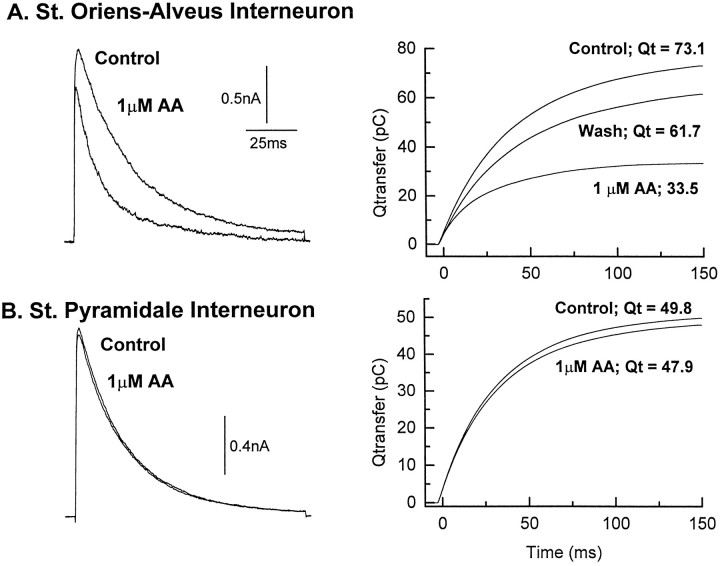
The transient current in CA1 st. oriens–alveus interneurons but not basket cell interneurons is blocked by AA.A, An outside-out macropatch excised from a morphologically confirmed interneuron of the stratum oriens–alveus possesses a transient current similarly modulated by AA. At a concentration of 1 μm AA, the charge transfer of the transient current is blocked by 41% (B). In contrast, an outside-out patch excised from the soma of a confirmed CA1 pyramidal cell layer inhibitory interneuron possessed a transient current insensitive to AA (1 μm).
Fig. 8.
Fig. 8.
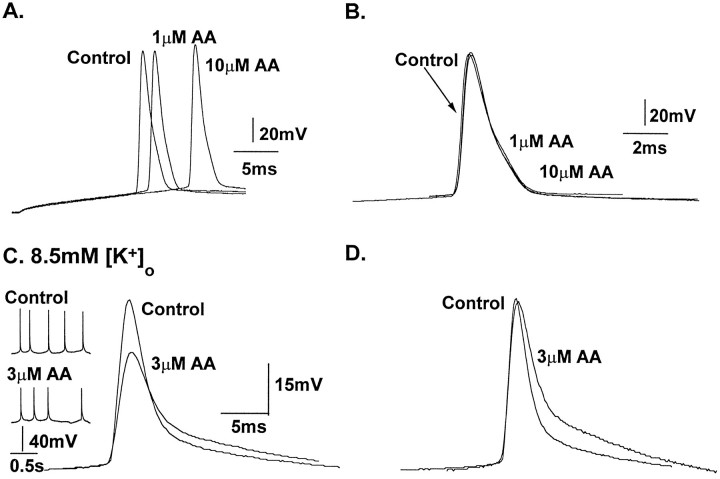
AA does not alter the time course of single action potentials but broadens spikes during electrographic interictal events. A, Under control physiological recording conditions, whole-cell current-clamp recordings were made from CA1 pyramidal neurons. AA (1 and 10 μm) raised the threshold for action potential firing (A) without altering the time course of single action potentials (B). Action potentials were activated by depolarizing pulses delivered from a holding potential of −60 mV. Typically, the action potential threshold occurred close to −45 mV in the control.B, Alignment of the action potential waveforms shown inA clearly shows that AA at concentrations that block 50 and 80% of the transient current in outside-out patches fail to modify the action potential waveform. C, When extracellular K+ was elevated to 8.5 mm, electrographic interictal bursts of action potentials were observed (insets). These action potentials were of a longer duration than seen under control physiological conditions (>10 msec) because of the reduced driving force for K+ current repolarization. Spike duration was prolonged and the amplitude was reduced in the presence of 3 μm AA.D, Normalization of the two action potentials shown inC shows that despite a similar time to peak, the entire repolarization phase of the action potential was prolonged. In the presence of AA, interictal events of similar durations were observed. The number of spikes usually contained in these episodes was reduced (inset). These data suggest that action potentials occurring during electrographic interictal events possess an increased fraction of transient current, which is a target for AA modulation.
Fig. 9.
Fig. 9.
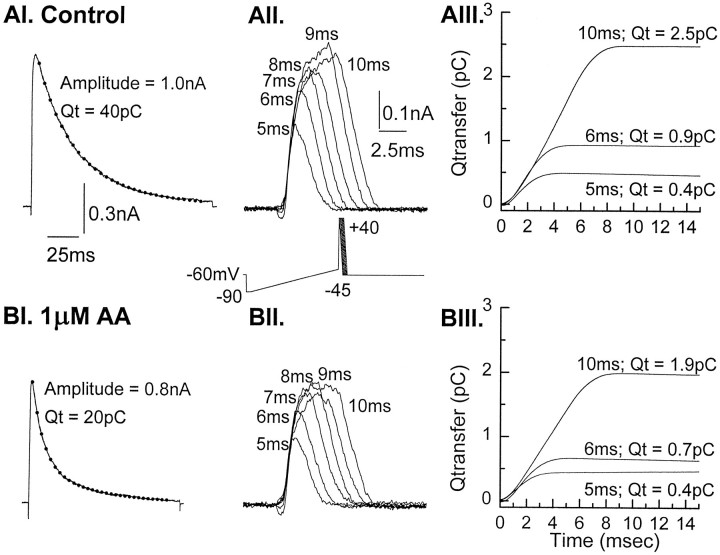
AA does not block the fraction of transient current underlying short duration “single action potentials” but does inhibit transient currents activated by longer duration spikes. The lack of an effect of AA on action potentials evoked in physiological conditions suggests that the transient current associated with a single spike may deactivate too rapidly for AA modulation. To determine the contribution of the transient current during a single spike, a test pulse paradigm designed to simulate the time course of pyramidal neuron action potentials (inset; see text for details) was used to activate transient currents in an outside-out patch containing a transient current >1 nA in amplitude during a 200 msec duration test pulse (Vtest = +40 mV). A, Current inactivation in the control was fit by a single exponential with a time constant of 23 msec (dotted line). AII,Increasing the duration of the spike test potential from 5 to 10 msec (1 msec increments) recruited an increasing fraction of the transient current (AII). The data shown inAII represent only the transient current component activated during the test pulse to +40 mV (Vhold = −45 mV).AIII, Plots of the charge transfer associated with each transient current activated by increasing action potentials reveals that doubling the duration of the action potential yields a fivefold increase in the transient current component obtained in the patch. Note that even when the duration of the action potential was 10 msec, the transient current activated was <5% of the total current activated by a 200 msec duration test pulse. B, In the same patch, AA (1 μm) blocked 50% of the transient current activated by a 200 msec test pulse to +40 mV and increased the rate of current inactivation (τ = 11 msec;dotted line). BII, BIII, In the presence of AA, short duration action potentials (5–7 msec) activated a similar fraction of transient current charge transfer to that seen in control. In contrast, transient currents activated by longer duration action potentials were subject to modulation by AA. The transient current charge transfer associated with a 10 msec action potential was reduced by 24% compared with control. These data are consistent with the data illustrated in Figure 8, which showed that AA was without effect during short duration action potentials but increased the duration of the broader action potentials recorded during electrographic interictal events.

References

    1. Anderson MP, Welsh MJ. Fatty acids inhibit apical membrane chloride channels in airway epithelia. Proc Natl Acad Sci USA. 1990;87:7334–7338. - PMC - PubMed
    1. Axelrod J. Receptor-mediated activation of phospholipase A2 and arachidonic acid release in signal transduction. Biochem Soc Trans. 1990;18:503–507. - PubMed
    1. Bazan NG, Birkle DL, Tang W, Reddy TS. The accumulation of free arachidonic acid, diacylglycerols, prostaglandins, and lipoxygenase reaction products in the brain during experimental epilepsy. In: Degado-Escueta AV, Ward AA Jr, Woodbury DM, Porter RJ, editors. Advances in neurology, Ed 44. Raven; New York: 1986. pp. 879–902. - PubMed
    1. Bevan S, Wood JN. Arachidonic-acid metabolites as second messengers. Nature. 1987;328:20–22. - PubMed
    1. Bito H, Mori M, Sakanaka C, Takano T, Zen-ichiro H, Gotoh Y, Nishida E, Shimizu T. Functional coupling of the SSTR4, a major hippocampal somatostatin receptor, to adenylate cyclase inhibition, arachidonate release, and activation of the mitogen-activated protein kinase cascade. J Biol Chem. 1993;269:12722–12730. - PubMed

Publication types

MeSH terms