


Behavioral and neurochemical recovery from partial 6-hydroxydopamine lesions of the substantia nigra is blocked by daily treatment with D1/D5, but not D2, dopamine receptor antagonists
- PMID: 9133402
- PMCID: PMC6573679
- DOI: 10.1523/JNEUROSCI.17-10-03840.1997
Behavioral and neurochemical recovery from partial 6-hydroxydopamine lesions of the substantia nigra is blocked by daily treatment with D1/D5, but not D2, dopamine receptor antagonists
Abstract
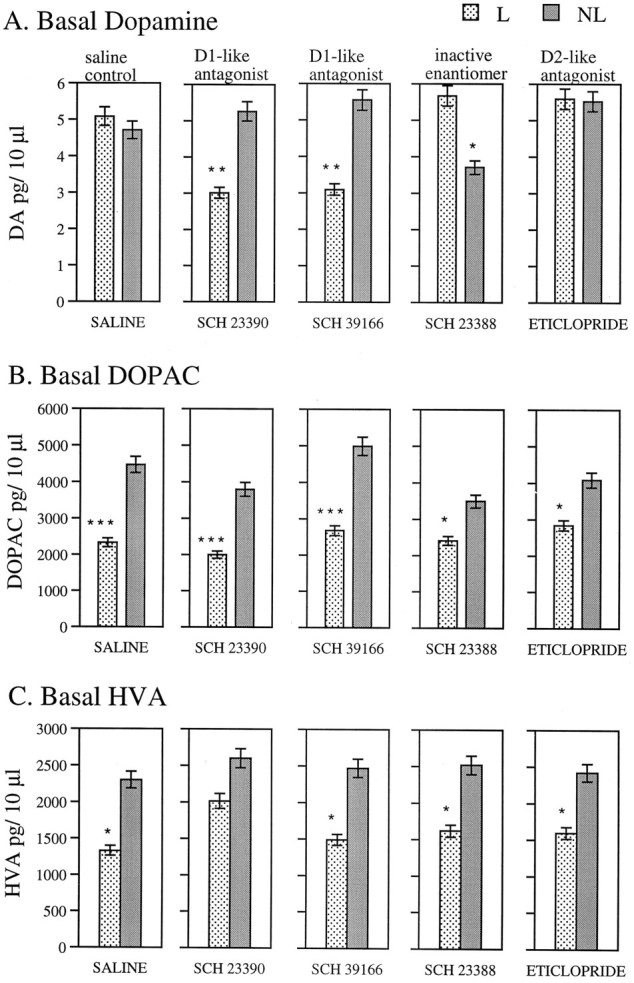
To determine whether D1/D5 dopamine (DA) receptors play a role in normalization of DA extracellular levels of striatal DA and behavioral recovery after partial 6-OHDA lesions of the substantia nigra, animals were treated on days 1-8 after lesioning with the D1/D5 DA receptor antagonists SCH 23390 (0.1 mg/kg, s.c.) and SCH 39166 (1.0 mg/kg, s.c.), the inactive enantiomer SCH 23388 (0.1 mg/kg, s.c.), the D2 antagonist eticlopride (0.1 mg/kg, i.p.), or saline. Spontaneous turning behavior was assessed on days 3 and 15. Basal extracellular DA and metabolites were measured in both striata using microdialysis on days 16 and 17, 8-9 d after termination of drug treatments. On day 3, all animals turned ipsilateral to the lesion. On day 15, animals previously treated with either saline, eticlopride, or SCH 23388 showed no behavioral asymmetries, whereas animals treated with SCH 23390 or SCH 39166 turned ipsilaterally. On days 16 and 17, extracellular DA did not differ on the two sides in animals treated with saline or eticlopride and were higher on the lesioned side after SCH 23388. In animals treated with the D1/D5 receptor antagonists, however, basal levels of DA were lower on the lesioned side, showing no evidence of normalization. These results suggest a role for the D1/D5 DA receptor in the development of compensatory changes in the DA neurons that accompany behavioral recovery from partial lesions of nigrostriatal DA system.
Figures


References
-
- Abercrombie ED, Bonatz AE, Zigmond MJ. Effects of l-DOPA on extracellular dopamine in striatum of normal and 6-hydroxydopamine-treated rats. Brain Res. 1990;525:36–44. - PubMed
-
- Akimoto K, Hamamura T, Kazahaya Y, Akiyama K, Otsuki S. Enhanced extracellular dopamine level may be the fundamental neuropharmacological basis of cross-behavioral sensntization betweeen methamphetamine and cocaine: an in vivo dialysis study in freely moving rats. Brain Res. 1990;507:344–346. - PubMed
-
- Altar CA, Hanser K. Topography of substantia nigra innervation by D1 receptor-containing striatal neurons. Brain Res. 1987;410:1–11. - PubMed
-
- Bjijou Y, Stinus L, Le Moal M, Cador M. Evidence for a selective involvement of dopamine D1 receptors of the ventral tegmental area in the behavioral sensitization induced by intra-ventral tegmental area injections of d-amphetamine. J Pharmacol Exp Ther. 1996;277:1177–1187. - PubMed
-
- Cador M, Bjijou Y, Stinus L. Evidence of a complete independence of the neurobiological substrates for the induction and expression of behavioral sensitization to amphetamine. Neuroscience. 1995;65:385–395. - PubMed
Publication types
MeSH terms
Substances
LinkOut - more resources
Full Text Sources
Miscellaneous
