


Classical Article
. 1997 Feb;120(4 Suppl):151-61; discussion 148-50.
doi: 10.1111/j.1476-5381.1997.tb06793.x.
Some quantitative uses of drug antagonists. 1958
- PMID: 9142403
- PMCID: PMC3224288
- DOI: 10.1111/j.1476-5381.1997.tb06793.x
Item in Clipboard
Classical Article
Some quantitative uses of drug antagonists. 1958
Br J Pharmacol.
1997 Feb.
Abstract
Various applications of pAx measurements are discussed based on the hypothesis that drugs and drug antagonists compete for receptors according to the mass law. Examples are given illustrating the use of pAx measurements to identify agonists which act on the same receptors and to compare the receptors of different tissues. Tests of competitive and noncompetitive antagonism are considered in relation to the antagonisms acetylcholine-atropine, histamine-atropine and acetylcholine-cinchonidine. A new measure, pAh, is introduced to express the activity of unsurmountable antagonists.
Figures
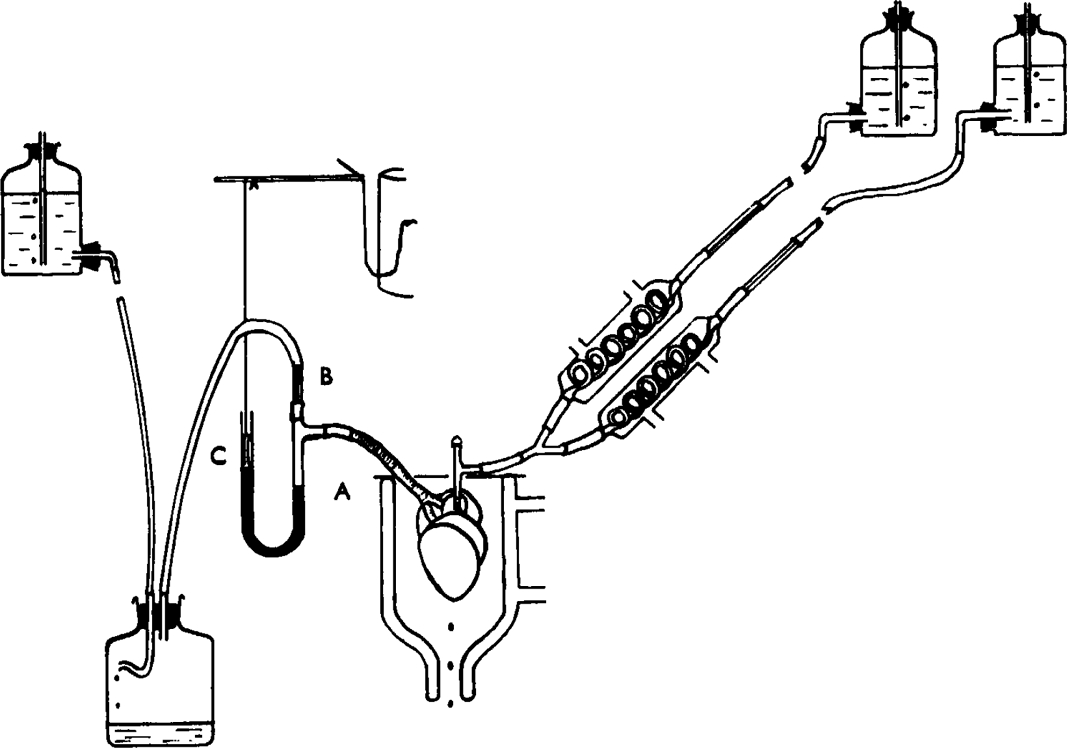
Apparatus for air perfusion of guinea-pig lung. The trachea was attached to side-arm A of the mercury manometer. Air at constant pressure passed through capillary resistance B and emerged through scarifications on surface of lung. C = weighted ebonite float attached to frontal writing lever. Prewarmed Tyrode solution flowed into pulmonary artery.
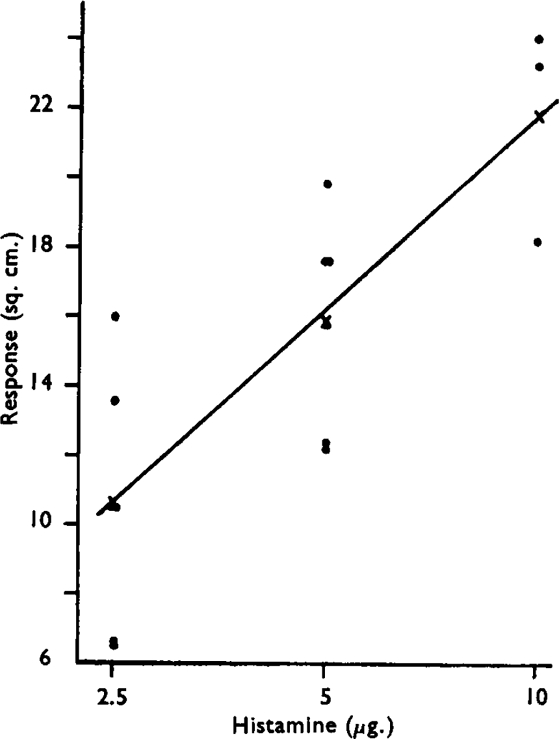
Dose/response curve for air-perfused guinea-pig lung. Ordinate represents area of curve above base-line following administration of histamine.
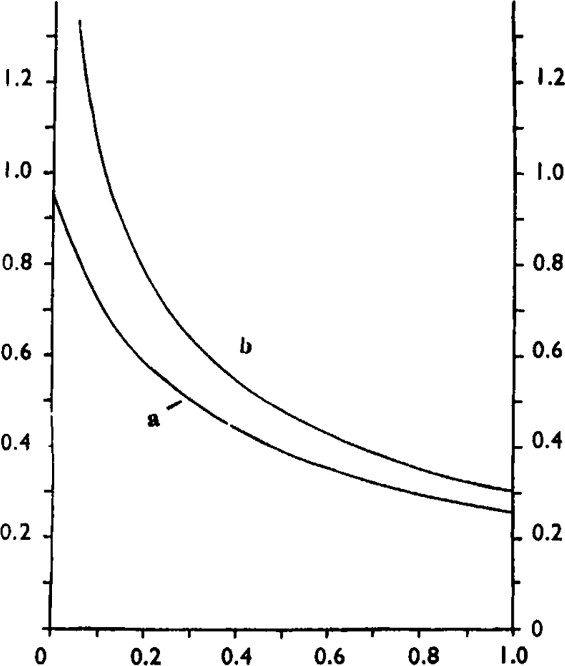
Abscissa: fraction of receptors occupied by agonist. Ordinate: theoretical values of (a) pA2 – pA10, (b) pA2–pAh for a noncompetitive antagonist.
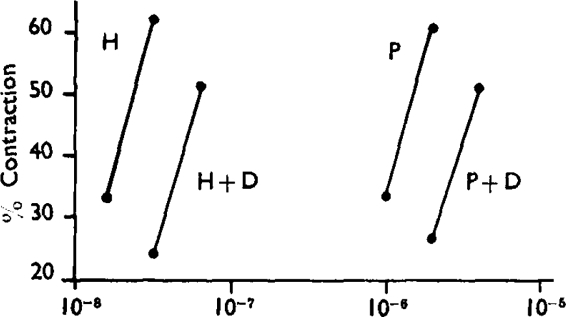
Guinea-pig ileum. Effects of histamine (H) and pyridylethylamine (P) in absence and presence of diphenhydramine (D) 1:300 × 106. Mean responses of six assays. Abscissa: concentration of agonist.
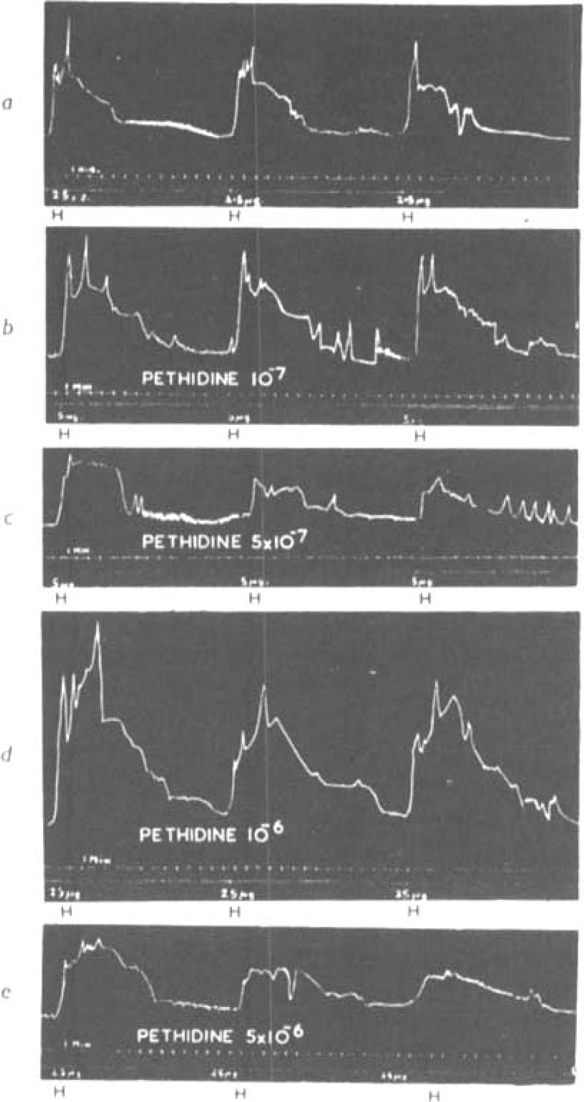
Air-perfused guinea-pig lung. Doses of histamine (H) injected into the perfusion fluid in absence and presence of pethidine hydrochloride (P). (a) 2·5 μg. H; (b) 5 μg. H with 10−7 P; (c) 5 μg. H with 5 × 10⁻⁷ P; (d) 25 μg. H with 10−7 P; (e) 25 μg. H with 5 × 10⁻⁶ P.
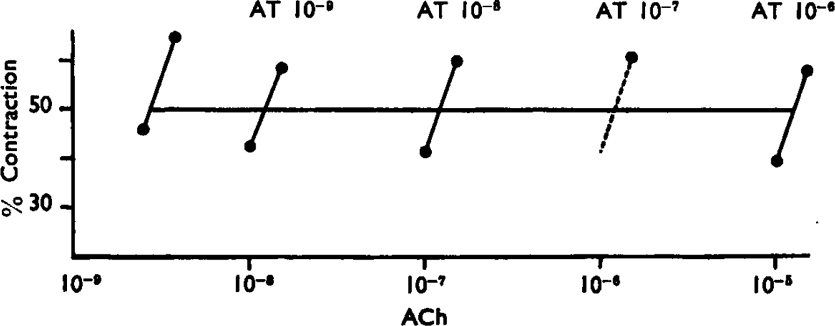
Guinea-pig Ileum. Effects of acetylcholine (ACh) in absence and presence of atropine (AT). Hexamethonium 10−6 was added to the Tyrode solution.
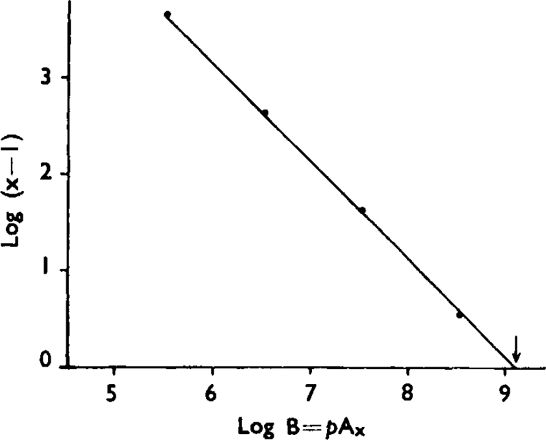
Results from Fig. 6 plotted by using equation (I) developed in the text — n = 1·04. The arrow indicates the pA2 value.
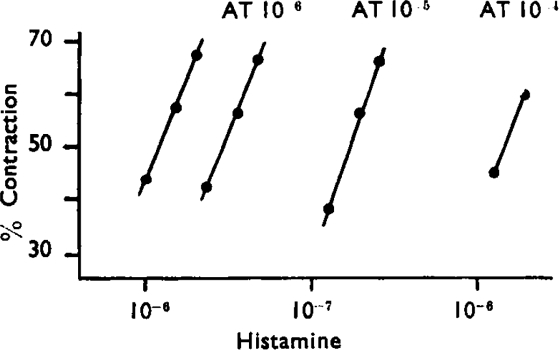
Guinea-pig ileum. Effects of histamine in absence and presence of atropine (AT).
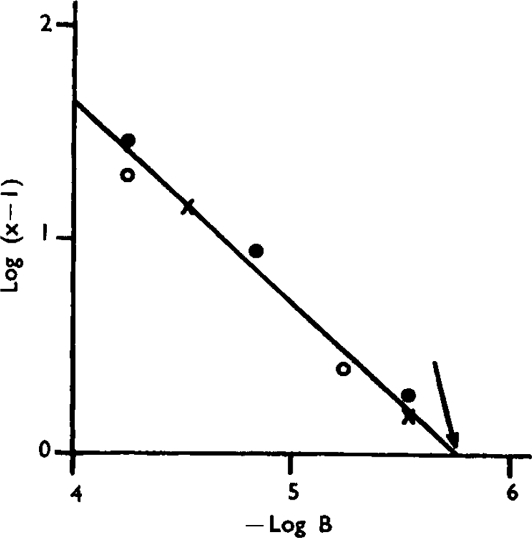
Plot of equation (1) for three separate experiments on guinea-pig ileum, with histamine as agonist and atropine as antagonist. The arrow indicates the pA2 value.
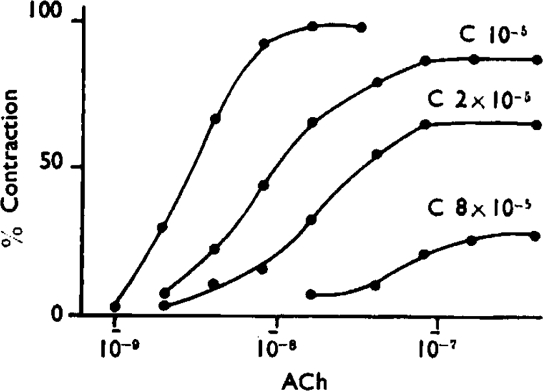
Guinea-pig ileum. Dose/response curves of acetylcholine (ACh) with cinchonidine (C). The left-hand curve was in the absence of cinchonidine.
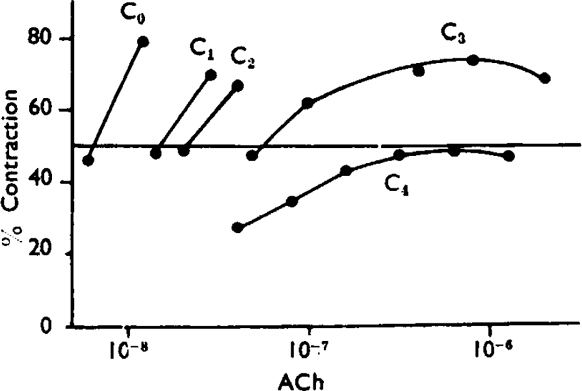
Guinea-pig ileum. Short dose/response curves of acetylcholine (ACh) with cinchonidine (C): C0 = no cinchonidine, C1 = 5 × 10⁻⁶, C2 = 10−5, C3 = 2 × 10⁻⁵, C4 = 4 × 10⁻⁵.
References
Publication types
MeSH terms
Substances
Personal name as subject
- Actions
- Actions
LinkOut - more resources
Full Text Sources
Other Literature Sources
