


Resistance to Leishmania major is linked to the H2 region on chromosome 17 and to chromosome 9
- PMID: 9151907
- PMCID: PMC2196292
- DOI: 10.1084/jem.185.9.1705
Resistance to Leishmania major is linked to the H2 region on chromosome 17 and to chromosome 9
Abstract
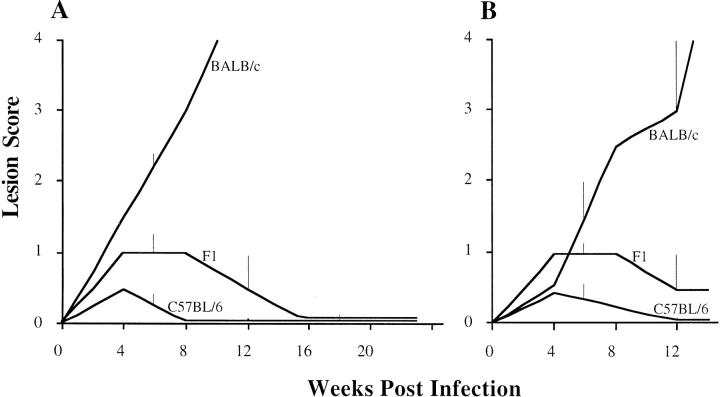
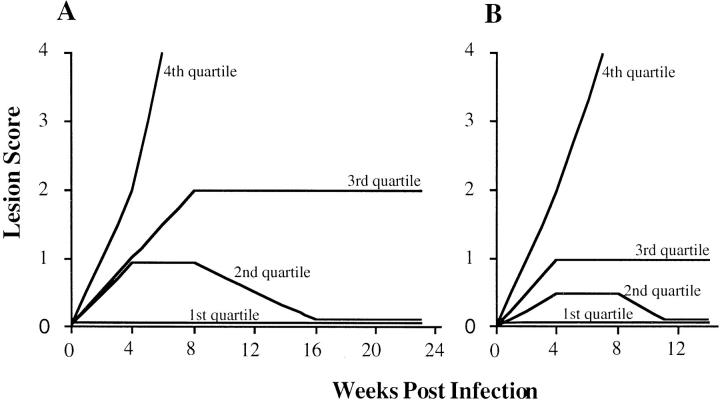
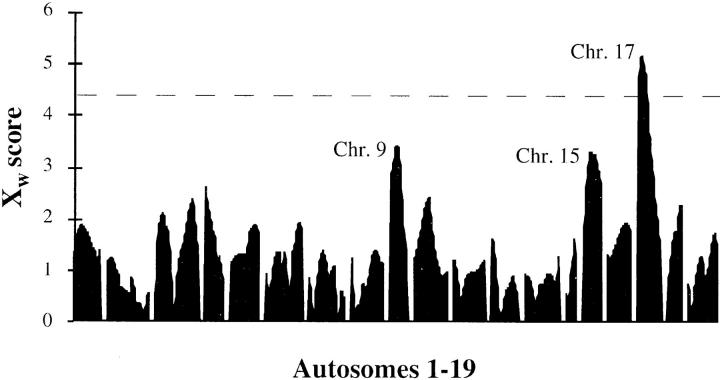
In Leishmaniasis, as in many infectious diseases, clinical manifestations are determined by the interaction between the genetics of the host and of the parasite. Here we describe studies mapping two loci controlling resistance to murine cutaneous leishmaniasis. Mice infected with L. major show marked genetic differences in disease manifestations: BALB/c mice are susceptible, exhibiting enlarging lesions that progress to systemic disease and death, whereas C57BL/6 are resistant, developing small, self-healing lesions. F2 animals from a C57BL/6 X BALB/c cross showed a continuous distribution of lesion score. Quantitative trait loci (QTL) have been mapped after a non-parametric QTL analysis on a genome-wide scan on 199 animals. QTLs identified were confirmed in a second cross of 271 animals. Linkage was confirmed to a chromosome 9 locus (D9Mit67-D9Mit71) and to a region including the H2 locus on chromosome 17. These have been named Imr2 and Imr1, respectively.
Figures
References
-
- Convit J, Pinardi ME, Rondon AJ. Diffuse cutaneous leishmaniasis: a disease due to an immunological defect of the host. Trans R Soc Trop Med Hyg. 1972;66:603–610. - PubMed
-
- Bradley DJ. Genetic control of natural resistance to Leishmania donovani. . Nature (Lond) 1974;250:353. - PubMed
-
- Howard JG, Hale C, Chan-Liew WL. Immunological regulation of experimental cutaneous leishmaniasis. I. Immunogenetic aspects of susceptibility to Leishmania tropicain mice. Parasite Immunol. 1980;2:303–314. - PubMed
-
- McLeod R, Buschman E, Arbuckle LD, Skamene E. Immunogenetics in the analysis of resistance to intracellular pathogens. Curr Opin Immunol. 1995;7:539–552. - PubMed
-
- Locksley RM, Heinzel FP, Sadick MD, Holaday BJ, Gardner KD., Jr Murine cutaneous leishmaniasis: susceptibility correlates with differential expansion of helper T-cell subsets. Ann Inst Pasteur Immunol. 1987;138:744–749. - PubMed
Publication types
MeSH terms
Substances
LinkOut - more resources
Full Text Sources
Molecular Biology Databases
Miscellaneous
