


doi: 10.1073/pnas.94.11.5784.
Antigens produced in plants by infection with chimeric plant viruses immunize against rabies virus and HIV-1
Affiliations
- PMID: 9159151
- PMCID: PMC20857
- DOI: 10.1073/pnas.94.11.5784
Item in Clipboard
Antigens produced in plants by infection with chimeric plant viruses immunize against rabies virus and HIV-1
Proc Natl Acad Sci U S A.
.
Abstract
The coat protein (CP) of alfalfa mosaic virus was used as a carrier molecule to express antigenic peptides from rabies virus and HIV. The antigens were separately cloned into the reading frame of alfalfa mosaic virus CP and placed under the control of the subgenomic promoter of tobacco mosaic virus CP in the 30BRz vector. The in vitro transcripts of recombinant virus with sequences encoding the antigenic peptides were synthesized from DNA constructs and used to inoculate tobacco plants. The plant-produced protein (virus particles) was purified and used for immunization of mice. Both antigens elicited specific virus-neutralizing antibodies in immunized mice.
Figures
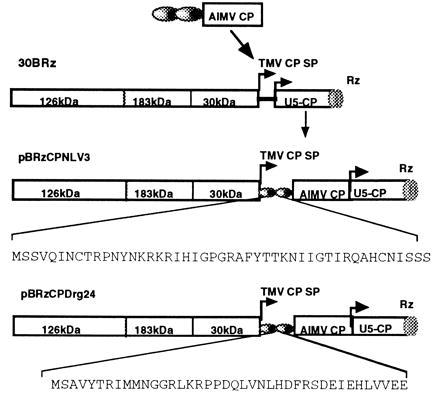
Schematic representation of the genome of 30BRz (derivative of TMV) and the cloning strategy: the 126- and 183-kDa proteins are required for the TMV replication, 30-kDa protein is the viral movement protein, and CP is viral CP. The arrow under TMV CP SP indicates the subgenomic promoter of TMV CP. The two ellipsoids indicates peptides fused to the AIMV CP. Rz, ribozyme for self-cleavage. pBRzCPMNV3 and pBRzCPDrg24 are viruses engineered to express antigenic peptides representing V3 loop of HIV-1 named MNV3 or chimeric epitope of rabies virus named Drg24, respectively. The amino acid sequence of inserted region of each peptide is shown under the linear map of plasmid.
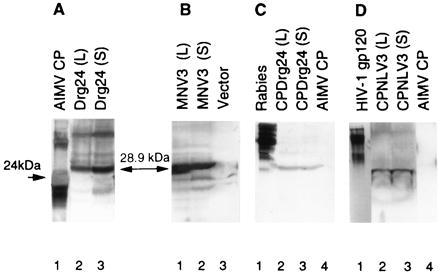
Western blot showing accumulation of recombinant AIMV CP fused to MNV3 of HIV-1 or Drg24 of rabies virus in locally (L) or systemically (S) infected tobacco leaves. The tobacco leaves were inoculated with transcripts of recombinant virus. Proteins were separated by electrophoresis through a SDS/13% polyacrylamide gel and bound with mAbs for the AIMV CP (A, lanes 2 and 3; B, lanes 1 and 2), for the linear epitope (G5-24) of rabies virus glycoprotein (C, lanes 2 and 3), or for the V3 loop of the HIV-1 (D, lanes 2 and 3). Wild-type AIMV CP (24 kDa) bound only with antibodies against AIMV CP (A, lane 1, positive control) and did not bind with antibodies against fusion peptides (C and D, lanes 4; negative control). Each protein is indicated above the lane.
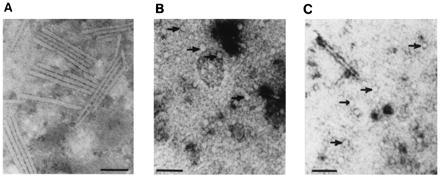
Electron micrographs of particles from tobacco plants, infected with 30BRz (A), pBRzCPMNV3 (B), and pBRzCPDrg24 (C). The spherical recombinant AIMV particles carrying antigens are indicated with arrows. The particles were negatively stained using 2% uranyl acetate. The bars indicate 100 nm. The amount of road shaped particles in chimeric virus infected plants were less compared with that of control.
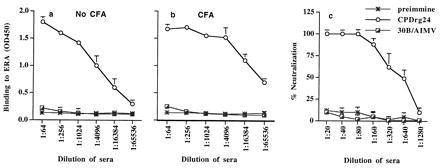
Serum antibody response of mice immunized intraperitoneally with CPDrg24 measured by ELISA (a and b) on a plates coated with inactivated rabies virus (ERA) and neutralizing activity of these antibodies. Each graph represents the average of the values calculated for individual mice. 30B/AIMV indicates the sera from the mice immunized with control (wild-type virus lacking insert). (a) The data when the antigen was administered without CFA; whereas b represents the data when CFA was incorporated. The curves reflect average ELISA data at different dilutions of sera. Graph c shows neutralization of the CVS-11 strain rabies virus by sera from mice immunized with recombinant CPDrg24, 30B/AIMV, or preimmune. The curves represent neutralizing titers of sera after seven immunizations. (c) Average data with SD from eight mice that had neutralizing serum antibodies.
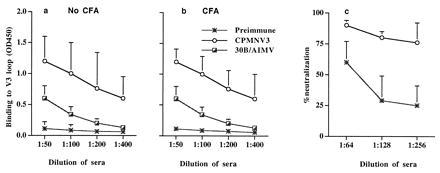
Serum antibody response of mice immunized with CPMNV3 and neutralizing activity of these antibodies. Serum antibody response was measured by ELISA on a plates coated with synthetic peptide resembling the V3 loop of HIV-1. (a) Serum antibody response when the antigen was administered without CFA; whereas b represents when CFA was added. Also shown are the ELISA data for preimmune and mice immunized with control virus. (c) Neutralization of HIV-1/MN isolate by sera from mice immunized with CPMNV3. Data points in c are averages obtained using preimmune and sera after the last (seventh) inoculation of antigen.
References
Publication types
MeSH terms
Substances
LinkOut - more resources
Full Text Sources
Other Literature Sources
Miscellaneous
