. 1997 May 27;94(11):5923-8.
doi: 10.1073/pnas.94.11.5923.

Neurotoxicity associated with dual actions of homocysteine at the N-methyl-D-aspartate receptor

Affiliations

Neurotoxicity associated with dual actions of homocysteine at the N-methyl-D-aspartate receptor

S A Lipton et al. Proc Natl Acad Sci U S A. .

Abstract

Severely elevated levels of total homocysteine (approximately millimolar) in the blood typify the childhood disease homocystinuria, whereas modest levels (tens of micromolar) are commonly found in adults who are at increased risk for vascular disease and stroke. Activation of the coagulation system and adverse effects of homocysteine on the endothelium and vessel wall are believed to underlie disease pathogenesis. Here we show that homocysteine acts as an agonist at the glutamate binding site of the N-methyl-D-aspartate receptor, but also as a partial antagonist of the glycine coagonist site. With physiological levels of glycine, neurotoxic concentrations of homocysteine are on the order of millimolar. However, under pathological conditions in which glycine levels in the nervous system are elevated, such as stroke and head trauma, homocysteine's neurotoxic (agonist) attributes at 10-100 microM levels outweigh its neuroprotective (antagonist) activity. Under these conditions neuronal damage derives from excessive Ca2+ influx and reactive oxygen generation. Accordingly, homocysteine neurotoxicity through overstimulation of N-methyl-D-aspartate receptors may contribute to the pathogenesis of both homocystinuria and modest hyperhomocysteinemia.


Figures
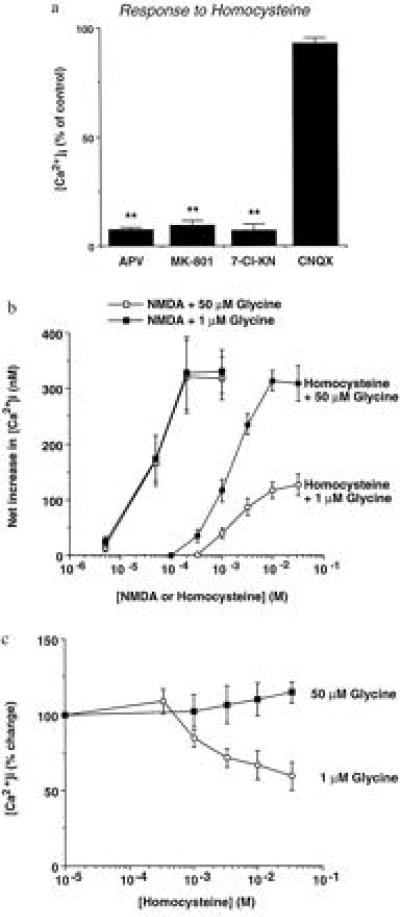
Figure 1
Figure 1
Homocysteine increases neuronal [Ca2+]i through NMDA receptor-channel activation. (a) Antagonism of homocysteine-mediated [Ca2+]i responses by NMDA receptor antagonists. Responses evoked by 5 mM d,l-homocysteine and 1 μM glycine were quantified in the absence and presence of NMDA- and non-NMDA-antagonists: d-2-amino-5-phosphonopentanoate (APV, 200 μM), dizocilpine (MK-801, 10 μM), 7-chlorokynurenate (7-Cl-KN, 10 μM), and 6-cyano-7-nitroquinoxaline-2,3-dione (CNQX, 50 μM). Values in this and subsequent figures represent the mean ± SEM. Imaged fields contained five to seven neurons, each serving as its own control, and the results represent data from three separate experiments. Data are expressed as the percentage change compared with the control response (≈150 nM [Ca2+]i) elicited by 5 mM homocysteine plus 1 μM glycine. Responses to homocysteine/glycine in the presence of antagonist that were statistically smaller than those obtained to homocysteine/glycine alone are indicated by asterisks (∗∗, P < 0.01, analyzed with an ANOVA followed by a Scheffé multiple comparison of means). (b) Dependence on glycine of the concentration–response relationship of NMDA- and homocysteine-mediated increases in neuronal [Ca2+]i. The increase in homocysteine responses in the presence of elevated concentrations of glycine suggests that homocysteine is not only an agonist at the NMDA binding site but also a partial antagonist of the glycine site (data from six neurons in a representative experiment from a total of eight experiments). The open boxes have been displaced slightly for clarity. (c) Partial antagonism of NMDA responses by homocysteine. NMDA (100 μM)-mediated increases in [Ca2+]i in the presence of 1 or 50 μM glycine were measured at various concentrations of homocysteine (n = 3 experiments). To exclude an effect of rundown or desensitization, high or low glycine was applied randomly during each response. The results are consistent with the notion that homocysteine is a full agonist at the NMDA binding site and that its inhibition of NMDA responses is mediated functionally by partial antagonism of the glycine site (we cannot exclude the possibility that homocysteine acts as a partial agonist at this site in the absence of glycine).
Figure 2
Figure 2
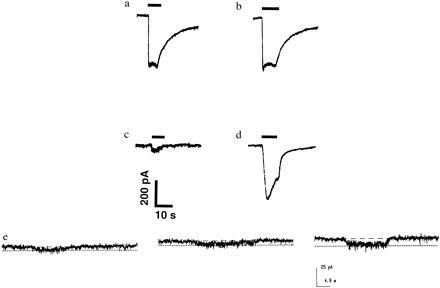
Whole-cell recording of homocysteine-evoked currents are increased by glycine. (a) Current evoked by 200 μM NMDA plus 1 μM glycine. (b) Current evoked by 200 μM NMDA plus 50 μM glycine. (c) The current evoked by 10 mM d,l-homocysteine (or 5 mM l-homocysteine, a maximal stimulus) with 1 μM glycine was relatively small. (d) Increasing the glycine concentration to 50 μM increased the magnitude of the current evoked by homocysteine on the same cortical neuron as in c. This action was not voltage-dependent as similar effects were seen at a holding potential of +40 mV (data not shown). Possibly due to rundown of the currents, 50 μM glycine did not always increase the maximal homocysteine-evoked current to the same level as the maximal NMDA-induced current in all neurons tested (n = 7). However, in each case the effect was qualitatively similar to that observed during the calcium imaging experiments. (e) Micromolar homocysteine evoked measurable currents in the presence of glycine and bicarbonate. When 200 μM d,l-homocysteine (equivalent to 100 μM l-homocysteine) was applied in Hanks’ balanced salt solution, a small macroscopic current was observed (left trace). To simulate physiological conditions, 24 mM bicarbonate was added, and then the same micromolar concentration of homocysteine elicited a somewhat larger whole-cell current (center trace; similar to the effect of bicarbonate on cysteine-induced currents noted previously; ref. 9). Application of 50 μM glycine in addition to the bicarbonate further increased the homocysteine-activated current to 200% (right trace). In e, the bath solution was made somewhat acidic (pH = 7.0 rather than 7.2) to more closely simulate ischemic conditions.
Figure 3
Figure 3
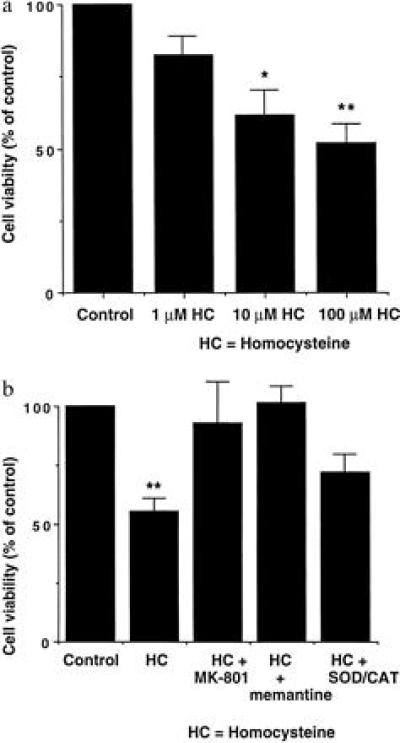
Homocysteine-mediated neuronal cell death. (a) Cultures incubated for 6 days in various concentrations of d,l-homocysteine (HC). Data are the means ± SEM of four replicate values from each of three pooled experiments. Asterisks indicate statistically different from control value (∗, P < 0.05; ∗∗, P < 0.01). (b) Neuroprotective effects of the NMDA antagonists dizocilpine (MK-801, 10 μM), memantine (12 μM), and superoxide dismutase/catalase (SOD/CAT, 50 units/ml each) from 100 μM d,l-homocysteine-mediated neurotoxicity. Cultures were incubated for 6 days in the presence of homocysteine before the assessment of neurotoxicity. Data are the means ± SEM from a representative experiment (performed with quadruplicate samples and repeated seven times). Asterisks indicate statistically different from control value and from the homocysteine groups treated with the NMDA antagonists dizocilpine or memantine (∗∗, P < 0.01). Note that although the superoxide dismutase/catalase value was not significantly different from the homocysteine group, it was also not significantly different from the control group (at either the P < 0.05 or 0.01 levels), indicating an intermediate save from homocysteine-induced neurotoxicity.
Figure 4
Figure 4
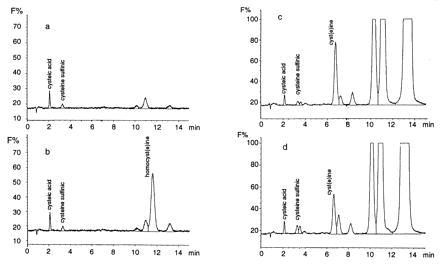
HPLC fluorescence chromatograms of o-phthaldialdehyde-derivatized culture media obtained from acute (5-min; a and b) or chronic (6-day; c and d) exposure to 100 μM homocysteine. The ordinate axis represents relative fluorescence (F%). (a) Chromatogram of control culture medium of mixed neuronal/glial cultures assayed 3 weeks after plating. The culture medium was changed on a Monday-Wednesday-Friday schedule and was assayed here just before a scheduled medium change. (b) Chromatogram of culture medium exposed to homocysteine for 5 min was similar to that of the control except for the presence of homocyst(e)ine. No other peak was consistently changed in three identical experiments; specifically, homocysteic acid was not found. (c) Chromatogram of control culture medium of mixed neuronal/glial cultures assayed 3 weeks after plating. In this case the medium was not changed for the previous 6 days. (d) Chromatogram of culture medium obtained identically to c, except exposed to homocysteine 6 days earlier. Under these conditions, oxidation of homocysteine to homocysteic acid was not encountered. The peaks appearing between 10 and 14 min in chromatograms c and d are not sulfated amino acids and did not comigrate as homocyst(e)ine on additional runs (not shown). By the end of the 6-day incubation, homocysteine had been metabolized and was no longer detectable. The experiment was repeated three times. Cysteic acid was added as an internal standard to all chromatograms and was not present if not added exogenously.

References

    1. Lindgren A, Brattström L, Norrving B, Hultberg B, Anderson A, Johannson B B. Stroke. 1995;26:795–800. - PubMed
    1. Perry I J, Refsum H, Morris R W, Ebrahim S B, Ueland P M, Shaper A G. Lancet. 1995;346:1395–1398. - PubMed
    1. Broch O J, Ueland P M. J Neurochem. 1984;43:1755–1757. - PubMed
    1. Stampfer M J, Malinow M R. N Engl J Med. 1995;332:328–329. - PubMed
    1. Perry T L, Bergeron C, Steele J C, McLachlan D R, Hansen S. J Neurol Sci. 1990;99:3–8. - PubMed

Publication types

MeSH terms

LinkOut - more resources