Comparative Study
. 1997 May 27;94(11):5955-60.
doi: 10.1073/pnas.94.11.5955.

Expression of a divergent expansin gene is fruit-specific and ripening-regulated

Affiliations
Comparative Study

Expression of a divergent expansin gene is fruit-specific and ripening-regulated

J K Rose et al. Proc Natl Acad Sci U S A. .

Abstract

Expansins are proteins that induce extension in isolated plant cell walls in vitro and have been proposed to disrupt noncovalent interactions between hemicellulose and cellulose microfibrils. Because the plant primary cell wall acts as a constraint to cell enlargement, this process may be integral to plant cell expansion, and studies of expansins have focused on their role in growth. We report the identification of an expansin (LeExp1) from tomato that exhibits high levels of mRNA abundance and is specifically expressed in ripening fruit, a developmental period when growth has ceased but when selective disassembly of cell wall components is pronounced. cDNAs closely related to LeExp1 were also identified in ripening melons and strawberries, suggesting that they are a common feature of fruit undergoing rapid softening. Furthermore, the sequence of LeExp1 and its homologs from other ripening fruit define a subclass of expansin genes. Expression of LeExp1 is regulated by ethylene, a hormone known to coordinate and induce ripening in many species. LeExp1 is differentially expressed in the ripening-impaired tomato mutants Nr, rin, and nor, and mRNA abundance appears to be influenced directly by ethylene and by a developmentally modulated transduction pathway. The identification of a ripening-regulated expansin gene in tomato and other fruit suggests that, in addition to their role in facilitating the expansion of plant cells, expansins may also contribute to cell wall disassembly in nongrowing tissues, possibly by enhancing the accessibility of noncovalently bound polymers to endogenous enzymic action.


Figures
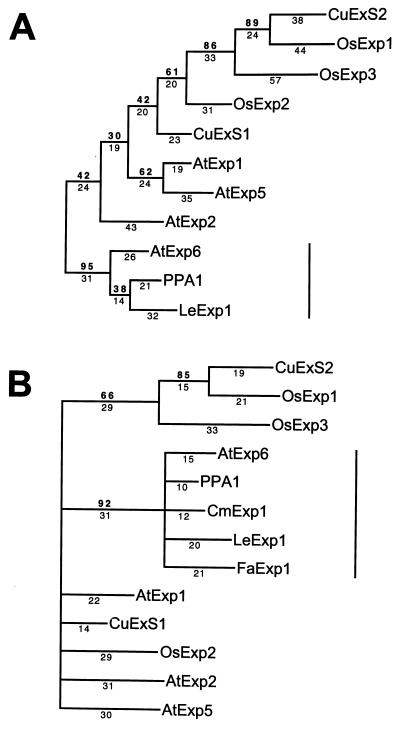
Figure 2
Figure 2
(A) Phylogenetic tree of full-length deduced amino acid sequences of 11 expansins and homologs. CuExS1 and CuExS2 (Cucumis sativus); OsExp2 and OsExp3 (Oryza sativa); AtExp1, AtExp2, AtExp5, and AtExp6 (Arabidopsis thaliana) all identified in Shcherban et al. (19); PPA1 (Pisum sativum) (28); OsExp1 (Oryza sativa) EMBL accession no. Y07782Y07782. (B) Similar alignment using truncated sequences of the above genes with deduced amino acid sequences of the PCR clones CmExp1 (Cucumis melo) and FaExp1 (Fragaria ananassa) derived from melon and strawberry fruit, respectively. For each alignment, bootstrap analysis used random stepwise addition of taxa with 100 replicates and global (tree bisection and reconnection) branch swapping. Bootstrap confidence values and branch lengths are depicted above and below the lines, respectively. A vertical line represents the position of the expansin subfamily containing three ripening-related genes (LeExp1, CmExp1, and FaExp1).
Figure 3
Figure 3
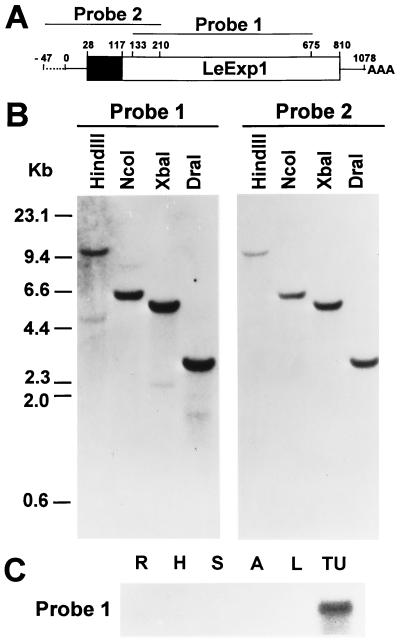
(A) Diagram of the LeExp1 gene and 47 bp of 5′ flanking sequence derived from the pARC7 and pBluescript II cloning vectors. The boxed region represents the coding sequence with the solid area representing the putative signal sequence. Both 5′ and 3′ untranslated regions are depicted by solid lines and residual cloning vector sequence is depicted by a broken line. Nucleotide numbers are indicated above the gene. Two probes were designed from this sequence and used for Northern and Southern blot analyses. Probe 1 corresponded to a more conserved sequence among expansins while probe 2 corresponded to more divergent sequence. (B) Genomic DNA analysis of LeExp1. Genomic DNA (20 μg per lane) was digested with the indicated restriction enzymes and hybridized with probe 1 and washed at low stringency or with probe 2 and washed at high stringency. (C) RNA gel blot analysis of LeExp1 mRNA abundance in fruit and vegetative tissues. Total RNA (15 μg) from roots (R), hypocotyls (H), stems (S), anthers (A), young leaves (L), or turning fruit (TU) was hybridized, after gel electrophoresis, with probe 1.
Figure 4
Figure 4
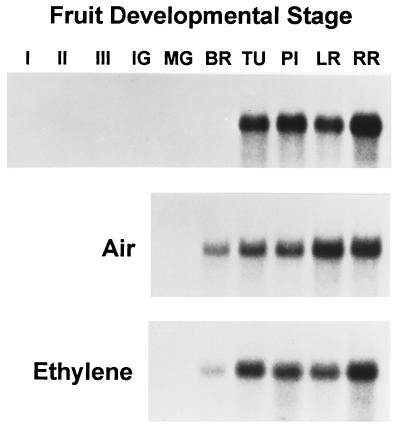
Total RNA gel blot analysis of LeExp1 expression in three expanding stages of fruit (I–III), and fruit ripened on the vine (Top) or first harvested at the MG stage and allowed to ripen in the presence of air (Middle) or ethylene at 10 μl/liter (Bottom). Ripening stages included immature green (IG), MG, breaker (BR), turning (TU), pink (PI), light red (LR), and red ripe (RR). Each blot was hybridized with probe 2 and exposed to film at −80°C for approximately 9 h.
Figure 7
Figure 7
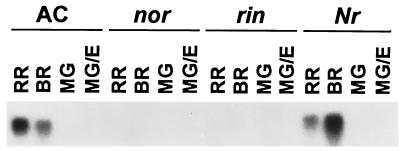
RNA gel blot analysis of LeExp1 expression in fruit ripening series of wild-type fruit (Ailsa Craig) and equivalent-age rin, nor, and Nr mutant fruit. Total RNA was isolated from MG, breaker (BR), red ripe (RR), or MG fruit treated with ethylene at 20 μl/liter for 8 h (MG/E), separated by gel electrophoresis (15 μg per lane), and hybridized with probe 2. This blot was generously provided by J. Giovannoni and P. Kannan (Texas A&M University).
Figure 1
Figure 1
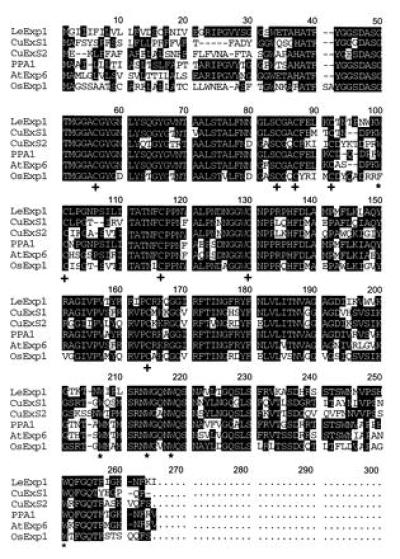
Multiple alignment of the LeExp1 deduced amino acid sequence with expansins and expansin homologs (see Fig. 2) using macdnasis pro 3.5 (Hitachi Software, San Bruno, CA). Amino acids conserved between any two sequences are indicated in reverse contrast and numbers above the alignment refer to numbering of the consensus sequence. Conserved tryptophan and cysteine residues are indicated by asterisks and crosses, respectively.
Figure 5
Figure 5
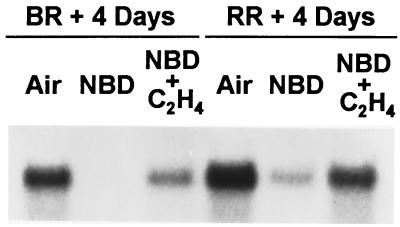
Effect of NBD on LeExp1 expression. MG fruit were harvested and held in air, NBD at 2 ml/liter, or the same NBD concentration plus ethylene at 10 μl/liter until air-treated control fruit reached the breaker plus 4 day or red ripe plus 4 day (over ripe) stages. Fruit from all three treatments were used to isolate total RNA (15 μg per lane) for RNA gel blot analysis using probe 2.
Figure 6
Figure 6
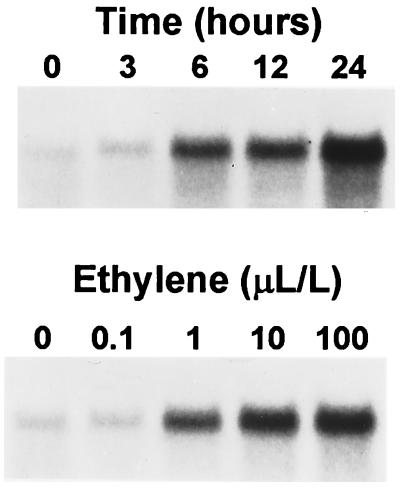
Time course and concentration series of ethylene induction of LeExp1 in ACC synthase antisense transgenic fruit. MG fruit were harvested and treated with ethylene at 10 μl/liter for up to 24 h (Upper) or with a range of ethylene concentrations for 24 h (Lower). Total RNA (15 μg per lane) was used for RNA gel blot analysis and hybridized with probe 2.

Comment in

References

    1. Carpita N C, Gibeaut D M. Plant J. 1993;3:1–30. - PubMed
    1. Hayashi T, Maclachlan G. Plant Physiol. 1984;75:596–604. - PMC - PubMed
    1. McCann M C, Wells B, Roberts K. J Cell Sci. 1990;96:323–334.
    1. Fry S C. Physiol Plant. 1989;75:532–536.
    1. Fry S C, Smith R C, Renwick K F, Martin D J, Hodge S K, Matthews K J. Biochem J. 1992;282:821–828. - PMC - PubMed

Publication types

Associated data

LinkOut - more resources