


Complete nucleotide sequence of the chloroplast genome from the green alga Chlorella vulgaris: the existence of genes possibly involved in chloroplast division
- PMID: 9159184
- PMCID: PMC20890
- DOI: 10.1073/pnas.94.11.5967
Complete nucleotide sequence of the chloroplast genome from the green alga Chlorella vulgaris: the existence of genes possibly involved in chloroplast division
Abstract
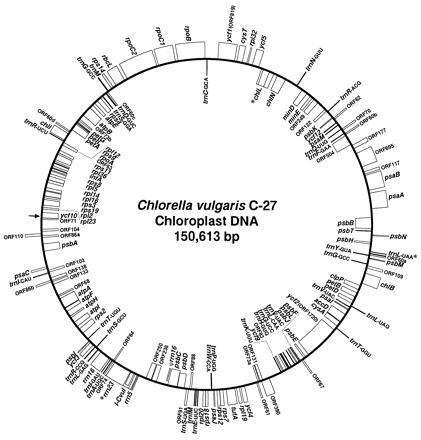
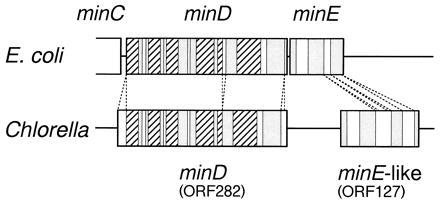
The complete nucleotide sequence of the chloroplast genome (150,613 bp) from the unicellular green alga Chlorella vulgaris C-27 has been determined. The genome contains no large inverted repeat and has one copy of rRNA gene cluster consisting of 16S, 23S, and 5S rRNA genes. It contains 31 tRNA genes, of which the tRNALeu(GAG) gene has not been found in land plant chloroplast DNAs analyzed so far. Sixty-nine protein genes and eight ORFs conserved with those found in land plant chloroplasts have also been found. The most striking is the existence of two adjacent genes homologous to bacterial genes involved in cell division, minD and minE, which are arranged in the same order in Escherichia coli. This finding suggests that the mechanism of chloroplast division is similar to bacterial division. Other than minD and minE homologues, genes encoding ribosomal proteins L5, L12, L19, and S9 (rpl5, rpl12, rpl19, and rps9); a chlorophyll biosynthesis Mg chelating subunit (chlI); and elongation factor EF-Tu (tufA), which have not been reported from land plant chloroplast DNAs, are present in this genome. However, many of the new chloroplast genes recently found in red and brown algae have not been found in C. vulgaris. Furthermore, this algal species possesses two long ORFs related to ycf1 and ycf2 that are exclusively found in land plants. These observations suggest that C. vulgaris is closer to land plants than to red and brown algae.
Figures
References
-
- Palmer J D. In: The Molecular Biology of Plastids. Bogorad L, Vasil I K, editors. San Diego: Academic; 1991. pp. 5–53.
-
- Sugiura M. Plant Mol Biol. 1992;19:149–168. - PubMed
-
- Sugiura M. In: Molecular Genetics of Photosynthesis. Anderson B, Salter A H, Barber J, editors. Oxford: IRL; 1996. pp. 58–74.
-
- Reith M, Munholland J. Plant Mol Biol Rep. 1995;13:333–335.
-
- Kowallik K V, Stoebe B, Schaffran I, Kroth-Pancic P, Freier U. Plant Mol Biol Rep. 1995;13:336–342.
Publication types
MeSH terms
Substances
Associated data
- Actions
LinkOut - more resources
Full Text Sources
Other Literature Sources
Molecular Biology Databases
Research Materials
Miscellaneous
