


Hepatitis B among the Khmer. Issues of translation and concepts of illness
- PMID: 9159698
- PMCID: PMC1497109
- DOI: 10.1046/j.1525-1497.1997.012005292.x
Hepatitis B among the Khmer. Issues of translation and concepts of illness
Abstract
Objective: To assess the comprehensibility of hepatitis B translations for Cambodian refugees, to identify Cambodian illnesses that include the symptoms of hepatitis, and to combine these observations with critical theoretical perspectives of language to reflect on the challenges of medical translations generally.
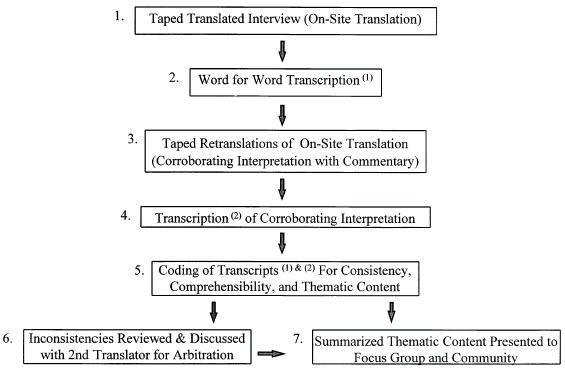
Design: Open-ended, semistructured interviews, and participant-observation of a refugee community in Seattle, Washington.
Setting: Homes of Cambodian residents of inner-city neighborhoods.
Participants: Thirty-four adult Cambodian refugees who had each been educated about hepatitis B through public health outreach.
Results: Medical interpreters translated hepatitis B as rauk tlaam, literally "liver disease." Unfortunately, while everyone knew of the liver (tlaam), rauk tlaam was a meaningless term to 28 (82%) of 34 respondents and conveyed none of the chronicity and communicability intended by refugee health workers for 34 (100%) of the respondents. In contrast, all respondents knew illnesses named after symptom complexes that include the symptoms of acute and chronic hepatitis, but do not refer to diseased organs. The Cambodian words chosen to translate hepatitis B reflect the medical thinking and medical authority that can unintentionally overwhelm attempts at meaningful communication with non-English-speaking patients.
Conclusions: To improve comprehension of hepatitis B translations for the Khmer, translators must choose between medical terminology focused on the liver and Khmer terminology which identifies recognizable experiences, but represents important Khmer health concepts. A critical linguistic view of this situation suggests that for these translations to be meaningful clinicians and health educators must first analyze and then monitor the contextual significance of medical language. In cross-cultural settings, this means a partnership with medical interpreters to pay close attention to the experience of illness and social context of the translation.
References
-
- Mitchell T. Colonising Egypt. Berkeley, Calif: University of California Press; 1991. pp. 128–60.
-
- Conjeevaram HS, Di Bisceglie AM. Management of chronic viral hepatitis in children. J Pediatr Gastroenterol Nutr. 1995;20:365–75. - PubMed
-
- Hill LL, Hovell M, Benenson AS. Prevention of hepatitis B transmission in Indo-Chinese refugees with active and passive immunization. Am J Prev Med. 1991;7:29–32. - PubMed
-
- Beasley RP, Hwang LY, Lin CC, et al. Incidence of hepatitis B virus infections in preschool children in Taiwan. J Infect Dis. 1982;146:198–204. - PubMed
-
- Grossman RA, Benenson MW, Scott RM, Snitbhan R, Top FH, Jr, Pantuwatana S. An epidemiologic study of hepatitis B virus in Bangcock, Thailand. Am J Epidemiol. 1983;117:213–22. - PubMed
Publication types
MeSH terms
LinkOut - more resources
Full Text Sources
Medical